

484
CARBOHYDRATES
centres. In the shorthand representation we thus have
to indicate the configuration at each anomeric centre, so the linkage becomes α1 → β2. Sucrose is
thus abbreviated to D-Glc(α1 → β2)D-Fru. Systematic nomenclature for sucrose is α-D-glucopyranosyl(1 → 2)-β-D-fructofuranoside, which also includes
the arrow to avoid confusion. Since the two sugars in
sucrose are both linked through their anomeric centres, this means that both the hemiacetal/hemiketal
structures are prevented from opening; and, in contrast to maltose, lactose, and lactulose, there can be no
open-chain form in equilibrium with the cyclic form.
Therefore, sucrose does not display any of the properties usually associated with the masked carbonyl
group.
In nature, the formation of oligosaccharides, and
also of polysaccharides (see Section 12.4), is dependent upon the generation of an activated sugar bound
to a nucleoside diphosphate, typically a UDPsugar.
As outlined above (see Box 12.4), nucleophilic displacement of the UDP leaving group by a suitable
nucleophile generates the new sugar derivative. This
will be a glycoside if the nucleophile is a suitable aglycone molecule, or an oligosaccharide if the
nucleophile is another sugar molecule. This reaction,
mechanistically of S N 2 type, should give an inversion
of configuration at C-1 in the electrophile, generating a product with the β-configuration in the case
of UDPglucose, as shown. Many of the linkages
formed between glucose monomers actually have the
α-configuration, and it is believed that a double S N 2
mechanism operates, which initially involves a nucleophilic group on the enzyme (see Box 12.4).
12.7 Polysaccharides
12.7.1 Structural aspects
Polysaccharides fulfil two main functions in living
organisms, as food reserves and as structural elements. Plants accumulate starch as their main food
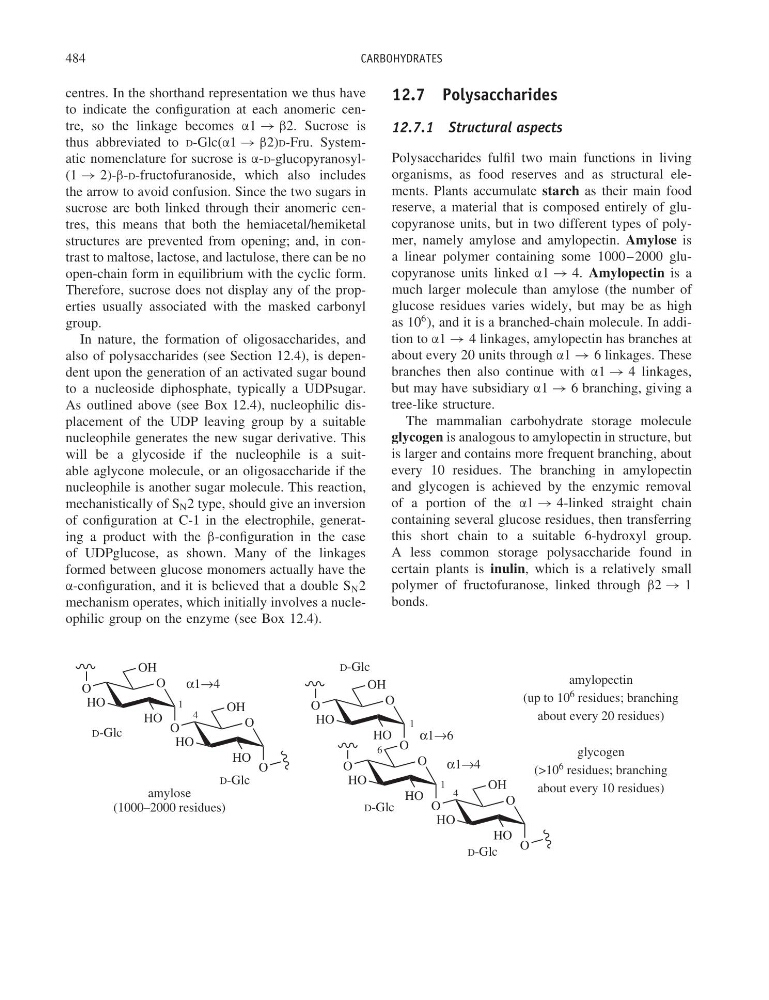
reserve, a material that is composed entirely of glucopyranose units, but in two different types of polymer, namely amylose and amylopectin. Amylose is
a linear polymer containing some 1000–2000 glucopyranose units linked α1 → 4. Amylopectin is a
much larger molecule than amylose (the number of
glucose residues varies widely, but may be as high
as 10
6 ), and it is a branched-chain molecule. In addition to α1 → 4 linkages, amylopectin has branches at
about every 20 units through α1 → 6 linkages. These
branches then also continue with α1 → 4 linkages,
but may have subsidiary α1 → 6 branching, giving a
tree-like structure.
The mammalian carbohydrate storage molecule
glycogen is analogous to amylopectin in structure, but
is larger and contains more frequent branching, about
every 10 residues. The branching in amylopectin
and glycogen is achieved by the enzymic removal
of a portion of the α1 → 4-linked straight chain
containing several glucose residues, then transferring
this short chain to a suitable 6-hydroxyl group.
A less common storage polysaccharide found in
certain plants is inulin, which is a relatively small
polymer of fructofuranose, linked through β2 → 1
bonds.
O
O
HO
OH
HO
O
O
HO
OH
HO
O
O
O
HO
HO
O
O
HO
OH
HO
O
O
O
HO
OH
HO
O
1
4
1
amylose
(1000–2000 residues)
6
1
4
amylopectin
(up to 10 6 residues; branching
about every 20 residues)
glycogen
(>10 6 residues; branching
about every 10 residues)
α1→4
α1→4
α1→6
D-Glc
D-Glc
D-Glc
D-Glc
D-Glc
CARBOHYDRATES
centres. In the shorthand representation we thus have
to indicate the configuration at each anomeric centre, so the linkage becomes α1 → β2. Sucrose is
thus abbreviated to D-Glc(α1 → β2)D-Fru. Systematic nomenclature for sucrose is α-D-glucopyranosyl(1 → 2)-β-D-fructofuranoside, which also includes
the arrow to avoid confusion. Since the two sugars in
sucrose are both linked through their anomeric centres, this means that both the hemiacetal/hemiketal
structures are prevented from opening; and, in contrast to maltose, lactose, and lactulose, there can be no
open-chain form in equilibrium with the cyclic form.
Therefore, sucrose does not display any of the properties usually associated with the masked carbonyl
group.
In nature, the formation of oligosaccharides, and
also of polysaccharides (see Section 12.4), is dependent upon the generation of an activated sugar bound
to a nucleoside diphosphate, typically a UDPsugar.
As outlined above (see Box 12.4), nucleophilic displacement of the UDP leaving group by a suitable
nucleophile generates the new sugar derivative. This
will be a glycoside if the nucleophile is a suitable aglycone molecule, or an oligosaccharide if the
nucleophile is another sugar molecule. This reaction,
mechanistically of S N 2 type, should give an inversion
of configuration at C-1 in the electrophile, generating a product with the β-configuration in the case
of UDPglucose, as shown. Many of the linkages
formed between glucose monomers actually have the
α-configuration, and it is believed that a double S N 2
mechanism operates, which initially involves a nucleophilic group on the enzyme (see Box 12.4).
12.7 Polysaccharides
12.7.1 Structural aspects
Polysaccharides fulfil two main functions in living
organisms, as food reserves and as structural elements. Plants accumulate starch as their main food
reserve, a material that is composed entirely of glucopyranose units, but in two different types of polymer, namely amylose and amylopectin. Amylose is
a linear polymer containing some 1000–2000 glucopyranose units linked α1 → 4. Amylopectin is a
much larger molecule than amylose (the number of
glucose residues varies widely, but may be as high
as 10
6 ), and it is a branched-chain molecule. In addition to α1 → 4 linkages, amylopectin has branches at
about every 20 units through α1 → 6 linkages. These
branches then also continue with α1 → 4 linkages,
but may have subsidiary α1 → 6 branching, giving a
tree-like structure.
The mammalian carbohydrate storage molecule
glycogen is analogous to amylopectin in structure, but
is larger and contains more frequent branching, about
every 10 residues. The branching in amylopectin
and glycogen is achieved by the enzymic removal
of a portion of the α1 → 4-linked straight chain
containing several glucose residues, then transferring
this short chain to a suitable 6-hydroxyl group.
A less common storage polysaccharide found in
certain plants is inulin, which is a relatively small
polymer of fructofuranose, linked through β2 → 1
bonds.
O
O
HO
OH
HO
O
O
HO
OH
HO
O
O
O
HO
HO
O
O
HO
OH
HO
O
O
O
HO
OH
HO
O
1
4
1
amylose
(1000–2000 residues)
6
1
4
amylopectin
(up to 10 6 residues; branching
about every 20 residues)
glycogen
(>10 6 residues; branching
about every 10 residues)
α1→4
α1→4
α1→6
D-Glc
D-Glc
D-Glc
D-Glc
D-Glc