

OLIGOSACCHARIDES
483
is the disaccharide sucrose, which we commonly
call ‘sugar’ and utilize widely as a sweetening
agent and as the raw material for sweets and
other confectionary. Other important disaccharides
are maltose, a hydrolysis product from starch, and
lactose, the main sugar component of cow’s milk.
O
HO
HO
OH
HO
O
O
HO
OH
HO
OH
O
HO
OH
HO
O
O
HO
OH
HO
OH
OH
maltose
D-Glc(α1→4)D-Glc
4-O-(α-D-glucopyranosyl)-D-glucopyranose
4
1
1
4
lactose
D-Gal(β1→4)D-Glc
4-O-(β-D-galactopyranosyl)-D-glucopyranose
α1→4
β1→4
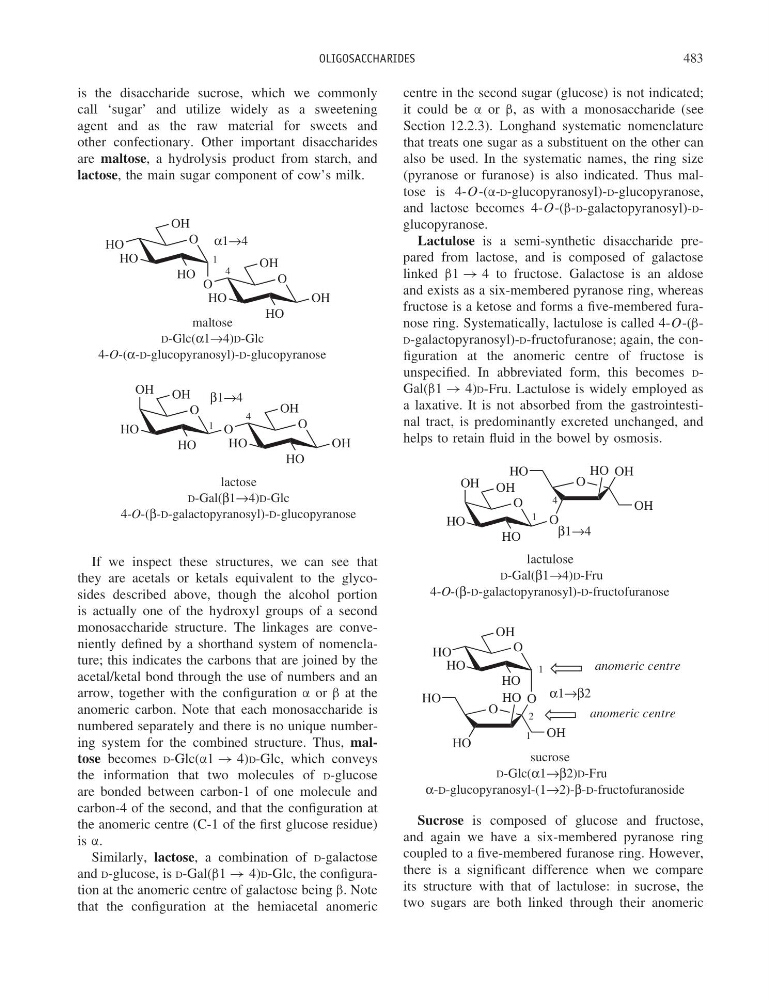
If we inspect these structures, we can see that
they are acetals or ketals equivalent to the glycosides described above, though the alcohol portion
is actually one of the hydroxyl groups of a second
monosaccharide structure. The linkages are conveniently defined by a shorthand system of nomenclature; this indicates the carbons that are joined by the
acetal/ketal bond through the use of numbers and an
arrow, together with the configuration α or β at the
anomeric carbon. Note that each monosaccharide is
numbered separately and there is no unique numbering system for the combined structure. Thus, maltose becomes D-Glc(α1 → 4)D-Glc, which conveys
the information that two molecules of D-glucose
are bonded between carbon-1 of one molecule and
carbon-4 of the second, and that the configuration at
the anomeric centre (C-1 of the first glucose residue)
is α.
Similarly, lactose, a combination of D-galactose
and D-glucose, is D-Gal(β1 → 4)D-Glc, the configuration at the anomeric centre of galactose being β. Note
that the configuration at the hemiacetal anomeric
centre in the second sugar (glucose) is not indicated;
it could be α or β, as with a monosaccharide (see
Section 12.2.3). Longhand systematic nomenclature
that treats one sugar as a substituent on the other can
also be used. In the systematic names, the ring size
(pyranose or furanose) is also indicated. Thus maltose is 4-O-(α-D-glucopyranosyl)-D-glucopyranose,
and lactose becomes 4-O-(β-D-galactopyranosyl)-Dglucopyranose.
Lactulose is a semi-synthetic disaccharide prepared from lactose, and is composed of galactose
linked β1 → 4 to fructose. Galactose is an aldose
and exists as a six-membered pyranose ring, whereas
fructose is a ketose and forms a five-membered furanose ring. Systematically, lactulose is called 4-O-(βD-galactopyranosyl)-D-fructofuranose; again, the configuration at the anomeric centre of fructose is
unspecified. In abbreviated form, this becomes DGal(β1 → 4)D-Fru. Lactulose is widely employed as
a laxative. It is not absorbed from the gastrointestinal tract, is predominantly excreted unchanged, and
helps to retain fluid in the bowel by osmosis.
O
HO
OH
HO
OH
O
O
HO OH
OH
HO
1
lactulose
D-Gal(β1→4)D-Fru
4-O-(β-D-galactopyranosyl)-D-fructofuranose
4
β1→4
O
HO
HO
OH
HO
O
HO
HO O
OH
HO
1
1
sucrose
D-Glc(α1→β2)D-Fru
α-D-glucopyranosyl-(1→2)-β-D-fructofuranoside
2
α1→β2
anomeric centre
anomeric centre
Sucrose is composed of glucose and fructose,
and again we have a six-membered pyranose ring
coupled to a five-membered furanose ring. However,
there is a significant difference when we compare
its structure with that of lactulose: in sucrose, the
two sugars are both linked through their anomeric
483
is the disaccharide sucrose, which we commonly
call ‘sugar’ and utilize widely as a sweetening
agent and as the raw material for sweets and
other confectionary. Other important disaccharides
are maltose, a hydrolysis product from starch, and
lactose, the main sugar component of cow’s milk.
O
HO
HO
OH
HO
O
O
HO
OH
HO
OH
O
HO
OH
HO
O
O
HO
OH
HO
OH
OH
maltose
D-Glc(α1→4)D-Glc
4-O-(α-D-glucopyranosyl)-D-glucopyranose
4
1
1
4
lactose
D-Gal(β1→4)D-Glc
4-O-(β-D-galactopyranosyl)-D-glucopyranose
α1→4
β1→4
If we inspect these structures, we can see that
they are acetals or ketals equivalent to the glycosides described above, though the alcohol portion
is actually one of the hydroxyl groups of a second
monosaccharide structure. The linkages are conveniently defined by a shorthand system of nomenclature; this indicates the carbons that are joined by the
acetal/ketal bond through the use of numbers and an
arrow, together with the configuration α or β at the
anomeric carbon. Note that each monosaccharide is
numbered separately and there is no unique numbering system for the combined structure. Thus, maltose becomes D-Glc(α1 → 4)D-Glc, which conveys
the information that two molecules of D-glucose
are bonded between carbon-1 of one molecule and
carbon-4 of the second, and that the configuration at
the anomeric centre (C-1 of the first glucose residue)
is α.
Similarly, lactose, a combination of D-galactose
and D-glucose, is D-Gal(β1 → 4)D-Glc, the configuration at the anomeric centre of galactose being β. Note
that the configuration at the hemiacetal anomeric
centre in the second sugar (glucose) is not indicated;
it could be α or β, as with a monosaccharide (see
Section 12.2.3). Longhand systematic nomenclature
that treats one sugar as a substituent on the other can
also be used. In the systematic names, the ring size
(pyranose or furanose) is also indicated. Thus maltose is 4-O-(α-D-glucopyranosyl)-D-glucopyranose,
and lactose becomes 4-O-(β-D-galactopyranosyl)-Dglucopyranose.
Lactulose is a semi-synthetic disaccharide prepared from lactose, and is composed of galactose
linked β1 → 4 to fructose. Galactose is an aldose
and exists as a six-membered pyranose ring, whereas
fructose is a ketose and forms a five-membered furanose ring. Systematically, lactulose is called 4-O-(βD-galactopyranosyl)-D-fructofuranose; again, the configuration at the anomeric centre of fructose is
unspecified. In abbreviated form, this becomes DGal(β1 → 4)D-Fru. Lactulose is widely employed as
a laxative. It is not absorbed from the gastrointestinal tract, is predominantly excreted unchanged, and
helps to retain fluid in the bowel by osmosis.
O
HO
OH
HO
OH
O
O
HO OH
OH
HO
1
lactulose
D-Gal(β1→4)D-Fru
4-O-(β-D-galactopyranosyl)-D-fructofuranose
4
β1→4
O
HO
HO
OH
HO
O
HO
HO O
OH
HO
1
1
sucrose
D-Glc(α1→β2)D-Fru
α-D-glucopyranosyl-(1→2)-β-D-fructofuranoside
2
α1→β2
anomeric centre
anomeric centre
Sucrose is composed of glucose and fructose,
and again we have a six-membered pyranose ring
coupled to a five-membered furanose ring. However,
there is a significant difference when we compare
its structure with that of lactulose: in sucrose, the
two sugars are both linked through their anomeric