

482
CARBOHYDRATES
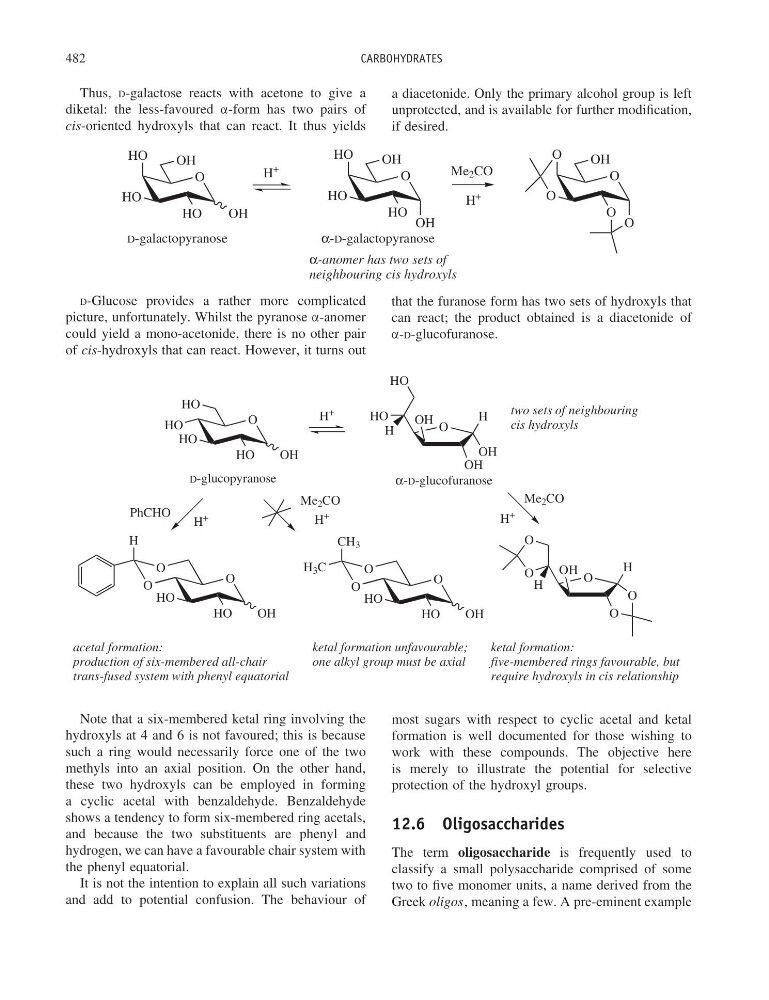
Thus, D-galactose reacts with acetone to give a
diketal: the less-favoured α-form has two pairs of
cis-oriented hydroxyls that can react. It thus yields
a diacetonide. Only the primary alcohol group is left
unprotected, and is available for further modification,
if desired.
O
HO
HO
OH
H
+
D-galactopyranose
O
HO
HO
α-D-galactopyranose
OH
O
O
O
O
OH
HO
OH
OH
HO
O
Me 2 CO
H
+
α-anomer has two sets of
neighbouring cis hydroxyls
D-Glucose provides a rather more complicated
picture, unfortunately. Whilst the pyranose α-anomer
could yield a mono-acetonide, there is no other pair
of cis-hydroxyls that can react. However, it turns out
that the furanose form has two sets of hydroxyls that
can react; the product obtained is a diacetonide of
α-D-glucofuranose.
O
HO
HO
HO
O
H
OH
HO
OH
OH
H
HO
OH
HO
O
HO
HO
OH
O
O
O
HO
HO
OH
O
O
H 3 C
CH 3
O
H
OH
O
O
H
O
O
PhCHO
H
+
Me 2 CO
H
+
H
+
Me 2 CO
H
+
acetal formation:
production of six-membered all-chair
trans-fused system with phenyl equatorial
ketal formation unfavourable;
one alkyl group must be axial
ketal formation:
five-membered rings favourable, but
require hydroxyls in cis relationship
two sets of neighbouring
cis hydroxyls
D-glucopyranose
α-D-glucofuranose
H
Note that a six-membered ketal ring involving the
hydroxyls at 4 and 6 is not favoured; this is because
such a ring would necessarily force one of the two
methyls into an axial position. On the other hand,
these two hydroxyls can be employed in forming
a cyclic acetal with benzaldehyde. Benzaldehyde
shows a tendency to form six-membered ring acetals,
and because the two substituents are phenyl and
hydrogen, we can have a favourable chair system with
the phenyl equatorial.
It is not the intention to explain all such variations
and add to potential confusion. The behaviour of
most sugars with respect to cyclic acetal and ketal
formation is well documented for those wishing to
work with these compounds. The objective here
is merely to illustrate the potential for selective
protection of the hydroxyl groups.
12.6 Oligosaccharides
The term oligosaccharide is frequently used to
classify a small polysaccharide comprised of some
two to five monomer units, a name derived from the
Greek oligos, meaning a few. A pre-eminent example
CARBOHYDRATES
Thus, D-galactose reacts with acetone to give a
diketal: the less-favoured α-form has two pairs of
cis-oriented hydroxyls that can react. It thus yields
a diacetonide. Only the primary alcohol group is left
unprotected, and is available for further modification,
if desired.
O
HO
HO
OH
H
+
D-galactopyranose
O
HO
HO
α-D-galactopyranose
OH
O
O
O
O
OH
HO
OH
OH
HO
O
Me 2 CO
H
+
α-anomer has two sets of
neighbouring cis hydroxyls
D-Glucose provides a rather more complicated
picture, unfortunately. Whilst the pyranose α-anomer
could yield a mono-acetonide, there is no other pair
of cis-hydroxyls that can react. However, it turns out
that the furanose form has two sets of hydroxyls that
can react; the product obtained is a diacetonide of
α-D-glucofuranose.
O
HO
HO
HO
O
H
OH
HO
OH
OH
H
HO
OH
HO
O
HO
HO
OH
O
O
O
HO
HO
OH
O
O
H 3 C
CH 3
O
H
OH
O
O
H
O
O
PhCHO
H
+
Me 2 CO
H
+
H
+
Me 2 CO
H
+
acetal formation:
production of six-membered all-chair
trans-fused system with phenyl equatorial
ketal formation unfavourable;
one alkyl group must be axial
ketal formation:
five-membered rings favourable, but
require hydroxyls in cis relationship
two sets of neighbouring
cis hydroxyls
D-glucopyranose
α-D-glucofuranose
H
Note that a six-membered ketal ring involving the
hydroxyls at 4 and 6 is not favoured; this is because
such a ring would necessarily force one of the two
methyls into an axial position. On the other hand,
these two hydroxyls can be employed in forming
a cyclic acetal with benzaldehyde. Benzaldehyde
shows a tendency to form six-membered ring acetals,
and because the two substituents are phenyl and
hydrogen, we can have a favourable chair system with
the phenyl equatorial.
It is not the intention to explain all such variations
and add to potential confusion. The behaviour of
most sugars with respect to cyclic acetal and ketal
formation is well documented for those wishing to
work with these compounds. The objective here
is merely to illustrate the potential for selective
protection of the hydroxyl groups.
12.6 Oligosaccharides
The term oligosaccharide is frequently used to
classify a small polysaccharide comprised of some
two to five monomer units, a name derived from the
Greek oligos, meaning a few. A pre-eminent example