

CYCLIC ACETALS AND KETALS: PROTECTING GROUPS
481
O
HO
HO
OH
OPPU
HO
H
O
HO
HO
OH
H
HO
OR
O
HO
HO
OH
OR
HO
H
β-glucoside
O
HO
HO
OH
OPPU
HO
S N 2
H
Enz
B
UDPglucose
α-glucoside
O
HO
HO
OH
H
HO
B
Enz
S N 2
S N 2
S N 2 process with
inversion of configuration
double S N 2 process leads to
retention of configuration
HOPPU = uridine diphosphate
ROH
ROH
ROH
ROH
12.5 Cyclic acetals and ketals:
protecting groups
We have just seen that intramolecular reactions
between the carbonyl group and one or other of the
hydroxyl functions readily leads to the formation of
cyclic hemiacetal or hemiketal forms. Further, these
products may then be converted into acetals or ketals
by an intermolecular reaction with another alcohol
molecule, giving us glycosides. We could also form
an acetal or ketal by supplying a carbonyl compound
and exploiting the hydroxyl groups of the sugar. This
provides a particularly useful means of protecting
some of the hydroxyl groups whilst other reactions
are carried out (see Box 7.21); the protecting group
is then easily removed by effectively reversing the
acetal/ketal reaction using hydrolytic conditions (see
Section 7.2).
In principle, a number of different types of
acetal or ketal might be produced. In this section,
we want to exemplify a small number of useful
reactions in which two of the hydroxyl groups on
the sugar are bound up by forming a cyclic acetal
or ketal with a suitable aldehyde or ketone reagent.
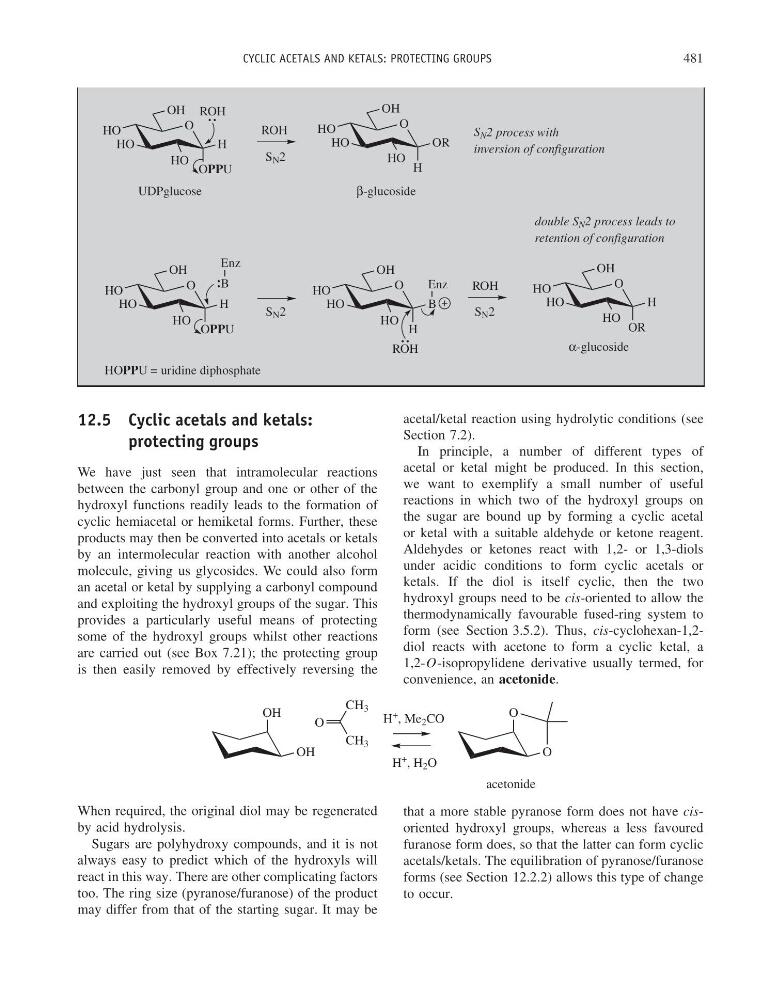
Aldehydes or ketones react with 1,2- or 1,3-diols
under acidic conditions to form cyclic acetals or
ketals. If the diol is itself cyclic, then the two
hydroxyl groups need to be cis-oriented to allow the
thermodynamically favourable fused-ring system to
form (see Section 3.5.2). Thus, cis-cyclohexan-1,2diol reacts with acetone to form a cyclic ketal, a
1,2-O-isopropylidene derivative usually termed, for
convenience, an acetonide.
OH
OH
O
CH 3
CH 3
H
+
, Me 2 CO
O
O
H
+
, H 2 O
acetonide
When required, the original diol may be regenerated
by acid hydrolysis.
Sugars are polyhydroxy compounds, and it is not
always easy to predict which of the hydroxyls will
react in this way. There are other complicating factors
too. The ring size (pyranose/furanose) of the product
may differ from that of the starting sugar. It may be
that a more stable pyranose form does not have cisoriented hydroxyl groups, whereas a less favoured
furanose form does, so that the latter can form cyclic
acetals/ketals. The equilibration of pyranose/furanose
forms (see Section 12.2.2) allows this type of change
to occur.
481
O
HO
HO
OH
OPPU
HO
H
O
HO
HO
OH
H
HO
OR
O
HO
HO
OH
OR
HO
H
β-glucoside
O
HO
HO
OH
OPPU
HO
S N 2
H
Enz
B
UDPglucose
α-glucoside
O
HO
HO
OH
H
HO
B
Enz
S N 2
S N 2
S N 2 process with
inversion of configuration
double S N 2 process leads to
retention of configuration
HOPPU = uridine diphosphate
ROH
ROH
ROH
ROH
12.5 Cyclic acetals and ketals:
protecting groups
We have just seen that intramolecular reactions
between the carbonyl group and one or other of the
hydroxyl functions readily leads to the formation of
cyclic hemiacetal or hemiketal forms. Further, these
products may then be converted into acetals or ketals
by an intermolecular reaction with another alcohol
molecule, giving us glycosides. We could also form
an acetal or ketal by supplying a carbonyl compound
and exploiting the hydroxyl groups of the sugar. This
provides a particularly useful means of protecting
some of the hydroxyl groups whilst other reactions
are carried out (see Box 7.21); the protecting group
is then easily removed by effectively reversing the
acetal/ketal reaction using hydrolytic conditions (see
Section 7.2).
In principle, a number of different types of
acetal or ketal might be produced. In this section,
we want to exemplify a small number of useful
reactions in which two of the hydroxyl groups on
the sugar are bound up by forming a cyclic acetal
or ketal with a suitable aldehyde or ketone reagent.
Aldehydes or ketones react with 1,2- or 1,3-diols
under acidic conditions to form cyclic acetals or
ketals. If the diol is itself cyclic, then the two
hydroxyl groups need to be cis-oriented to allow the
thermodynamically favourable fused-ring system to
form (see Section 3.5.2). Thus, cis-cyclohexan-1,2diol reacts with acetone to form a cyclic ketal, a
1,2-O-isopropylidene derivative usually termed, for
convenience, an acetonide.
OH
OH
O
CH 3
CH 3
H
+
, Me 2 CO
O
O
H
+
, H 2 O
acetonide
When required, the original diol may be regenerated
by acid hydrolysis.
Sugars are polyhydroxy compounds, and it is not
always easy to predict which of the hydroxyls will
react in this way. There are other complicating factors
too. The ring size (pyranose/furanose) of the product
may differ from that of the starting sugar. It may be
that a more stable pyranose form does not have cisoriented hydroxyl groups, whereas a less favoured
furanose form does, so that the latter can form cyclic
acetals/ketals. The equilibration of pyranose/furanose
forms (see Section 12.2.2) allows this type of change
to occur.