

480
CARBOHYDRATES
The bromide leaving group is now nicely
positioned for an S N 2 reaction with an incoming
nucleophile; in the example shown, this is the
phenoxide anion from salicyl alcohol. In the presence
of base, the phenolic group of salicyl alcohol is
ionized, since phenols are very much more acidic than
alcohols (see Section 4.3.5). S N 2 processes occur
with inversion of configuration (see Section 6.1), so
the product is consequently the esterified β-glucoside
derivative. Further base treatment then hydrolyses the
ester functions, liberating the glucoside salicin. As we
shall see in Box 12.4, this type of substitution process
is similar to the way glucosides (and polysaccharides)
are produced in nature, though the enzymic reactions
do not require any ester protecting groups for the
sugars.
Box 12.4
Biosynthesis of glycosides via UDPsugars
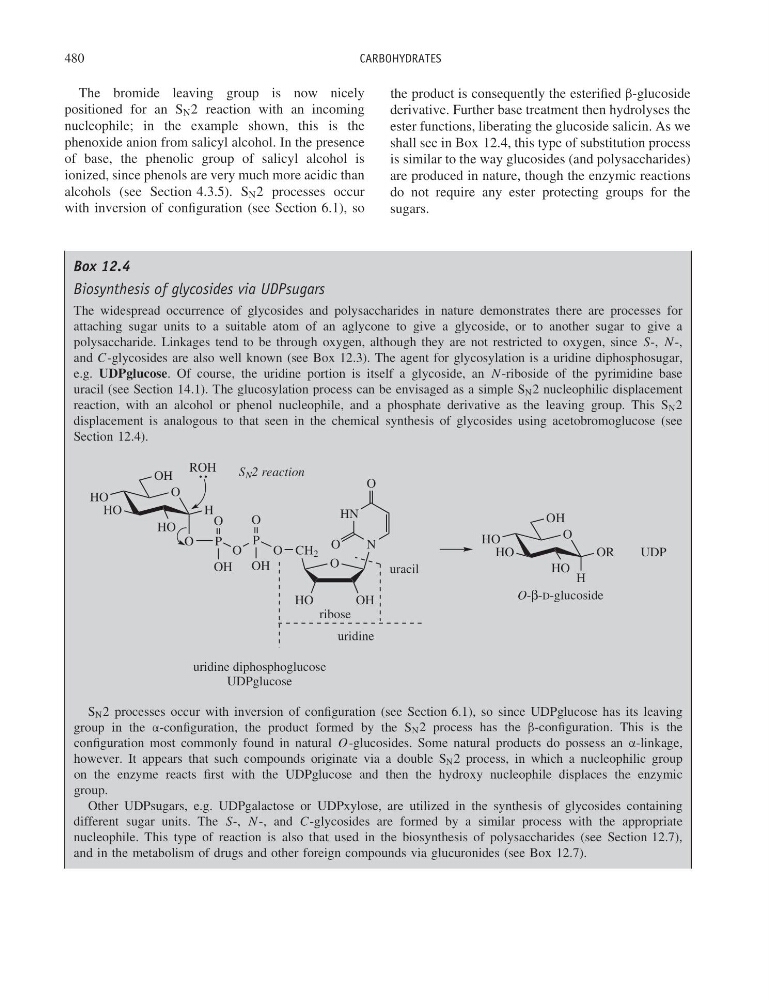
The widespread occurrence of glycosides and polysaccharides in nature demonstrates there are processes for
attaching sugar units to a suitable atom of an aglycone to give a glycoside, or to another sugar to give a
polysaccharide. Linkages tend to be through oxygen, although they are not restricted to oxygen, since S-, N-,
and C-glycosides are also well known (see Box 12.3). The agent for glycosylation is a uridine diphosphosugar,
e.g. UDPglucose. Of course, the uridine portion is itself a glycoside, an N-riboside of the pyrimidine base
uracil (see Section 14.1). The glucosylation process can be envisaged as a simple S N 2 nucleophilic displacement
reaction, with an alcohol or phenol nucleophile, and a phosphate derivative as the leaving group. This S N 2
displacement is analogous to that seen in the chemical synthesis of glycosides using acetobromoglucose (see
Section 12.4).
O
HO
OH
CH 2
N
HN
O
O
P
O
OH
O
P
O
OH
O
O
HO
HO
HO
H
O
OH
O
HO
HO
HO
OR
OH
H
uridine diphosphoglucose
UDPglucose
O-β-D-glucoside
S N 2 reaction
ribose
uracil
uridine
UDP
ROH
S N 2 processes occur with inversion of configuration (see Section 6.1), so since UDPglucose has its leaving
group in the α-configuration, the product formed by the S N 2 process has the β-configuration. This is the
configuration most commonly found in natural O-glucosides. Some natural products do possess an α-linkage,
however. It appears that such compounds originate via a double S N 2 process, in which a nucleophilic group
on the enzyme reacts first with the UDPglucose and then the hydroxy nucleophile displaces the enzymic
group.
Other UDPsugars, e.g. UDPgalactose or UDPxylose, are utilized in the synthesis of glycosides containing
different sugar units. The S-, N-, and C-glycosides are formed by a similar process with the appropriate
nucleophile. This type of reaction is also that used in the biosynthesis of polysaccharides (see Section 12.7),
and in the metabolism of drugs and other foreign compounds via glucuronides (see Box 12.7).
CARBOHYDRATES
The bromide leaving group is now nicely
positioned for an S N 2 reaction with an incoming
nucleophile; in the example shown, this is the
phenoxide anion from salicyl alcohol. In the presence
of base, the phenolic group of salicyl alcohol is
ionized, since phenols are very much more acidic than
alcohols (see Section 4.3.5). S N 2 processes occur
with inversion of configuration (see Section 6.1), so
the product is consequently the esterified β-glucoside
derivative. Further base treatment then hydrolyses the
ester functions, liberating the glucoside salicin. As we
shall see in Box 12.4, this type of substitution process
is similar to the way glucosides (and polysaccharides)
are produced in nature, though the enzymic reactions
do not require any ester protecting groups for the
sugars.
Box 12.4
Biosynthesis of glycosides via UDPsugars
The widespread occurrence of glycosides and polysaccharides in nature demonstrates there are processes for
attaching sugar units to a suitable atom of an aglycone to give a glycoside, or to another sugar to give a
polysaccharide. Linkages tend to be through oxygen, although they are not restricted to oxygen, since S-, N-,
and C-glycosides are also well known (see Box 12.3). The agent for glycosylation is a uridine diphosphosugar,
e.g. UDPglucose. Of course, the uridine portion is itself a glycoside, an N-riboside of the pyrimidine base
uracil (see Section 14.1). The glucosylation process can be envisaged as a simple S N 2 nucleophilic displacement
reaction, with an alcohol or phenol nucleophile, and a phosphate derivative as the leaving group. This S N 2
displacement is analogous to that seen in the chemical synthesis of glycosides using acetobromoglucose (see
Section 12.4).
O
HO
OH
CH 2
N
HN
O
O
P
O
OH
O
P
O
OH
O
O
HO
HO
HO
H
O
OH
O
HO
HO
HO
OR
OH
H
uridine diphosphoglucose
UDPglucose
O-β-D-glucoside
S N 2 reaction
ribose
uracil
uridine
UDP
ROH
S N 2 processes occur with inversion of configuration (see Section 6.1), so since UDPglucose has its leaving
group in the α-configuration, the product formed by the S N 2 process has the β-configuration. This is the
configuration most commonly found in natural O-glucosides. Some natural products do possess an α-linkage,
however. It appears that such compounds originate via a double S N 2 process, in which a nucleophilic group
on the enzyme reacts first with the UDPglucose and then the hydroxy nucleophile displaces the enzymic
group.
Other UDPsugars, e.g. UDPgalactose or UDPxylose, are utilized in the synthesis of glycosides containing
different sugar units. The S-, N-, and C-glycosides are formed by a similar process with the appropriate
nucleophile. This type of reaction is also that used in the biosynthesis of polysaccharides (see Section 12.7),
and in the metabolism of drugs and other foreign compounds via glucuronides (see Box 12.7).