

GLYCOSIDES
479
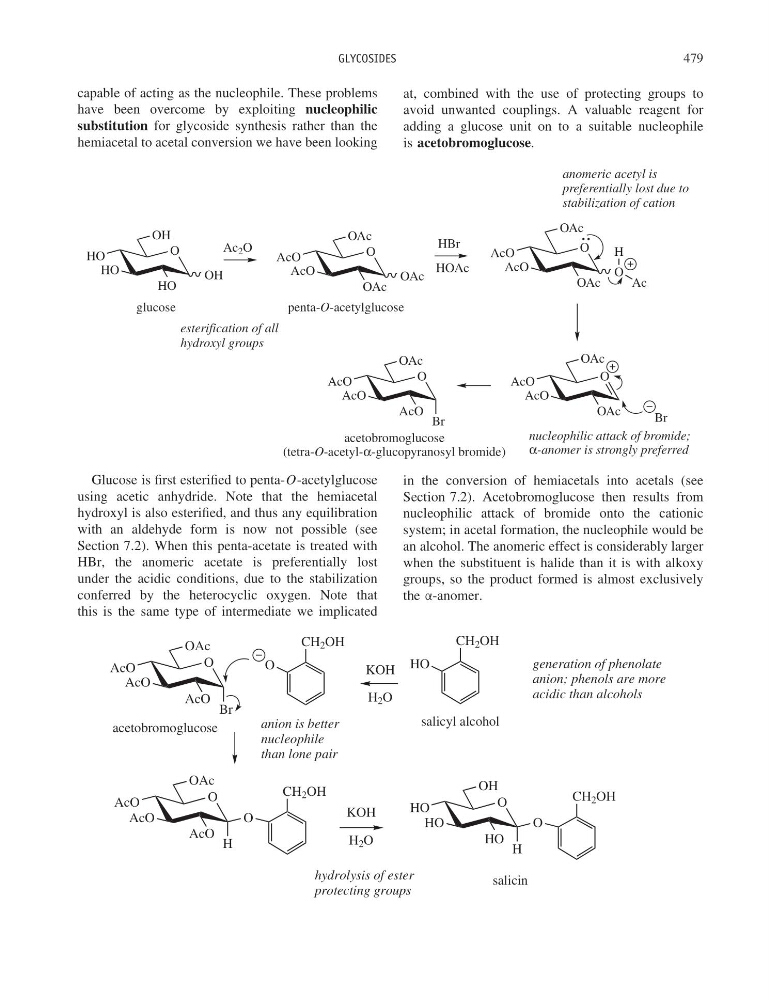
capable of acting as the nucleophile. These problems
have been overcome by exploiting nucleophilic
substitution for glycoside synthesis rather than the
hemiacetal to acetal conversion we have been looking
at, combined with the use of protecting groups to
avoid unwanted couplings. A valuable reagent for
adding a glucose unit on to a suitable nucleophile
is acetobromoglucose.
O
HO
HO
OH
HO
OH
O
AcO
AcO
OAc
OAc
OAc
O
AcO
AcO
OAc
AcO
Br
O
AcO
AcO
OAc
OAc
O
H
Ac
O
AcO
AcO
OAc
OAc
HBr
HOAc
Br
Ac 2 O
acetobromoglucose
(tetra-O-acetyl-α-glucopyranosyl bromide)
glucose
penta-O-acetylglucose
esterification of all
hydroxyl groups
anomeric acetyl is
preferentially lost due to
stabilization of cation
nucleophilic attack of bromide;
α-anomer is strongly preferred
Glucose is first esterified to penta-O-acetylglucose
using acetic anhydride. Note that the hemiacetal
hydroxyl is also esterified, and thus any equilibration
with an aldehyde form is now not possible (see
Section 7.2). When this penta-acetate is treated with
HBr, the anomeric acetate is preferentially lost
under the acidic conditions, due to the stabilization
conferred by the heterocyclic oxygen. Note that
this is the same type of intermediate we implicated
in the conversion of hemiacetals into acetals (see
Section 7.2). Acetobromoglucose then results from
nucleophilic attack of bromide onto the cationic
system; in acetal formation, the nucleophile would be
an alcohol. The anomeric effect is considerably larger
when the substituent is halide than it is with alkoxy
groups, so the product formed is almost exclusively
the α-anomer.
O
AcO
AcO
OAc
AcO
Br
O
CH 2 OH
HO
CH 2 OH
O
HO
HO
OH
H
HO
O
CH 2 OH
O
AcO
AcO
OAc
H
AcO
O
CH 2 OH
KOH
H 2 O
KOH
H 2 O
salicyl alcohol
acetobromoglucose
salicin
generation of phenolate
anion; phenols are more
acidic than alcohols
anion is better
nucleophile
than lone pair
hydrolysis of ester
protecting groups
479
capable of acting as the nucleophile. These problems
have been overcome by exploiting nucleophilic
substitution for glycoside synthesis rather than the
hemiacetal to acetal conversion we have been looking
at, combined with the use of protecting groups to
avoid unwanted couplings. A valuable reagent for
adding a glucose unit on to a suitable nucleophile
is acetobromoglucose.
O
HO
HO
OH
HO
OH
O
AcO
AcO
OAc
OAc
OAc
O
AcO
AcO
OAc
AcO
Br
O
AcO
AcO
OAc
OAc
O
H
Ac
O
AcO
AcO
OAc
OAc
HBr
HOAc
Br
Ac 2 O
acetobromoglucose
(tetra-O-acetyl-α-glucopyranosyl bromide)
glucose
penta-O-acetylglucose
esterification of all
hydroxyl groups
anomeric acetyl is
preferentially lost due to
stabilization of cation
nucleophilic attack of bromide;
α-anomer is strongly preferred
Glucose is first esterified to penta-O-acetylglucose
using acetic anhydride. Note that the hemiacetal
hydroxyl is also esterified, and thus any equilibration
with an aldehyde form is now not possible (see
Section 7.2). When this penta-acetate is treated with
HBr, the anomeric acetate is preferentially lost
under the acidic conditions, due to the stabilization
conferred by the heterocyclic oxygen. Note that
this is the same type of intermediate we implicated
in the conversion of hemiacetals into acetals (see
Section 7.2). Acetobromoglucose then results from
nucleophilic attack of bromide onto the cationic
system; in acetal formation, the nucleophile would be
an alcohol. The anomeric effect is considerably larger
when the substituent is halide than it is with alkoxy
groups, so the product formed is almost exclusively
the α-anomer.
O
AcO
AcO
OAc
AcO
Br
O
CH 2 OH
HO
CH 2 OH
O
HO
HO
OH
H
HO
O
CH 2 OH
O
AcO
AcO
OAc
H
AcO
O
CH 2 OH
KOH
H 2 O
KOH
H 2 O
salicyl alcohol
acetobromoglucose
salicin
generation of phenolate
anion; phenols are more
acidic than alcohols
anion is better
nucleophile
than lone pair
hydrolysis of ester
protecting groups