

478
CARBOHYDRATES
Box 12.3 (continued)
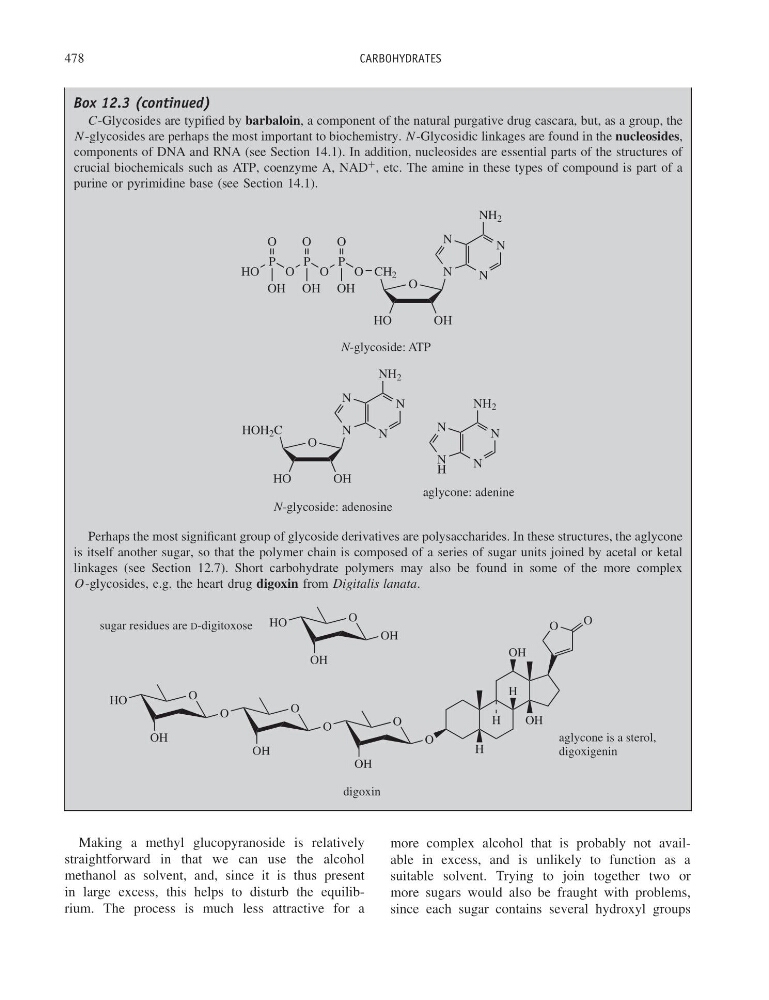
C-Glycosides are typified by barbaloin, a component of the natural purgative drug cascara, but, as a group, the
N-glycosides are perhaps the most important to biochemistry. N-Glycosidic linkages are found in the nucleosides,
components of DNA and RNA (see Section 14.1). In addition, nucleosides are essential parts of the structures of
crucial biochemicals such as ATP, coenzyme A, NAD
+ , etc. The amine in these types of compound is part of a
purine or pyrimidine base (see Section 14.1).
N-glycoside: ATP
N
N
N
NH 2
N
H
aglycone: adenine
N
N
N
NH 2
O
HO
OH
N
HOH 2 C
N-glycoside: adenosine
N
N
N
NH 2
O
HO
OH
N
CH 2
O
P
HO
O
P
O
O
OH OH
P
O
O
OH
Perhaps the most significant group of glycoside derivatives are polysaccharides. In these structures, the aglycone
is itself another sugar, so that the polymer chain is composed of a series of sugar units joined by acetal or ketal
linkages (see Section 12.7). Short carbohydrate polymers may also be found in some of the more complex
O-glycosides, e.g. the heart drug digoxin from Digitalis lanata.
OH
H
O
O
O
OH
O
O
OH
O
O
OH
O
HO
OH
H
H
digoxin
aglycone is a sterol,
digoxigenin
sugar residues are D-digitoxose
O
OH
OH
HO
Making a methyl glucopyranoside is relatively
straightforward in that we can use the alcohol
methanol as solvent, and, since it is thus present
in large excess, this helps to disturb the equilibrium. The process is much less attractive for a
more complex alcohol that is probably not available in excess, and is unlikely to function as a
suitable solvent. Trying to join together two or
more sugars would also be fraught with problems,
since each sugar contains several hydroxyl groups
CARBOHYDRATES
Box 12.3 (continued)
C-Glycosides are typified by barbaloin, a component of the natural purgative drug cascara, but, as a group, the
N-glycosides are perhaps the most important to biochemistry. N-Glycosidic linkages are found in the nucleosides,
components of DNA and RNA (see Section 14.1). In addition, nucleosides are essential parts of the structures of
crucial biochemicals such as ATP, coenzyme A, NAD
+ , etc. The amine in these types of compound is part of a
purine or pyrimidine base (see Section 14.1).
N-glycoside: ATP
N
N
N
NH 2
N
H
aglycone: adenine
N
N
N
NH 2
O
HO
OH
N
HOH 2 C
N-glycoside: adenosine
N
N
N
NH 2
O
HO
OH
N
CH 2
O
P
HO
O
P
O
O
OH OH
P
O
O
OH
Perhaps the most significant group of glycoside derivatives are polysaccharides. In these structures, the aglycone
is itself another sugar, so that the polymer chain is composed of a series of sugar units joined by acetal or ketal
linkages (see Section 12.7). Short carbohydrate polymers may also be found in some of the more complex
O-glycosides, e.g. the heart drug digoxin from Digitalis lanata.
OH
H
O
O
O
OH
O
O
OH
O
O
OH
O
HO
OH
H
H
digoxin
aglycone is a sterol,
digoxigenin
sugar residues are D-digitoxose
O
OH
OH
HO
Making a methyl glucopyranoside is relatively
straightforward in that we can use the alcohol
methanol as solvent, and, since it is thus present
in large excess, this helps to disturb the equilibrium. The process is much less attractive for a
more complex alcohol that is probably not available in excess, and is unlikely to function as a
suitable solvent. Trying to join together two or
more sugars would also be fraught with problems,
since each sugar contains several hydroxyl groups