

GLYCOSIDES
477
O-glycoside: prunasin
C
N
H
O
OH
HO
HO
OH
O
C
N
H
HO
aglycone: mandelonitrile
(benzaldehyde cyanohydrin)
hydrolysis
H
O
HCN
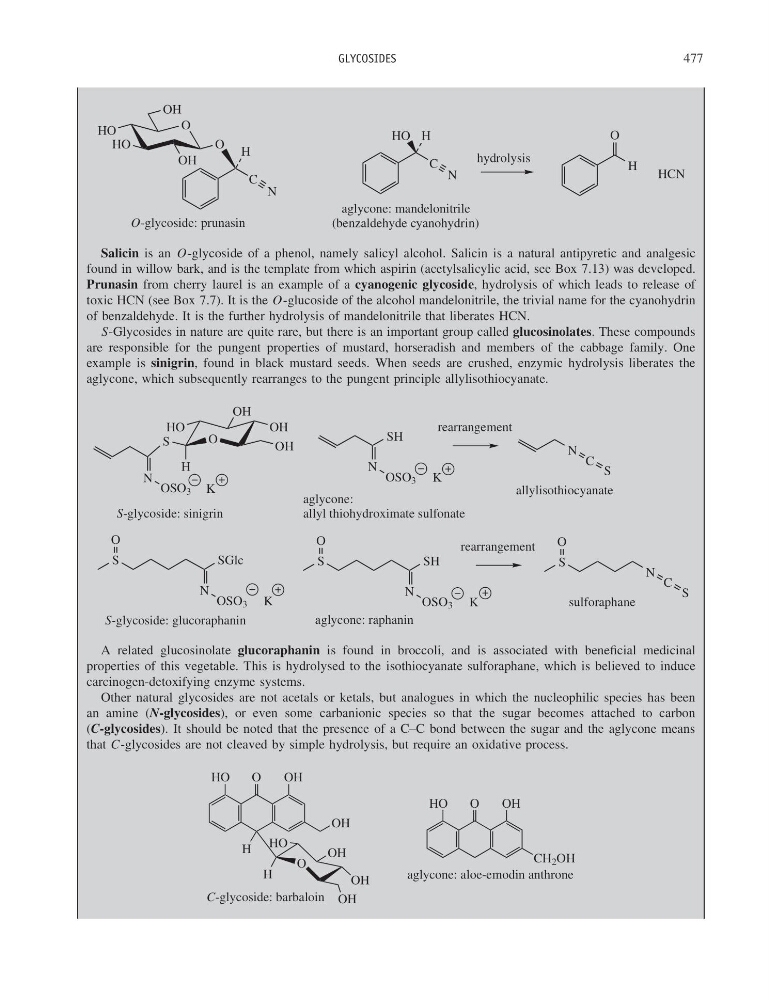
Salicin is an O-glycoside of a phenol, namely salicyl alcohol. Salicin is a natural antipyretic and analgesic
found in willow bark, and is the template from which aspirin (acetylsalicylic acid, see Box 7.13) was developed.
Prunasin from cherry laurel is an example of a cyanogenic glycoside, hydrolysis of which leads to release of
toxic HCN (see Box 7.7). It is the O-glucoside of the alcohol mandelonitrile, the trivial name for the cyanohydrin
of benzaldehyde. It is the further hydrolysis of mandelonitrile that liberates HCN.
S-Glycosides in nature are quite rare, but there is an important group called glucosinolates. These compounds
are responsible for the pungent properties of mustard, horseradish and members of the cabbage family. One
example is sinigrin, found in black mustard seeds. When seeds are crushed, enzymic hydrolysis liberates the
aglycone, which subsequently rearranges to the pungent principle allylisothiocyanate.
S-glycoside: sinigrin
aglycone:
allyl thiohydroximate sulfonate
N
OSO 3
N
C
S
allylisothiocyanate
SH
N
OSO 3
rearrangement
O
OH
OH
H
S
HO
OH
S
N
O
C
S
S
O
SGlc
N
OSO 3
S-glycoside: glucoraphanin
sulforaphane
S
O
SH
N
OSO 3
rearrangement
aglycone: raphanin
K
K
K
K
A related glucosinolate glucoraphanin is found in broccoli, and is associated with beneficial medicinal
properties of this vegetable. This is hydrolysed to the isothiocyanate sulforaphane, which is believed to induce
carcinogen-detoxifying enzyme systems.
Other natural glycosides are not acetals or ketals, but analogues in which the nucleophilic species has been
an amine (N-glycosides), or even some carbanionic species so that the sugar becomes attached to carbon
(C-glycosides). It should be noted that the presence of a C–C bond between the sugar and the aglycone means
that C-glycosides are not cleaved by simple hydrolysis, but require an oxidative process.
HO
O
OH
OH
H
O
OH
OH
OH
HO
H
C-glycoside: barbaloin
HO
O
OH
CH 2 OH
aglycone: aloe-emodin anthrone
477
O-glycoside: prunasin
C
N
H
O
OH
HO
HO
OH
O
C
N
H
HO
aglycone: mandelonitrile
(benzaldehyde cyanohydrin)
hydrolysis
H
O
HCN
Salicin is an O-glycoside of a phenol, namely salicyl alcohol. Salicin is a natural antipyretic and analgesic
found in willow bark, and is the template from which aspirin (acetylsalicylic acid, see Box 7.13) was developed.
Prunasin from cherry laurel is an example of a cyanogenic glycoside, hydrolysis of which leads to release of
toxic HCN (see Box 7.7). It is the O-glucoside of the alcohol mandelonitrile, the trivial name for the cyanohydrin
of benzaldehyde. It is the further hydrolysis of mandelonitrile that liberates HCN.
S-Glycosides in nature are quite rare, but there is an important group called glucosinolates. These compounds
are responsible for the pungent properties of mustard, horseradish and members of the cabbage family. One
example is sinigrin, found in black mustard seeds. When seeds are crushed, enzymic hydrolysis liberates the
aglycone, which subsequently rearranges to the pungent principle allylisothiocyanate.
S-glycoside: sinigrin
aglycone:
allyl thiohydroximate sulfonate
N
OSO 3
N
C
S
allylisothiocyanate
SH
N
OSO 3
rearrangement
O
OH
OH
H
S
HO
OH
S
N
O
C
S
S
O
SGlc
N
OSO 3
S-glycoside: glucoraphanin
sulforaphane
S
O
SH
N
OSO 3
rearrangement
aglycone: raphanin
K
K
K
K
A related glucosinolate glucoraphanin is found in broccoli, and is associated with beneficial medicinal
properties of this vegetable. This is hydrolysed to the isothiocyanate sulforaphane, which is believed to induce
carcinogen-detoxifying enzyme systems.
Other natural glycosides are not acetals or ketals, but analogues in which the nucleophilic species has been
an amine (N-glycosides), or even some carbanionic species so that the sugar becomes attached to carbon
(C-glycosides). It should be noted that the presence of a C–C bond between the sugar and the aglycone means
that C-glycosides are not cleaved by simple hydrolysis, but require an oxidative process.
HO
O
OH
OH
H
O
OH
OH
OH
HO
H
C-glycoside: barbaloin
HO
O
OH
CH 2 OH
aglycone: aloe-emodin anthrone