

476
CARBOHYDRATES
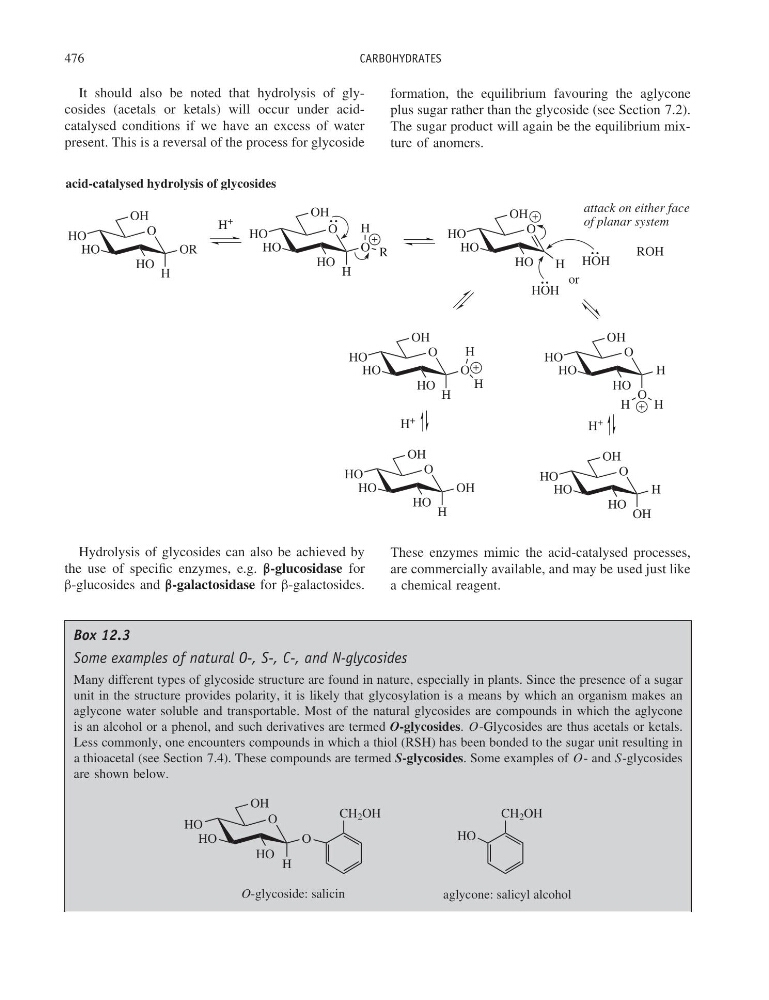
It should also be noted that hydrolysis of glycosides (acetals or ketals) will occur under acidcatalysed conditions if we have an excess of water
present. This is a reversal of the process for glycoside
formation, the equilibrium favouring the aglycone
plus sugar rather than the glycoside (see Section 7.2).
The sugar product will again be the equilibrium mixture of anomers.
O
HO
HO
OH
H
HO
OR
O
HO
HO
OH
H
HO
O
H
R
H +
O
HO
HO
OH
HO
H HOH
O
HO
HO
OH
O
HO
H
O
HO
HO
OH
H
HO
O
HOH
or
attack on either face
of planar system
H
H
H
H
O
HO
HO
OH
OH
HO
H
O
HO
HO
OH
H
HO
OH
ROH
acid-catalysed hydrolysis of glycosides
H +
H +
Hydrolysis of glycosides can also be achieved by
the use of specific enzymes, e.g. β-glucosidase for
β-glucosides and β-galactosidase for β-galactosides.
These enzymes mimic the acid-catalysed processes,
are commercially available, and may be used just like
a chemical reagent.
Box 12.3
Some examples of natural O-, S-, C-, and N-glycosides
Many different types of glycoside structure are found in nature, especially in plants. Since the presence of a sugar
unit in the structure provides polarity, it is likely that glycosylation is a means by which an organism makes an
aglycone water soluble and transportable. Most of the natural glycosides are compounds in which the aglycone
is an alcohol or a phenol, and such derivatives are termed O-glycosides. O-Glycosides are thus acetals or ketals.
Less commonly, one encounters compounds in which a thiol (RSH) has been bonded to the sugar unit resulting in
a thioacetal (see Section 7.4). These compounds are termed S-glycosides. Some examples of O- and S-glycosides
are shown below.
O
HO
HO
OH
H
HO
O
CH 2 OH
HO
CH 2 OH
O-glycoside: salicin
aglycone: salicyl alcohol
CARBOHYDRATES
It should also be noted that hydrolysis of glycosides (acetals or ketals) will occur under acidcatalysed conditions if we have an excess of water
present. This is a reversal of the process for glycoside
formation, the equilibrium favouring the aglycone
plus sugar rather than the glycoside (see Section 7.2).
The sugar product will again be the equilibrium mixture of anomers.
O
HO
HO
OH
H
HO
OR
O
HO
HO
OH
H
HO
O
H
R
H +
O
HO
HO
OH
HO
H HOH
O
HO
HO
OH
O
HO
H
O
HO
HO
OH
H
HO
O
HOH
or
attack on either face
of planar system
H
H
H
H
O
HO
HO
OH
OH
HO
H
O
HO
HO
OH
H
HO
OH
ROH
acid-catalysed hydrolysis of glycosides
H +
H +
Hydrolysis of glycosides can also be achieved by
the use of specific enzymes, e.g. β-glucosidase for
β-glucosides and β-galactosidase for β-galactosides.
These enzymes mimic the acid-catalysed processes,
are commercially available, and may be used just like
a chemical reagent.
Box 12.3
Some examples of natural O-, S-, C-, and N-glycosides
Many different types of glycoside structure are found in nature, especially in plants. Since the presence of a sugar
unit in the structure provides polarity, it is likely that glycosylation is a means by which an organism makes an
aglycone water soluble and transportable. Most of the natural glycosides are compounds in which the aglycone
is an alcohol or a phenol, and such derivatives are termed O-glycosides. O-Glycosides are thus acetals or ketals.
Less commonly, one encounters compounds in which a thiol (RSH) has been bonded to the sugar unit resulting in
a thioacetal (see Section 7.4). These compounds are termed S-glycosides. Some examples of O- and S-glycosides
are shown below.
O
HO
HO
OH
H
HO
O
CH 2 OH
HO
CH 2 OH
O-glycoside: salicin
aglycone: salicyl alcohol