

GLYCOSIDES
475
O
X
O
X
lone pair anti-periplanar with
axial electronegative group
neither lone pair anti-periplanar with
equatorial electronegative group
O
X
H
α-anomer
rotate
≡
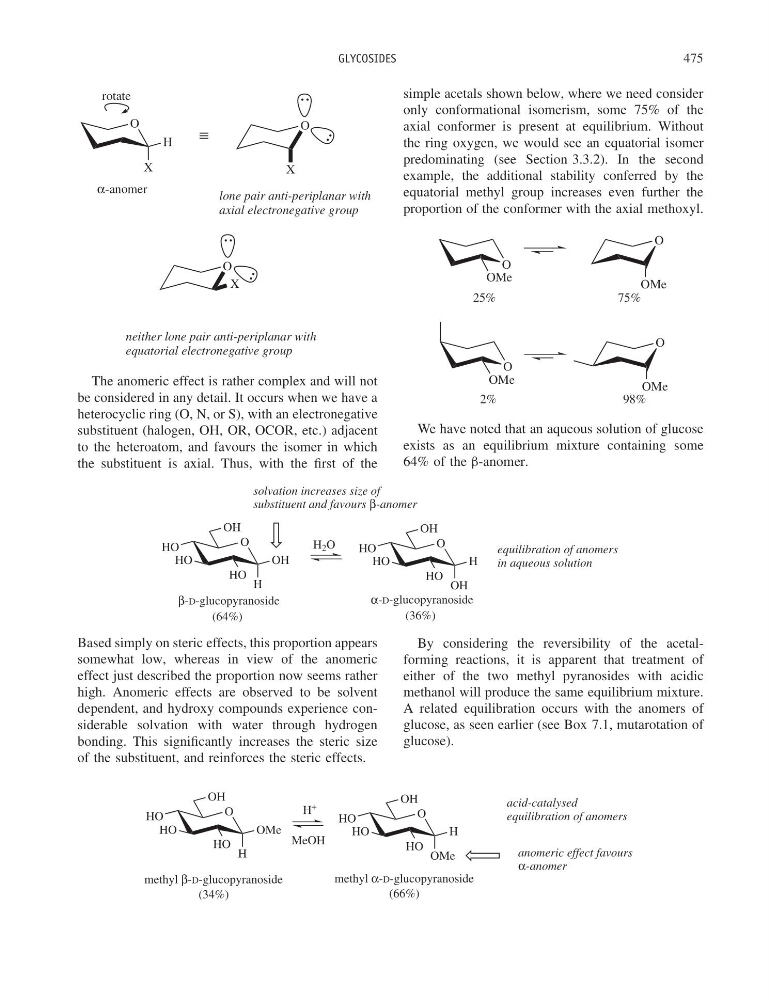
The anomeric effect is rather complex and will not
be considered in any detail. It occurs when we have a
heterocyclic ring (O, N, or S), with an electronegative
substituent (halogen, OH, OR, OCOR, etc.) adjacent
to the heteroatom, and favours the isomer in which
the substituent is axial. Thus, with the first of the
simple acetals shown below, where we need consider
only conformational isomerism, some 75% of the
axial conformer is present at equilibrium. Without
the ring oxygen, we would see an equatorial isomer
predominating (see Section 3.3.2). In the second
example, the additional stability conferred by the
equatorial methyl group increases even further the
proportion of the conformer with the axial methoxyl.
O
O
25%
75%
O
O
2%
98%
OMe
OMe
OMe
OMe
We have noted that an aqueous solution of glucose
exists as an equilibrium mixture containing some
64% of the β-anomer.
O
HO
HO
OH
OH
HO
H
O
HO
HO
OH
H
HO
OH
β-D-glucopyranoside
(64%)
α-D-glucopyranoside
(36%)
H 2 O
solvation increases size of
substituent and favours β-anomer
equilibration of anomers
in aqueous solution
Based simply on steric effects, this proportion appears
somewhat low, whereas in view of the anomeric
effect just described the proportion now seems rather
high. Anomeric effects are observed to be solvent
dependent, and hydroxy compounds experience considerable solvation with water through hydrogen
bonding. This significantly increases the steric size
of the substituent, and reinforces the steric effects.
By considering the reversibility of the acetalforming reactions, it is apparent that treatment of
either of the two methyl pyranosides with acidic
methanol will produce the same equilibrium mixture.
A related equilibration occurs with the anomers of
glucose, as seen earlier (see Box 7.1, mutarotation of
glucose).
O
HO
HO
OH
OMe
HO
H
O
HO
HO
OH
H
HO
OMe
methyl α-D-glucopyranoside
(66%)
methyl β-D-glucopyranoside
(34%)
MeOH
H +
acid-catalysed
equilibration of anomers
anomeric effect favours
α-anomer
475
O
X
O
X
lone pair anti-periplanar with
axial electronegative group
neither lone pair anti-periplanar with
equatorial electronegative group
O
X
H
α-anomer
rotate
≡
The anomeric effect is rather complex and will not
be considered in any detail. It occurs when we have a
heterocyclic ring (O, N, or S), with an electronegative
substituent (halogen, OH, OR, OCOR, etc.) adjacent
to the heteroatom, and favours the isomer in which
the substituent is axial. Thus, with the first of the
simple acetals shown below, where we need consider
only conformational isomerism, some 75% of the
axial conformer is present at equilibrium. Without
the ring oxygen, we would see an equatorial isomer
predominating (see Section 3.3.2). In the second
example, the additional stability conferred by the
equatorial methyl group increases even further the
proportion of the conformer with the axial methoxyl.
O
O
25%
75%
O
O
2%
98%
OMe
OMe
OMe
OMe
We have noted that an aqueous solution of glucose
exists as an equilibrium mixture containing some
64% of the β-anomer.
O
HO
HO
OH
OH
HO
H
O
HO
HO
OH
H
HO
OH
β-D-glucopyranoside
(64%)
α-D-glucopyranoside
(36%)
H 2 O
solvation increases size of
substituent and favours β-anomer
equilibration of anomers
in aqueous solution
Based simply on steric effects, this proportion appears
somewhat low, whereas in view of the anomeric
effect just described the proportion now seems rather
high. Anomeric effects are observed to be solvent
dependent, and hydroxy compounds experience considerable solvation with water through hydrogen
bonding. This significantly increases the steric size
of the substituent, and reinforces the steric effects.
By considering the reversibility of the acetalforming reactions, it is apparent that treatment of
either of the two methyl pyranosides with acidic
methanol will produce the same equilibrium mixture.
A related equilibration occurs with the anomers of
glucose, as seen earlier (see Box 7.1, mutarotation of
glucose).
O
HO
HO
OH
OMe
HO
H
O
HO
HO
OH
H
HO
OMe
methyl α-D-glucopyranoside
(66%)
methyl β-D-glucopyranoside
(34%)
MeOH
H +
acid-catalysed
equilibration of anomers
anomeric effect favours
α-anomer