

474
CARBOHYDRATES
On the other hand, borohydride reduction of the
ketose D-fructose will give a mixture of D-glucitol
and its epimer, D-mannitol. A better approach
to D-mannitol would be reduction of the aldose
D-mannose. D-Glucitol (sorbitol) is found naturally
in the ripe berries of the mountain ash (Sorbus
aucuparia), but is prepared semi-synthetically from
glucose. It is half as sweet as sucrose, is not
absorbed orally, and is not readily metabolized in
the body. It finds particular use as a sweetener for
diabetic products. D-Mannitol also occurs naturally in
manna, the exudate of the manna ash Fraxinus ornus.
This material has similar characteristics to sorbitol,
but is used principally as a diuretic. It is injected
intravenously, is eliminated rapidly into the urine, and
removes fluid by an osmotic effect.
12.4 Glycosides
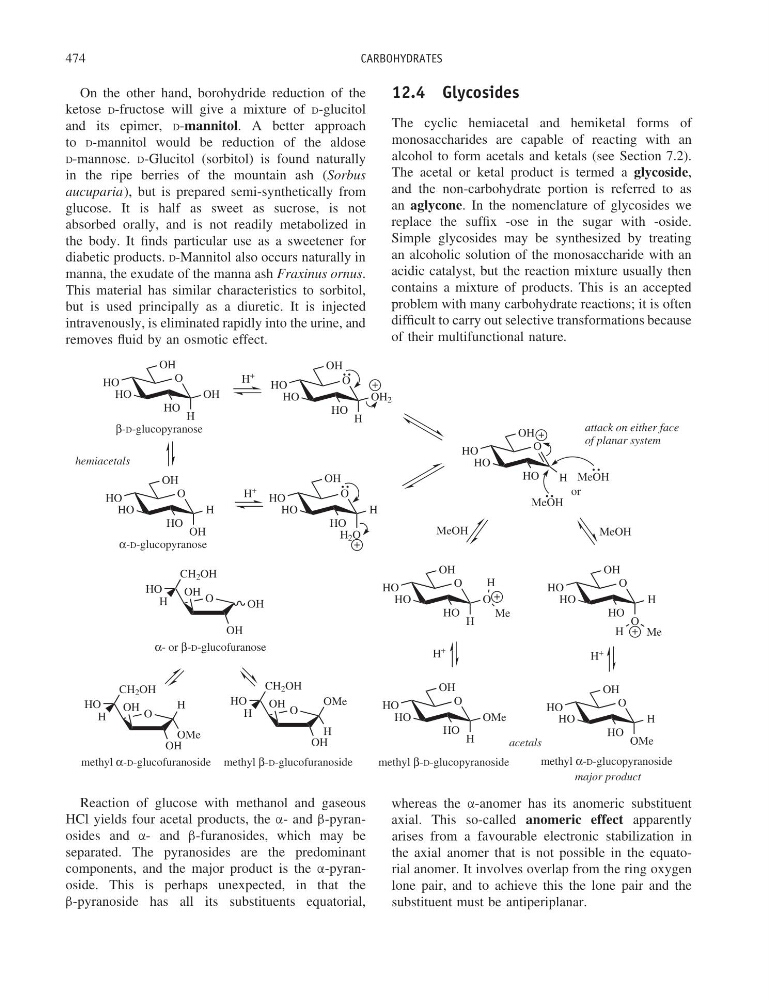
The cyclic hemiacetal and hemiketal forms of
monosaccharides are capable of reacting with an
alcohol to form acetals and ketals (see Section 7.2).
The acetal or ketal product is termed a glycoside,
and the non-carbohydrate portion is referred to as
an aglycone. In the nomenclature of glycosides we
replace the suffix -ose in the sugar with -oside.
Simple glycosides may be synthesized by treating
an alcoholic solution of the monosaccharide with an
acidic catalyst, but the reaction mixture usually then
contains a mixture of products. This is an accepted
problem with many carbohydrate reactions; it is often
difficult to carry out selective transformations because
of their multifunctional nature.
O
HO
HO
OH
OH
HO
H
O
HO
HO
OH
H
HO
OH
O
HO
HO
OH
H 2 O
HO
H
O
HO
HO
OH
H
HO
OH 2
O
HO
HO
OH
HO
H MeOH
O
HO
HO
OH
O
HO
H
O
HO
HO
OH
H
HO
O
O
H
OMe
HO
OH
OH
CH 2 OH
H
O
OMe
H
HO
OH
OH
CH 2 OH
H
MeOH
or
attack on either face
of planar system
O
HO
HO
OH
OMe
HO
H
O
HO
HO
OH
H
HO
OMe
Me
H
H
Me
methyl α-D-glucopyranoside
methyl β-D-glucopyranoside
methyl β-D-glucofuranoside
methyl α-D-glucofuranoside
β-D-glucopyranose
α-D-glucopyranose
O
HO
OH
OH
CH 2 OH
H
α- or β-D-glucofuranose
OH
hemiacetals
acetals
H
+
H
+
MeOH
MeOH
major product
H
+
H
+
Reaction of glucose with methanol and gaseous
HCl yields four acetal products, the α- and β-pyranosides and α- and β-furanosides, which may be
separated. The pyranosides are the predominant
components, and the major product is the α-pyranoside. This is perhaps unexpected, in that the
β-pyranoside has all its substituents equatorial,
whereas the α-anomer has its anomeric substituent
axial. This so-called anomeric effect apparently
arises from a favourable electronic stabilization in
the axial anomer that is not possible in the equatorial anomer. It involves overlap from the ring oxygen
lone pair, and to achieve this the lone pair and the
substituent must be antiperiplanar.
CARBOHYDRATES
On the other hand, borohydride reduction of the
ketose D-fructose will give a mixture of D-glucitol
and its epimer, D-mannitol. A better approach
to D-mannitol would be reduction of the aldose
D-mannose. D-Glucitol (sorbitol) is found naturally
in the ripe berries of the mountain ash (Sorbus
aucuparia), but is prepared semi-synthetically from
glucose. It is half as sweet as sucrose, is not
absorbed orally, and is not readily metabolized in
the body. It finds particular use as a sweetener for
diabetic products. D-Mannitol also occurs naturally in
manna, the exudate of the manna ash Fraxinus ornus.
This material has similar characteristics to sorbitol,
but is used principally as a diuretic. It is injected
intravenously, is eliminated rapidly into the urine, and
removes fluid by an osmotic effect.
12.4 Glycosides
The cyclic hemiacetal and hemiketal forms of
monosaccharides are capable of reacting with an
alcohol to form acetals and ketals (see Section 7.2).
The acetal or ketal product is termed a glycoside,
and the non-carbohydrate portion is referred to as
an aglycone. In the nomenclature of glycosides we
replace the suffix -ose in the sugar with -oside.
Simple glycosides may be synthesized by treating
an alcoholic solution of the monosaccharide with an
acidic catalyst, but the reaction mixture usually then
contains a mixture of products. This is an accepted
problem with many carbohydrate reactions; it is often
difficult to carry out selective transformations because
of their multifunctional nature.
O
HO
HO
OH
OH
HO
H
O
HO
HO
OH
H
HO
OH
O
HO
HO
OH
H 2 O
HO
H
O
HO
HO
OH
H
HO
OH 2
O
HO
HO
OH
HO
H MeOH
O
HO
HO
OH
O
HO
H
O
HO
HO
OH
H
HO
O
O
H
OMe
HO
OH
OH
CH 2 OH
H
O
OMe
H
HO
OH
OH
CH 2 OH
H
MeOH
or
attack on either face
of planar system
O
HO
HO
OH
OMe
HO
H
O
HO
HO
OH
H
HO
OMe
Me
H
H
Me
methyl α-D-glucopyranoside
methyl β-D-glucopyranoside
methyl β-D-glucofuranoside
methyl α-D-glucofuranoside
β-D-glucopyranose
α-D-glucopyranose
O
HO
OH
OH
CH 2 OH
H
α- or β-D-glucofuranose
OH
hemiacetals
acetals
H
+
H
+
MeOH
MeOH
major product
H
+
H
+
Reaction of glucose with methanol and gaseous
HCl yields four acetal products, the α- and β-pyranosides and α- and β-furanosides, which may be
separated. The pyranosides are the predominant
components, and the major product is the α-pyranoside. This is perhaps unexpected, in that the
β-pyranoside has all its substituents equatorial,
whereas the α-anomer has its anomeric substituent
axial. This so-called anomeric effect apparently
arises from a favourable electronic stabilization in
the axial anomer that is not possible in the equatorial anomer. It involves overlap from the ring oxygen
lone pair, and to achieve this the lone pair and the
substituent must be antiperiplanar.