

ALDITOLS
473
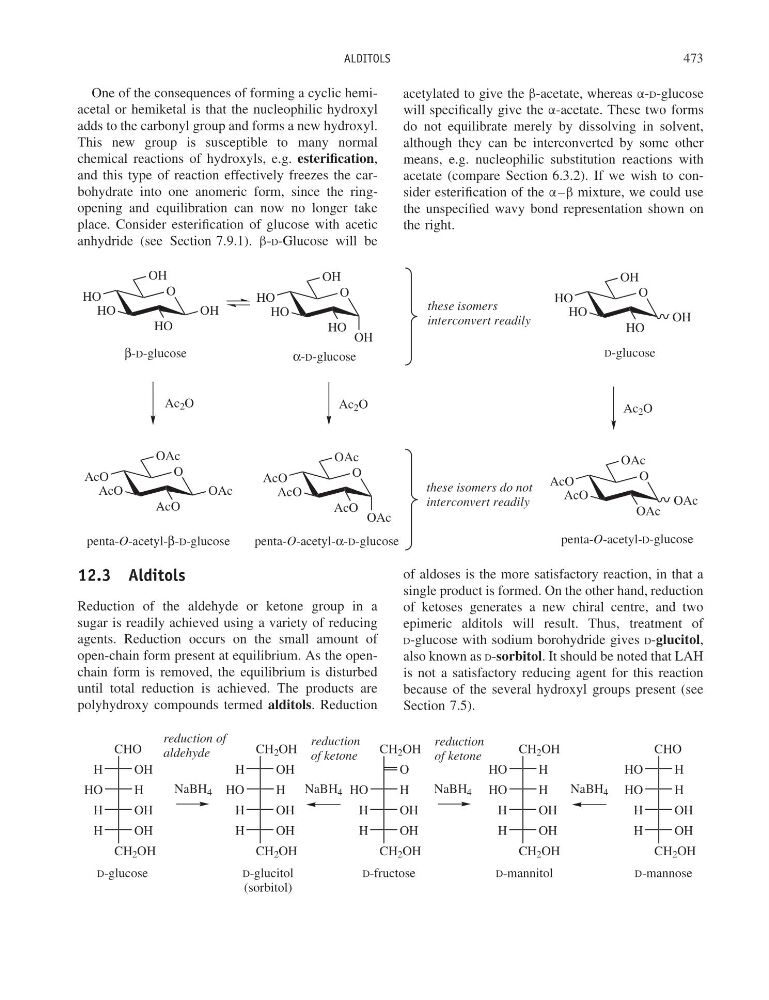
One of the consequences of forming a cyclic hemiacetal or hemiketal is that the nucleophilic hydroxyl
adds to the carbonyl group and forms a new hydroxyl.
This new group is susceptible to many normal
chemical reactions of hydroxyls, e.g. esterification,
and this type of reaction effectively freezes the carbohydrate into one anomeric form, since the ringopening and equilibration can now no longer take
place. Consider esterification of glucose with acetic
anhydride (see Section 7.9.1). β-D-Glucose will be
acetylated to give the β-acetate, whereas α-D-glucose
will specifically give the α-acetate. These two forms
do not equilibrate merely by dissolving in solvent,
although they can be interconverted by some other
means, e.g. nucleophilic substitution reactions with
acetate (compare Section 6.3.2). If we wish to consider esterification of the α–β mixture, we could use
the unspecified wavy bond representation shown on
the right.
O
HO
HO
OH
HO
OH
O
HO
HO
OH
HO
OH
β-D-glucose
α-D-glucose
Ac 2 O
Ac 2 O
these isomers do not
interconvert readily
these isomers
interconvert readily
O
HO
HO
OH
HO
OH
O
AcO
AcO
OAc
OAc
OAc
D-glucose
penta-O-acetyl-D-glucose
Ac 2 O
O
AcO
AcO
OAc
AcO
OAc
penta-O-acetyl-α-D-glucose
O
AcO
AcO
OAc
AcO
OAc
penta-O-acetyl-β-D-glucose
12.3 Alditols
Reduction of the aldehyde or ketone group in a
sugar is readily achieved using a variety of reducing
agents. Reduction occurs on the small amount of
open-chain form present at equilibrium. As the openchain form is removed, the equilibrium is disturbed
until total reduction is achieved. The products are
polyhydroxy compounds termed alditols. Reduction
of aldoses is the more satisfactory reaction, in that a
single product is formed. On the other hand, reduction
of ketoses generates a new chiral centre, and two
epimeric alditols will result. Thus, treatment of
D-glucose with sodium borohydride gives D-glucitol,
also known as D-sorbitol. It should be noted that LAH
is not a satisfactory reducing agent for this reaction
because of the several hydroxyl groups present (see
Section 7.5).
CHO
OH
H
HO
H
H
OH
H
OH
CH 2 OH
CH 2 OH
OH
HO
H
H
OH
H
OH
CH 2 OH
CH 2 OH
O
HO
H
H
OH
H
OH
CH 2 OH
H
D-glucose
D-fructose
D-glucitol
(sorbitol)
reduction of
aldehyde
reduction
of ketone
NaBH 4
NaBH 4
CH 2 OH
H
HO
H
H
OH
H
OH
CH 2 OH
HO
NaBH 4
D-mannitol
reduction
of ketone
CHO
H
HO
HO
H
H
OH
H
OH
CH 2 OH
D-mannose
NaBH 4
473
One of the consequences of forming a cyclic hemiacetal or hemiketal is that the nucleophilic hydroxyl
adds to the carbonyl group and forms a new hydroxyl.
This new group is susceptible to many normal
chemical reactions of hydroxyls, e.g. esterification,
and this type of reaction effectively freezes the carbohydrate into one anomeric form, since the ringopening and equilibration can now no longer take
place. Consider esterification of glucose with acetic
anhydride (see Section 7.9.1). β-D-Glucose will be
acetylated to give the β-acetate, whereas α-D-glucose
will specifically give the α-acetate. These two forms
do not equilibrate merely by dissolving in solvent,
although they can be interconverted by some other
means, e.g. nucleophilic substitution reactions with
acetate (compare Section 6.3.2). If we wish to consider esterification of the α–β mixture, we could use
the unspecified wavy bond representation shown on
the right.
O
HO
HO
OH
HO
OH
O
HO
HO
OH
HO
OH
β-D-glucose
α-D-glucose
Ac 2 O
Ac 2 O
these isomers do not
interconvert readily
these isomers
interconvert readily
O
HO
HO
OH
HO
OH
O
AcO
AcO
OAc
OAc
OAc
D-glucose
penta-O-acetyl-D-glucose
Ac 2 O
O
AcO
AcO
OAc
AcO
OAc
penta-O-acetyl-α-D-glucose
O
AcO
AcO
OAc
AcO
OAc
penta-O-acetyl-β-D-glucose
12.3 Alditols
Reduction of the aldehyde or ketone group in a
sugar is readily achieved using a variety of reducing
agents. Reduction occurs on the small amount of
open-chain form present at equilibrium. As the openchain form is removed, the equilibrium is disturbed
until total reduction is achieved. The products are
polyhydroxy compounds termed alditols. Reduction
of aldoses is the more satisfactory reaction, in that a
single product is formed. On the other hand, reduction
of ketoses generates a new chiral centre, and two
epimeric alditols will result. Thus, treatment of
D-glucose with sodium borohydride gives D-glucitol,
also known as D-sorbitol. It should be noted that LAH
is not a satisfactory reducing agent for this reaction
because of the several hydroxyl groups present (see
Section 7.5).
CHO
OH
H
HO
H
H
OH
H
OH
CH 2 OH
CH 2 OH
OH
HO
H
H
OH
H
OH
CH 2 OH
CH 2 OH
O
HO
H
H
OH
H
OH
CH 2 OH
H
D-glucose
D-fructose
D-glucitol
(sorbitol)
reduction of
aldehyde
reduction
of ketone
NaBH 4
NaBH 4
CH 2 OH
H
HO
H
H
OH
H
OH
CH 2 OH
HO
NaBH 4
D-mannitol
reduction
of ketone
CHO
H
HO
HO
H
H
OH
H
OH
CH 2 OH
D-mannose
NaBH 4