

488
CARBOHYDRATES
Box 12.6
Some examples of natural uronic acid derivatives
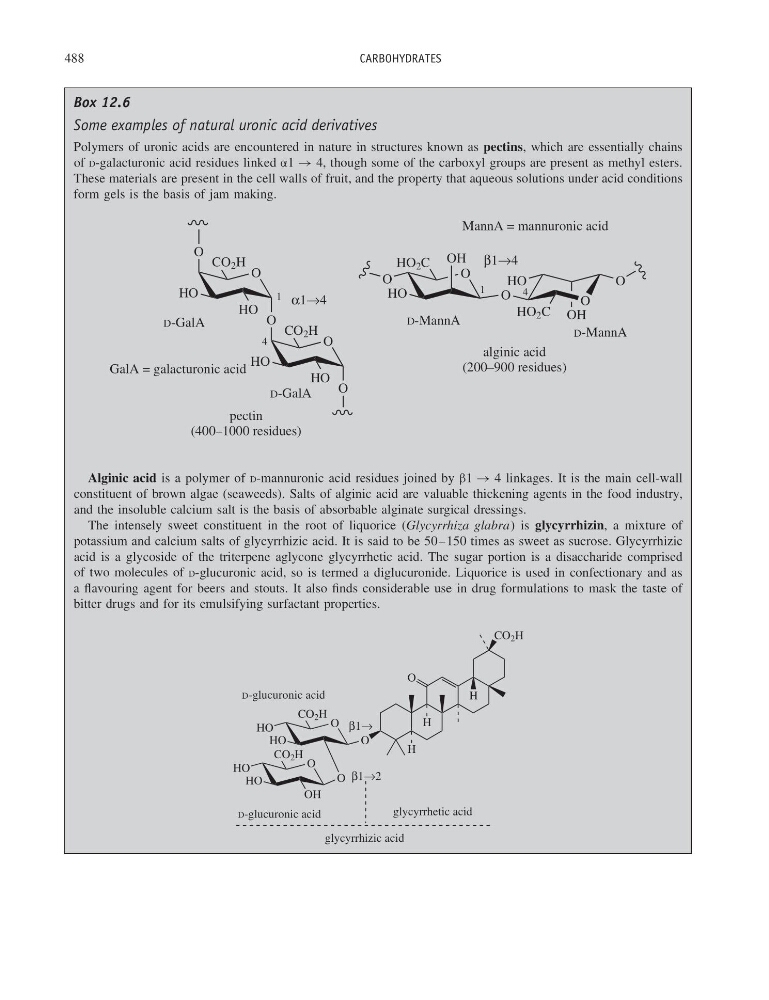
Polymers of uronic acids are encountered in nature in structures known as pectins, which are essentially chains
of D-galacturonic acid residues linked α1 → 4, though some of the carboxyl groups are present as methyl esters.
These materials are present in the cell walls of fruit, and the property that aqueous solutions under acid conditions
form gels is the basis of jam making.
O
HO
CO 2 H
HO
O
O
HO
CO 2 H
HO
O
O
O
HO
HO 2 C
O
HO
HO 2 C
O
O
OH
OH
O
pectin
(400–1000 residues)
4
1
alginic acid
(200–900 residues)
β1→4
4
α1→4
D-GalA
D-GalA
GalA = galacturonic acid
D-MannA
1
D-MannA
MannA = mannuronic acid
Alginic acid is a polymer of D-mannuronic acid residues joined by β1 → 4 linkages. It is the main cell-wall
constituent of brown algae (seaweeds). Salts of alginic acid are valuable thickening agents in the food industry,
and the insoluble calcium salt is the basis of absorbable alginate surgical dressings.
The intensely sweet constituent in the root of liquorice (Glycyrrhiza glabra) is glycyrrhizin, a mixture of
potassium and calcium salts of glycyrrhizic acid. It is said to be 50–150 times as sweet as sucrose. Glycyrrhizic
acid is a glycoside of the triterpene aglycone glycyrrhetic acid. The sugar portion is a disaccharide comprised
of two molecules of D-glucuronic acid, so is termed a diglucuronide. Liquorice is used in confectionary and as
a flavouring agent for beers and stouts. It also finds considerable use in drug formulations to mask the taste of
bitter drugs and for its emulsifying surfactant properties.
H
H
CO 2 H
O
O
CO 2 H
HO
HO
O
O
O
CO 2 H
HO
HO
OH
D-glucuronic acid
glycyrrhizic acid
D-glucuronic acid
glycyrrhetic acid
H
β1→2
β1→
CARBOHYDRATES
Box 12.6
Some examples of natural uronic acid derivatives
Polymers of uronic acids are encountered in nature in structures known as pectins, which are essentially chains
of D-galacturonic acid residues linked α1 → 4, though some of the carboxyl groups are present as methyl esters.
These materials are present in the cell walls of fruit, and the property that aqueous solutions under acid conditions
form gels is the basis of jam making.
O
HO
CO 2 H
HO
O
O
HO
CO 2 H
HO
O
O
O
HO
HO 2 C
O
HO
HO 2 C
O
O
OH
OH
O
pectin
(400–1000 residues)
4
1
alginic acid
(200–900 residues)
β1→4
4
α1→4
D-GalA
D-GalA
GalA = galacturonic acid
D-MannA
1
D-MannA
MannA = mannuronic acid
Alginic acid is a polymer of D-mannuronic acid residues joined by β1 → 4 linkages. It is the main cell-wall
constituent of brown algae (seaweeds). Salts of alginic acid are valuable thickening agents in the food industry,
and the insoluble calcium salt is the basis of absorbable alginate surgical dressings.
The intensely sweet constituent in the root of liquorice (Glycyrrhiza glabra) is glycyrrhizin, a mixture of
potassium and calcium salts of glycyrrhizic acid. It is said to be 50–150 times as sweet as sucrose. Glycyrrhizic
acid is a glycoside of the triterpene aglycone glycyrrhetic acid. The sugar portion is a disaccharide comprised
of two molecules of D-glucuronic acid, so is termed a diglucuronide. Liquorice is used in confectionary and as
a flavouring agent for beers and stouts. It also finds considerable use in drug formulations to mask the taste of
bitter drugs and for its emulsifying surfactant properties.
H
H
CO 2 H
O
O
CO 2 H
HO
HO
O
O
O
CO 2 H
HO
HO
OH
D-glucuronic acid
glycyrrhizic acid
D-glucuronic acid
glycyrrhetic acid
H
β1→2
β1→