

MONOSACCHARIDES
469
HO
O
OH
OH
β-D-ribopyranose
OH
O
HOH 2 C
HO
OH
OH
β-D-ribofuranose
OH
HO
H
HO
O
D-ribose
(open-chain)
1
2
3
4
5
D-ribose
(open-chain)
OH
O
H
HO
1
5
3
2
4
OH
OH
HO
HO
O
HO OH
α-D-ribopyranose
OH
O
HOH 2 C
HO
OH
OH
α-D-ribofuranose
CHO
OH
H
OH
H
CH 2 OH
OH
H
D-ribose
3
4
5
1
2
H
H
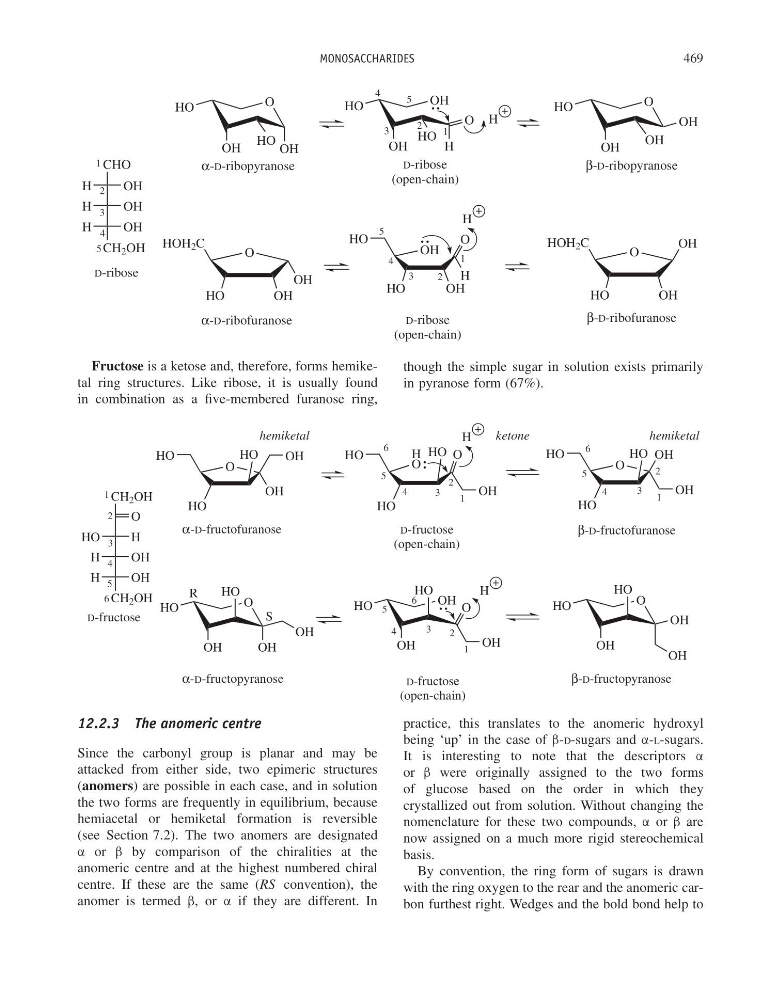
Fructose is a ketose and, therefore, forms hemiketal ring structures. Like ribose, it is usually found
in combination as a five-membered furanose ring,
though the simple sugar in solution exists primarily
in pyranose form (67%).
O
HO
HO OH
OH
HO
O
HO
HO
OH
HO
OH
H
O
HO
HO O
OH
HO
α-D-fructofuranose
β-D-fructofuranose
D-fructose
(open-chain)
1
5
3
2
4
6
1
2
3
4
5
6
hemiketal
ketone
hemiketal
OH
HO
OH
O
OH
HO
O
HO
HO
OH
OH
OH
O
HO
HO
OH
OH
OH
D-fructose
(open-chain)
1
2
3
4
5
6
α-D-fructopyranose
β-D-fructopyranose
S
R
CH 2 OH
O
HO
H
H
OH
H
OH
CH 2 OH
D-fructose
3
4
5
6
1
2
H
H
12.2.3 The anomeric centre
Since the carbonyl group is planar and may be
attacked from either side, two epimeric structures
(anomers) are possible in each case, and in solution
the two forms are frequently in equilibrium, because
hemiacetal or hemiketal formation is reversible
(see Section 7.2). The two anomers are designated
α or β by comparison of the chiralities at the
anomeric centre and at the highest numbered chiral
centre. If these are the same (RS convention), the
anomer is termed β, or α if they are different. In
practice, this translates to the anomeric hydroxyl
being ‘up’ in the case of β-D-sugars and α-L-sugars.
It is interesting to note that the descriptors α
or β were originally assigned to the two forms
of glucose based on the order in which they
crystallized out from solution. Without changing the
nomenclature for these two compounds, α or β are
now assigned on a much more rigid stereochemical
basis.
By convention, the ring form of sugars is drawn
with the ring oxygen to the rear and the anomeric carbon furthest right. Wedges and the bold bond help to
469
HO
O
OH
OH
β-D-ribopyranose
OH
O
HOH 2 C
HO
OH
OH
β-D-ribofuranose
OH
HO
H
HO
O
D-ribose
(open-chain)
1
2
3
4
5
D-ribose
(open-chain)
OH
O
H
HO
1
5
3
2
4
OH
OH
HO
HO
O
HO OH
α-D-ribopyranose
OH
O
HOH 2 C
HO
OH
OH
α-D-ribofuranose
CHO
OH
H
OH
H
CH 2 OH
OH
H
D-ribose
3
4
5
1
2
H
H
Fructose is a ketose and, therefore, forms hemiketal ring structures. Like ribose, it is usually found
in combination as a five-membered furanose ring,
though the simple sugar in solution exists primarily
in pyranose form (67%).
O
HO
HO OH
OH
HO
O
HO
HO
OH
HO
OH
H
O
HO
HO O
OH
HO
α-D-fructofuranose
β-D-fructofuranose
D-fructose
(open-chain)
1
5
3
2
4
6
1
2
3
4
5
6
hemiketal
ketone
hemiketal
OH
HO
OH
O
OH
HO
O
HO
HO
OH
OH
OH
O
HO
HO
OH
OH
OH
D-fructose
(open-chain)
1
2
3
4
5
6
α-D-fructopyranose
β-D-fructopyranose
S
R
CH 2 OH
O
HO
H
H
OH
H
OH
CH 2 OH
D-fructose
3
4
5
6
1
2
H
H
12.2.3 The anomeric centre
Since the carbonyl group is planar and may be
attacked from either side, two epimeric structures
(anomers) are possible in each case, and in solution
the two forms are frequently in equilibrium, because
hemiacetal or hemiketal formation is reversible
(see Section 7.2). The two anomers are designated
α or β by comparison of the chiralities at the
anomeric centre and at the highest numbered chiral
centre. If these are the same (RS convention), the
anomer is termed β, or α if they are different. In
practice, this translates to the anomeric hydroxyl
being ‘up’ in the case of β-D-sugars and α-L-sugars.
It is interesting to note that the descriptors α
or β were originally assigned to the two forms
of glucose based on the order in which they
crystallized out from solution. Without changing the
nomenclature for these two compounds, α or β are
now assigned on a much more rigid stereochemical
basis.
By convention, the ring form of sugars is drawn
with the ring oxygen to the rear and the anomeric carbon furthest right. Wedges and the bold bond help to