

470
CARBOHYDRATES
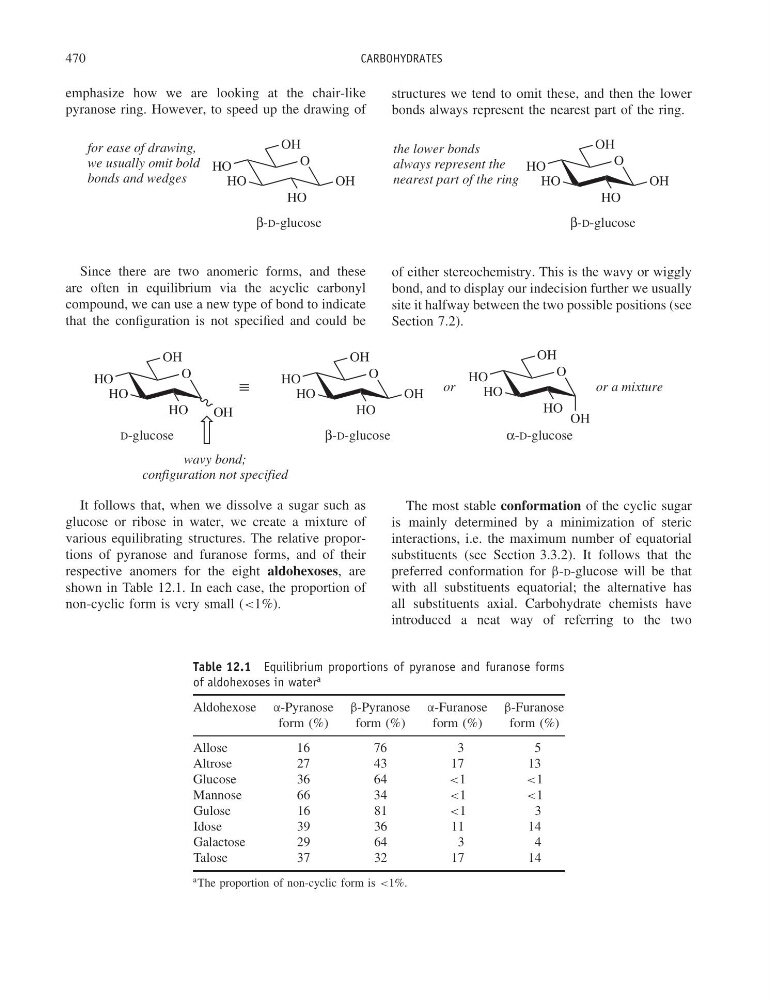
emphasize how we are looking at the chair-like
pyranose ring. However, to speed up the drawing of
structures we tend to omit these, and then the lower
bonds always represent the nearest part of the ring.
O
HO
HO
OH
HO
OH
β-D-glucose
O
HO
HO
OH
HO
OH
β-D-glucose
for ease of drawing,
we usually omit bold
bonds and wedges
the lower bonds
always represent the
nearest part of the ring
Since there are two anomeric forms, and these
are often in equilibrium via the acyclic carbonyl
compound, we can use a new type of bond to indicate
that the configuration is not specified and could be
of either stereochemistry. This is the wavy or wiggly
bond, and to display our indecision further we usually
site it halfway between the two possible positions (see
Section 7.2).
O
HO
HO
OH
HO
O
HO
HO
OH
HO
OH
O
HO
HO
OH
HO
OH
OH
D-glucose
or
β-D-glucose
α-D-glucose
wavy bond;
configuration not specified
or a mixture
≡
It follows that, when we dissolve a sugar such as
glucose or ribose in water, we create a mixture of
various equilibrating structures. The relative proportions of pyranose and furanose forms, and of their
respective anomers for the eight aldohexoses, are
shown in Table 12.1. In each case, the proportion of
non-cyclic form is very small (<1%).
The most stable conformation of the cyclic sugar
is mainly determined by a minimization of steric
interactions, i.e. the maximum number of equatorial
substituents (see Section 3.3.2). It follows that the
preferred conformation for β-D-glucose will be that
with all substituents equatorial; the alternative has
all substituents axial. Carbohydrate chemists have
introduced a neat way of referring to the two
Table 12.1 Equilibrium proportions of pyranose and furanose forms
of aldohexoses in water
a
Aldohexose α-Pyranose
form (%)
β-Pyranose
form (%)
α-Furanose
form (%)
β-Furanose
form (%)
Allose
16
76
3
5
A l t r o s e
2 7
4 3
1 7
1 3
Glucose
36
64
<1
<1
Mannose
66
34
<1
<1
Gulose
16
81
<1
3
I d o s e
3 9
3 6
1 1
1 4
Galactose
29
64
3
4
Talose
37
32
17
14
a The proportion of non-cyclic form is <1%.
CARBOHYDRATES
emphasize how we are looking at the chair-like
pyranose ring. However, to speed up the drawing of
structures we tend to omit these, and then the lower
bonds always represent the nearest part of the ring.
O
HO
HO
OH
HO
OH
β-D-glucose
O
HO
HO
OH
HO
OH
β-D-glucose
for ease of drawing,
we usually omit bold
bonds and wedges
the lower bonds
always represent the
nearest part of the ring
Since there are two anomeric forms, and these
are often in equilibrium via the acyclic carbonyl
compound, we can use a new type of bond to indicate
that the configuration is not specified and could be
of either stereochemistry. This is the wavy or wiggly
bond, and to display our indecision further we usually
site it halfway between the two possible positions (see
Section 7.2).
O
HO
HO
OH
HO
O
HO
HO
OH
HO
OH
O
HO
HO
OH
HO
OH
OH
D-glucose
or
β-D-glucose
α-D-glucose
wavy bond;
configuration not specified
or a mixture
≡
It follows that, when we dissolve a sugar such as
glucose or ribose in water, we create a mixture of
various equilibrating structures. The relative proportions of pyranose and furanose forms, and of their
respective anomers for the eight aldohexoses, are
shown in Table 12.1. In each case, the proportion of
non-cyclic form is very small (<1%).
The most stable conformation of the cyclic sugar
is mainly determined by a minimization of steric
interactions, i.e. the maximum number of equatorial
substituents (see Section 3.3.2). It follows that the
preferred conformation for β-D-glucose will be that
with all substituents equatorial; the alternative has
all substituents axial. Carbohydrate chemists have
introduced a neat way of referring to the two
Table 12.1 Equilibrium proportions of pyranose and furanose forms
of aldohexoses in water
a
Aldohexose α-Pyranose
form (%)
β-Pyranose
form (%)
α-Furanose
form (%)
β-Furanose
form (%)
Allose
16
76
3
5
A l t r o s e
2 7
4 3
1 7
1 3
Glucose
36
64
<1
<1
Mannose
66
34
<1
<1
Gulose
16
81
<1
3
I d o s e
3 9
3 6
1 1
1 4
Galactose
29
64
3
4
Talose
37
32
17
14
a The proportion of non-cyclic form is <1%.