

468
CARBOHYDRATES
12.2.2 Cyclic hemiacetals and hemiketals
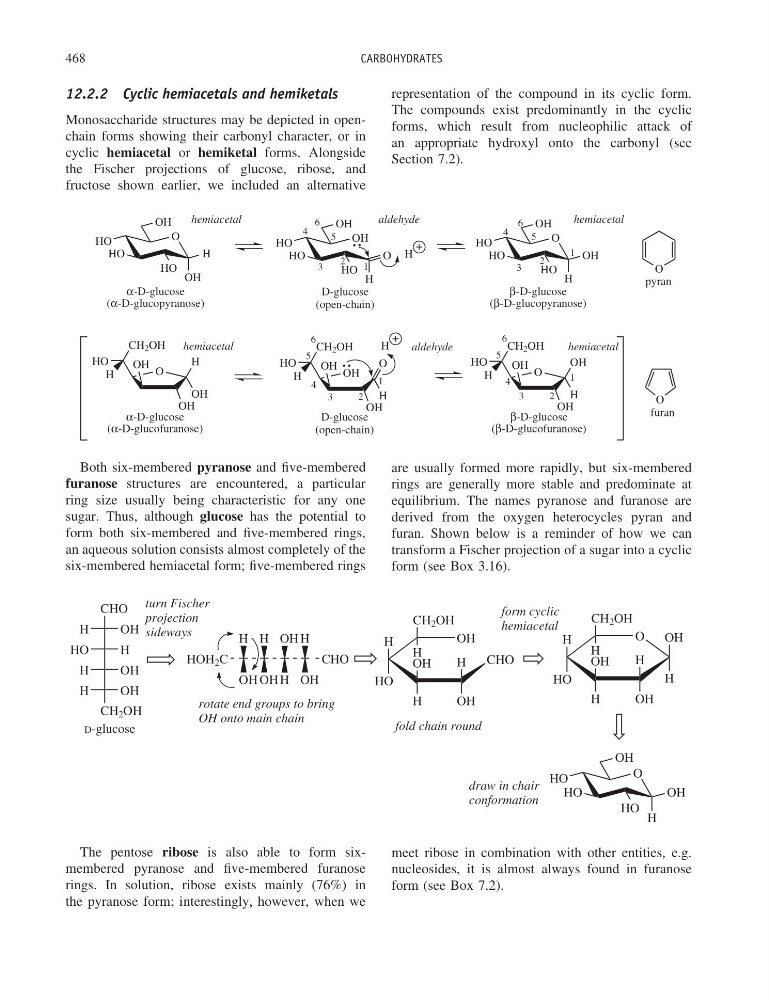
Monosaccharide structures may be depicted in openchain forms showing their carbonyl character, or in
cyclic hemiacetal or hemiketal forms. Alongside
the Fischer projections of glucose, ribose, and
fructose shown earlier, we included an alternative
representation of the compound in its cyclic form.
The compounds exist predominantly in the cyclic
forms, which result from nucleophilic attack of
an appropriate hydroxyl onto the carbonyl (see
Section 7.2).
O
HO
HO
OH
H
HO
OH
O
HO
HO
OH
OH
HO
H
OH
HO
HO
OH
H
HO
O
α-D-glucose
(α-D-glucopyranose)
β-D-glucose
(β-D-glucopyranose)
D-glucose
(open-chain)
3
4
5
6
1
2
3
4
5
6
1
2
hemiacetal
aldehyde
hemiacetal
O
O
pyran
furan
O
OH
H
HO
α-D-glucose
(α-D-glucofuranose)
β-D-glucose
(β-D-glucofuranose)
D-glucose
(open-chain)
1
5
3
2
4
6
hemiacetal
aldehyde
hemiacetal
OH
OH
CH 2 OH
OH
O
H
HO
1
5
3
2
4
6
OH
OH
CH 2 OH
O
H
OH
HO
OH
OH
CH 2 OH
H
H
H
H
H
Both six-membered pyranose and five-membered
furanose structures are encountered, a particular
ring size usually being characteristic for any one
sugar. Thus, although glucose has the potential to
form both six-membered and five-membered rings,
an aqueous solution consists almost completely of the
six-membered hemiacetal form; five-membered rings
are usually formed more rapidly, but six-membered
rings are generally more stable and predominate at
equilibrium. The names pyranose and furanose are
derived from the oxygen heterocycles pyran and
furan. Shown below is a reminder of how we can
transform a Fischer projection of a sugar into a cyclic
form (see Box 3.16).
CHO
OH
H
HO
H
H
OH
H
CH 2 OH
OH
D-glucose
CHO
OH
H
OH
H
H
OH
H
HOH 2 C
OH
H
CHO
OH
HO
H
OH
H
OH
CH 2 OH
H
H
O
HO
H
OH
H
OH
CH 2 OH
H
OH
H
O
HO
HO
OH
H
HO
OH
turn Fischer
projection
sideways
rotate end groups to bring
OH onto main chain
fold chain round
form cyclic
hemiacetal
draw in chair
conformation
The pentose ribose is also able to form sixmembered pyranose and five-membered furanose
rings. In solution, ribose exists mainly (76%) in
the pyranose form; interestingly, however, when we
meet ribose in combination with other entities, e.g.
nucleosides, it is almost always found in furanose
form (see Box 7.2).
CARBOHYDRATES
12.2.2 Cyclic hemiacetals and hemiketals
Monosaccharide structures may be depicted in openchain forms showing their carbonyl character, or in
cyclic hemiacetal or hemiketal forms. Alongside
the Fischer projections of glucose, ribose, and
fructose shown earlier, we included an alternative
representation of the compound in its cyclic form.
The compounds exist predominantly in the cyclic
forms, which result from nucleophilic attack of
an appropriate hydroxyl onto the carbonyl (see
Section 7.2).
O
HO
HO
OH
H
HO
OH
O
HO
HO
OH
OH
HO
H
OH
HO
HO
OH
H
HO
O
α-D-glucose
(α-D-glucopyranose)
β-D-glucose
(β-D-glucopyranose)
D-glucose
(open-chain)
3
4
5
6
1
2
3
4
5
6
1
2
hemiacetal
aldehyde
hemiacetal
O
O
pyran
furan
O
OH
H
HO
α-D-glucose
(α-D-glucofuranose)
β-D-glucose
(β-D-glucofuranose)
D-glucose
(open-chain)
1
5
3
2
4
6
hemiacetal
aldehyde
hemiacetal
OH
OH
CH 2 OH
OH
O
H
HO
1
5
3
2
4
6
OH
OH
CH 2 OH
O
H
OH
HO
OH
OH
CH 2 OH
H
H
H
H
H
Both six-membered pyranose and five-membered
furanose structures are encountered, a particular
ring size usually being characteristic for any one
sugar. Thus, although glucose has the potential to
form both six-membered and five-membered rings,
an aqueous solution consists almost completely of the
six-membered hemiacetal form; five-membered rings
are usually formed more rapidly, but six-membered
rings are generally more stable and predominate at
equilibrium. The names pyranose and furanose are
derived from the oxygen heterocycles pyran and
furan. Shown below is a reminder of how we can
transform a Fischer projection of a sugar into a cyclic
form (see Box 3.16).
CHO
OH
H
HO
H
H
OH
H
CH 2 OH
OH
D-glucose
CHO
OH
H
OH
H
H
OH
H
HOH 2 C
OH
H
CHO
OH
HO
H
OH
H
OH
CH 2 OH
H
H
O
HO
H
OH
H
OH
CH 2 OH
H
OH
H
O
HO
HO
OH
H
HO
OH
turn Fischer
projection
sideways
rotate end groups to bring
OH onto main chain
fold chain round
form cyclic
hemiacetal
draw in chair
conformation
The pentose ribose is also able to form sixmembered pyranose and five-membered furanose
rings. In solution, ribose exists mainly (76%) in
the pyranose form; interestingly, however, when we
meet ribose in combination with other entities, e.g.
nucleosides, it is almost always found in furanose
form (see Box 7.2).