

MONOSACCHARIDES
467
Note how the process may be modified to extend its versatility. Thus, using
14 C-labelled potassium cyanide with
D-erythrose yields a mixture of [114 C]-D-ribose and [114 C]-D-arabinose. The sequence could then be repeated on
the latter product, using unlabelled KCN, to give [214 C]-D-glucose.
12.2.1 Enolization and isomerization
In common with other aldehydes or ketones that have
hydrogen on the α-carbon, enolization is possible
(see Section 10.1), especially when sugars are treated
with base. The additional presence of a hydroxyl
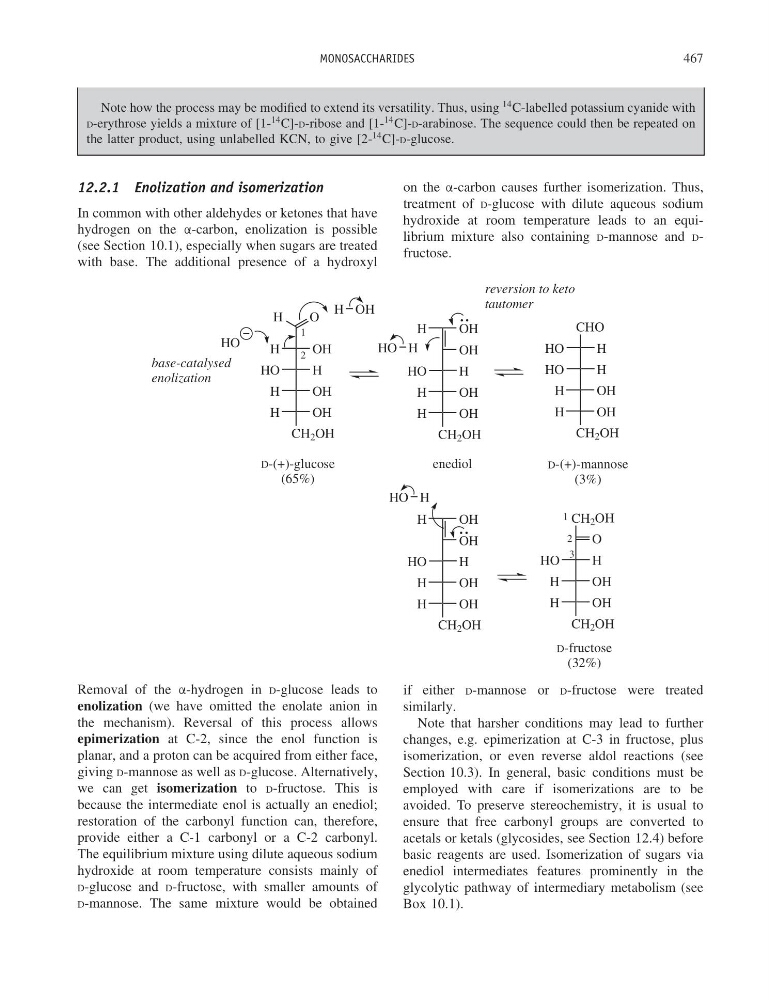
on the α-carbon causes further isomerization. Thus,
treatment of D-glucose with dilute aqueous sodium
hydroxide at room temperature leads to an equilibrium mixture also containing D-mannose and Dfructose.
OH
H
HO
H
H
OH
H
CH 2 OH
OH
D-(+)-glucose
(65%)
CHO
H
HO
HO
H
H
OH
H
CH 2 OH
OH
D-(+)-mannose
(3%)
CH 2 OH
O
HO
H
H
OH
H
OH
CH 2 OH
D-fructose
(32%)
OH
HO
H
H
OH
H
CH 2 OH
OH
H
O
HO
H OH
H
OH
H
HO
OH
HO
H
H
OH
H
CH 2 OH
OH
H
OH
H
HO
enediol
1
2
3
1
2
base-catalysed
enolization
reversion to keto
tautomer
Removal of the α-hydrogen in D-glucose leads to
enolization (we have omitted the enolate anion in
the mechanism). Reversal of this process allows
epimerization at C-2, since the enol function is
planar, and a proton can be acquired from either face,
giving D-mannose as well as D-glucose. Alternatively,
we can get isomerization to D-fructose. This is
because the intermediate enol is actually an enediol;
restoration of the carbonyl function can, therefore,
provide either a C-1 carbonyl or a C-2 carbonyl.
The equilibrium mixture using dilute aqueous sodium
hydroxide at room temperature consists mainly of
D-glucose and D-fructose, with smaller amounts of
D-mannose. The same mixture would be obtained
if either D-mannose or D-fructose were treated
similarly.
Note that harsher conditions may lead to further
changes, e.g. epimerization at C-3 in fructose, plus
isomerization, or even reverse aldol reactions (see
Section 10.3). In general, basic conditions must be
employed with care if isomerizations are to be
avoided. To preserve stereochemistry, it is usual to
ensure that free carbonyl groups are converted to
acetals or ketals (glycosides, see Section 12.4) before
basic reagents are used. Isomerization of sugars via
enediol intermediates features prominently in the
glycolytic pathway of intermediary metabolism (see
Box 10.1).
467
Note how the process may be modified to extend its versatility. Thus, using
14 C-labelled potassium cyanide with
D-erythrose yields a mixture of [114 C]-D-ribose and [114 C]-D-arabinose. The sequence could then be repeated on
the latter product, using unlabelled KCN, to give [214 C]-D-glucose.
12.2.1 Enolization and isomerization
In common with other aldehydes or ketones that have
hydrogen on the α-carbon, enolization is possible
(see Section 10.1), especially when sugars are treated
with base. The additional presence of a hydroxyl
on the α-carbon causes further isomerization. Thus,
treatment of D-glucose with dilute aqueous sodium
hydroxide at room temperature leads to an equilibrium mixture also containing D-mannose and Dfructose.
OH
H
HO
H
H
OH
H
CH 2 OH
OH
D-(+)-glucose
(65%)
CHO
H
HO
HO
H
H
OH
H
CH 2 OH
OH
D-(+)-mannose
(3%)
CH 2 OH
O
HO
H
H
OH
H
OH
CH 2 OH
D-fructose
(32%)
OH
HO
H
H
OH
H
CH 2 OH
OH
H
O
HO
H OH
H
OH
H
HO
OH
HO
H
H
OH
H
CH 2 OH
OH
H
OH
H
HO
enediol
1
2
3
1
2
base-catalysed
enolization
reversion to keto
tautomer
Removal of the α-hydrogen in D-glucose leads to
enolization (we have omitted the enolate anion in
the mechanism). Reversal of this process allows
epimerization at C-2, since the enol function is
planar, and a proton can be acquired from either face,
giving D-mannose as well as D-glucose. Alternatively,
we can get isomerization to D-fructose. This is
because the intermediate enol is actually an enediol;
restoration of the carbonyl function can, therefore,
provide either a C-1 carbonyl or a C-2 carbonyl.
The equilibrium mixture using dilute aqueous sodium
hydroxide at room temperature consists mainly of
D-glucose and D-fructose, with smaller amounts of
D-mannose. The same mixture would be obtained
if either D-mannose or D-fructose were treated
similarly.
Note that harsher conditions may lead to further
changes, e.g. epimerization at C-3 in fructose, plus
isomerization, or even reverse aldol reactions (see
Section 10.3). In general, basic conditions must be
employed with care if isomerizations are to be
avoided. To preserve stereochemistry, it is usual to
ensure that free carbonyl groups are converted to
acetals or ketals (glycosides, see Section 12.4) before
basic reagents are used. Isomerization of sugars via
enediol intermediates features prominently in the
glycolytic pathway of intermediary metabolism (see
Box 10.1).