

466
CARBOHYDRATES
Box 12.1 (continued)
O
H
HO
H
H
OH
H
OH
CH 2 OH
D-arabinose
14 CN
H 2 O
K 14 CN HO
H
H
OH
H
OH
CH 2 OH
H
OH
14 CN
HO
H
H
OH
H
OH
CH 2 OH
HO
H
14 CN
+
H +
HO
H
H
OH
H
OH
CH 2 OH
H
OH
14 CO 2 H
HO
H
H
OH
H
OH
CH 2 OH
HO
H
14 CO 2 H
+
nucleophilic addition of cyanide to
either face of planar carbonyl
produces epimeric cyanohydrins
hydrolysis of nitrile group
yields carboxylic acid
heat
O
HO
OH
O
HO
formation of
γ-lactone
O
O
OH
HOH 2 C
HOH 2 C
OH
OH
+
NaBH 4
HO
H
H
OH
H
OH
CH 2 OH
H
OH
14 CHO
HO
H
H
OH
H
OH
CH 2 OH
HO
H
14 CHO
+
[1- 14 C]-D-glucose
[1- 14 C]-D-mannose
* =
14 C
*
*
O
HO
OH
O
HO
OH
OH
OH
HOH 2 C
HOH 2 C
OH
OH
+
*
*
borohydride reduction of
lactone gives hemiacetals
OH means configuration not specified;
a mixture of both configurations
(see Section 12.2.3)
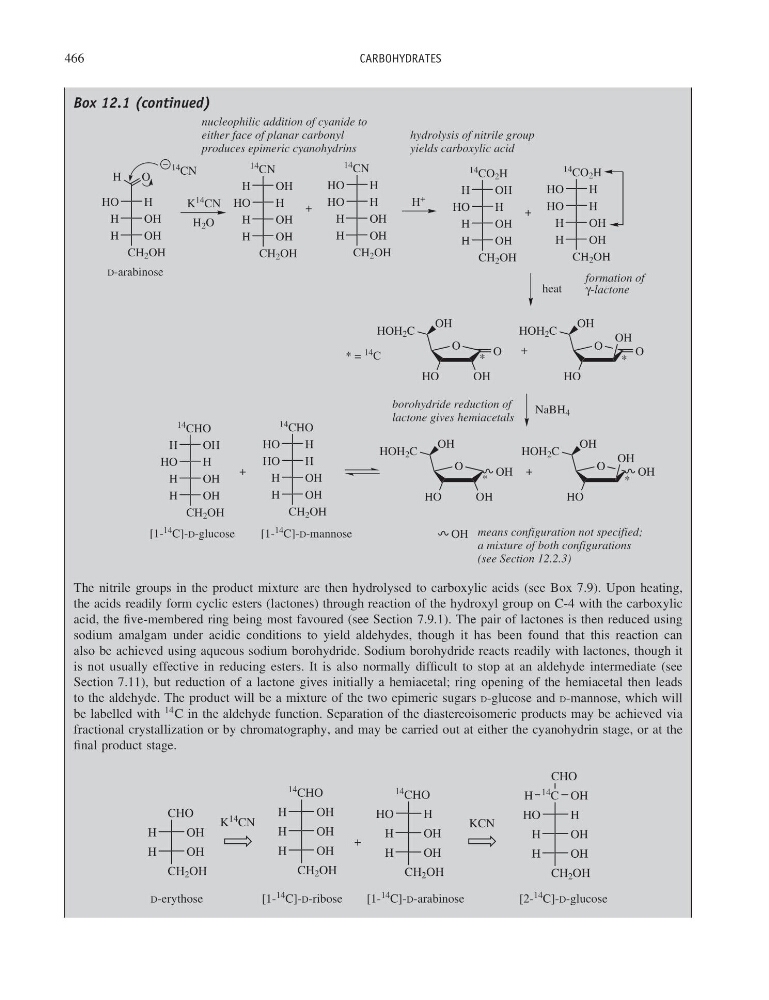
The nitrile groups in the product mixture are then hydrolysed to carboxylic acids (see Box 7.9). Upon heating,
the acids readily form cyclic esters (lactones) through reaction of the hydroxyl group on C-4 with the carboxylic
acid, the five-membered ring being most favoured (see Section 7.9.1). The pair of lactones is then reduced using
sodium amalgam under acidic conditions to yield aldehydes, though it has been found that this reaction can
also be achieved using aqueous sodium borohydride. Sodium borohydride reacts readily with lactones, though it
is not usually effective in reducing esters. It is also normally difficult to stop at an aldehyde intermediate (see
Section 7.11), but reduction of a lactone gives initially a hemiacetal; ring opening of the hemiacetal then leads
to the aldehyde. The product will be a mixture of the two epimeric sugars D-glucose and D-mannose, which will
be labelled with
14 C in the aldehyde function. Separation of the diastereoisomeric products may be achieved via
fractional crystallization or by chromatography, and may be carried out at either the cyanohydrin stage, or at the
final product stage.
CHO
H
OH
H
OH
CH 2 OH
D-erythose
K 14 CN
14
CHO
HO
H
H
OH
H
OH
CH 2 OH
[1- 14 C]-D-arabinose
KCN
14 C
HO
H
H
OH
H
OH
CH 2 OH
H
OH
CHO
[2- 14 C]-D-glucose
14 CHO
H
OH
H
OH
H
OH
CH 2 OH
[1- 14 C]-D-ribose
+
CARBOHYDRATES
Box 12.1 (continued)
O
H
HO
H
H
OH
H
OH
CH 2 OH
D-arabinose
14 CN
H 2 O
K 14 CN HO
H
H
OH
H
OH
CH 2 OH
H
OH
14 CN
HO
H
H
OH
H
OH
CH 2 OH
HO
H
14 CN
+
H +
HO
H
H
OH
H
OH
CH 2 OH
H
OH
14 CO 2 H
HO
H
H
OH
H
OH
CH 2 OH
HO
H
14 CO 2 H
+
nucleophilic addition of cyanide to
either face of planar carbonyl
produces epimeric cyanohydrins
hydrolysis of nitrile group
yields carboxylic acid
heat
O
HO
OH
O
HO
formation of
γ-lactone
O
O
OH
HOH 2 C
HOH 2 C
OH
OH
+
NaBH 4
HO
H
H
OH
H
OH
CH 2 OH
H
OH
14 CHO
HO
H
H
OH
H
OH
CH 2 OH
HO
H
14 CHO
+
[1- 14 C]-D-glucose
[1- 14 C]-D-mannose
* =
14 C
*
*
O
HO
OH
O
HO
OH
OH
OH
HOH 2 C
HOH 2 C
OH
OH
+
*
*
borohydride reduction of
lactone gives hemiacetals
OH means configuration not specified;
a mixture of both configurations
(see Section 12.2.3)
The nitrile groups in the product mixture are then hydrolysed to carboxylic acids (see Box 7.9). Upon heating,
the acids readily form cyclic esters (lactones) through reaction of the hydroxyl group on C-4 with the carboxylic
acid, the five-membered ring being most favoured (see Section 7.9.1). The pair of lactones is then reduced using
sodium amalgam under acidic conditions to yield aldehydes, though it has been found that this reaction can
also be achieved using aqueous sodium borohydride. Sodium borohydride reacts readily with lactones, though it
is not usually effective in reducing esters. It is also normally difficult to stop at an aldehyde intermediate (see
Section 7.11), but reduction of a lactone gives initially a hemiacetal; ring opening of the hemiacetal then leads
to the aldehyde. The product will be a mixture of the two epimeric sugars D-glucose and D-mannose, which will
be labelled with
14 C in the aldehyde function. Separation of the diastereoisomeric products may be achieved via
fractional crystallization or by chromatography, and may be carried out at either the cyanohydrin stage, or at the
final product stage.
CHO
H
OH
H
OH
CH 2 OH
D-erythose
K 14 CN
14
CHO
HO
H
H
OH
H
OH
CH 2 OH
[1- 14 C]-D-arabinose
KCN
14 C
HO
H
H
OH
H
OH
CH 2 OH
H
OH
CHO
[2- 14 C]-D-glucose
14 CHO
H
OH
H
OH
H
OH
CH 2 OH
[1- 14 C]-D-ribose
+