

MONOSACCHARIDES
465
CHO
H
OH
CH 2 OH
CHO
OH
H
HO
H
H
OH
H
CH 2 OH
OH
D-(+)-glyceraldehyde
D-(+)-glucose
CHO
CH 2 OH
OH
OH
H
H
D-(–)-erythrose
CHO
CH 2 OH
H
OH
H
HO
D-(–)-threose
CH 2 OH
OH
OH
H
H
D-(–)-ribose
CHO
H
OH
CHO
H
HO
H
OH
H
CH 2 OH
OH
D-(–)-arabinose
CHO
OH
H
HO
H
H
CH 2 OH
OH
D-(+)-xylose
CHO
H
HO
HO
H
H
CH 2 OH
OH
D-(–)-lyxose
CHO
H
HO
HO
H
H
OH
H
CH 2 OH
OH
D-(+)-mannose
CH 2 OH
OH
OH
H
H
D-(+)-allose
H
OH
CHO
H
OH
CH 2 OH
OH
OH
H
H
D-(+)-altrose
H
OH
CHO
HO
H
CHO
OH
H
HO
H
HO
H
H
CH 2 OH
OH
D-(+)-galactose
CHO
H
HO
HO
H
HO
H
H
CH 2 OH
OH
D-(+)-talose
CH 2 OH
H
OH
H
HO
D-(–)-gulose
H
OH
CHO
H
OH
CH 2 OH
H
OH
H
HO
D-(+)-idose
H
OH
CHO
HO
H
1
3
1
4
1
5
1
6
CHO
HO
H
CH 2 OH
L-(–)-glyceraldehyde
CHO
CH 2 OH
HO
HO
H
H
L-(+)-erythrose
CHO
CH 2 OH
H
HO
H
OH
L-(+)-threose
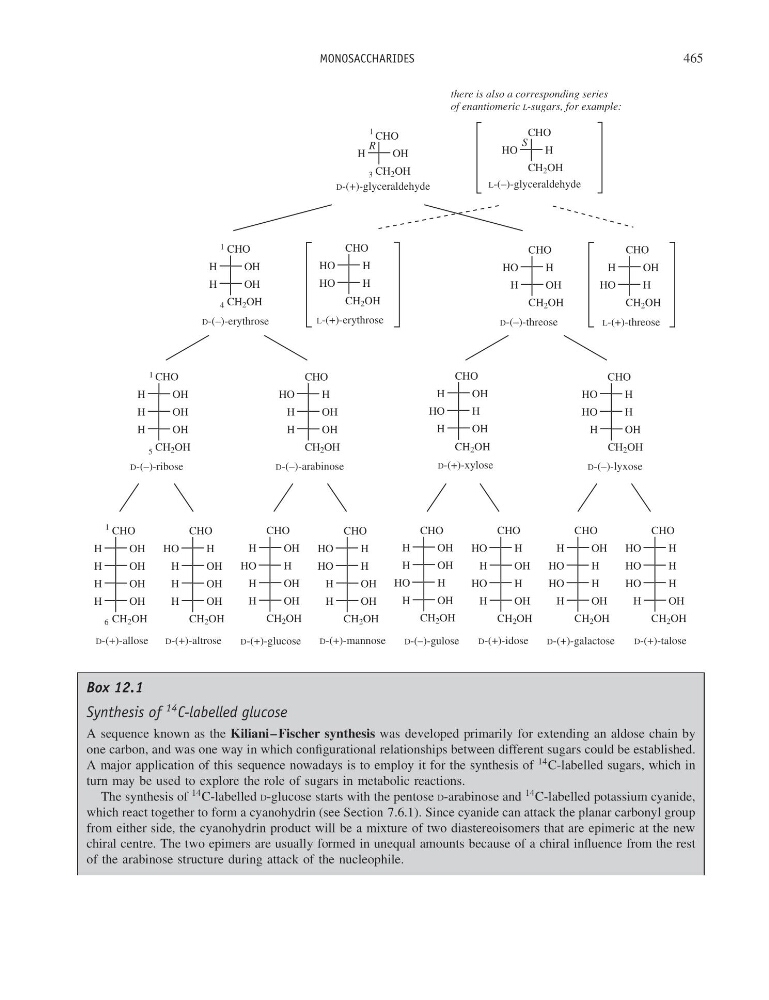
there is also a corresponding series
of enantiomeric L-sugars, for example:
R
S
Box 12.1
Synthesis of
14 C-labelled glucose
A sequence known as the Kiliani–Fischer synthesis was developed primarily for extending an aldose chain by
one carbon, and was one way in which configurational relationships between different sugars could be established.
A major application of this sequence nowadays is to employ it for the synthesis of
14 C-labelled sugars, which in
turn may be used to explore the role of sugars in metabolic reactions.
The synthesis of
14 C-labelled D-glucose starts with the pentose D-arabinose and
14 C-labelled potassium cyanide,
which react together to form a cyanohydrin (see Section 7.6.1). Since cyanide can attack the planar carbonyl group
from either side, the cyanohydrin product will be a mixture of two diastereoisomers that are epimeric at the new
chiral centre. The two epimers are usually formed in unequal amounts because of a chiral influence from the rest
of the arabinose structure during attack of the nucleophile.
465
CHO
H
OH
CH 2 OH
CHO
OH
H
HO
H
H
OH
H
CH 2 OH
OH
D-(+)-glyceraldehyde
D-(+)-glucose
CHO
CH 2 OH
OH
OH
H
H
D-(–)-erythrose
CHO
CH 2 OH
H
OH
H
HO
D-(–)-threose
CH 2 OH
OH
OH
H
H
D-(–)-ribose
CHO
H
OH
CHO
H
HO
H
OH
H
CH 2 OH
OH
D-(–)-arabinose
CHO
OH
H
HO
H
H
CH 2 OH
OH
D-(+)-xylose
CHO
H
HO
HO
H
H
CH 2 OH
OH
D-(–)-lyxose
CHO
H
HO
HO
H
H
OH
H
CH 2 OH
OH
D-(+)-mannose
CH 2 OH
OH
OH
H
H
D-(+)-allose
H
OH
CHO
H
OH
CH 2 OH
OH
OH
H
H
D-(+)-altrose
H
OH
CHO
HO
H
CHO
OH
H
HO
H
HO
H
H
CH 2 OH
OH
D-(+)-galactose
CHO
H
HO
HO
H
HO
H
H
CH 2 OH
OH
D-(+)-talose
CH 2 OH
H
OH
H
HO
D-(–)-gulose
H
OH
CHO
H
OH
CH 2 OH
H
OH
H
HO
D-(+)-idose
H
OH
CHO
HO
H
1
3
1
4
1
5
1
6
CHO
HO
H
CH 2 OH
L-(–)-glyceraldehyde
CHO
CH 2 OH
HO
HO
H
H
L-(+)-erythrose
CHO
CH 2 OH
H
HO
H
OH
L-(+)-threose
there is also a corresponding series
of enantiomeric L-sugars, for example:
R
S
Box 12.1
Synthesis of
14 C-labelled glucose
A sequence known as the Kiliani–Fischer synthesis was developed primarily for extending an aldose chain by
one carbon, and was one way in which configurational relationships between different sugars could be established.
A major application of this sequence nowadays is to employ it for the synthesis of
14 C-labelled sugars, which in
turn may be used to explore the role of sugars in metabolic reactions.
The synthesis of
14 C-labelled D-glucose starts with the pentose D-arabinose and
14 C-labelled potassium cyanide,
which react together to form a cyanohydrin (see Section 7.6.1). Since cyanide can attack the planar carbonyl group
from either side, the cyanohydrin product will be a mixture of two diastereoisomers that are epimeric at the new
chiral centre. The two epimers are usually formed in unequal amounts because of a chiral influence from the rest
of the arabinose structure during attack of the nucleophile.