

464
CARBOHYDRATES
CHO
OH
H
HO
H
H
OH
H
OH
CH 2 OH
CHO
OH
H
OH
H
CH 2 OH
OH
D-glucose
H
D-ribose
O
HO
HO
OH
HO
OH
O
HO
OH
HO
OH
β-D-glucose
(β-D-Glc)
β-D-ribose
(β-D-Rib)
3
4
5
6
1
2
3
4
5
1
2
R
R
R
R
O
HO
HO OH
OH
HO
β-D-fructose
(β-D-Fru)
CH 2 OH
O
HO
H
H
OH
H
OH
CH 2 OH
D-fructose
CH 2 OH
O
H
OH
H
CH 2 OH
OH
D-ribulose
CH 2 OH
O
HO
H
H
CH 2 OH
OH
D-xylulose
3
4
5
6
1
2
3
4
5
1
2
3
4
5
1
2
R
R
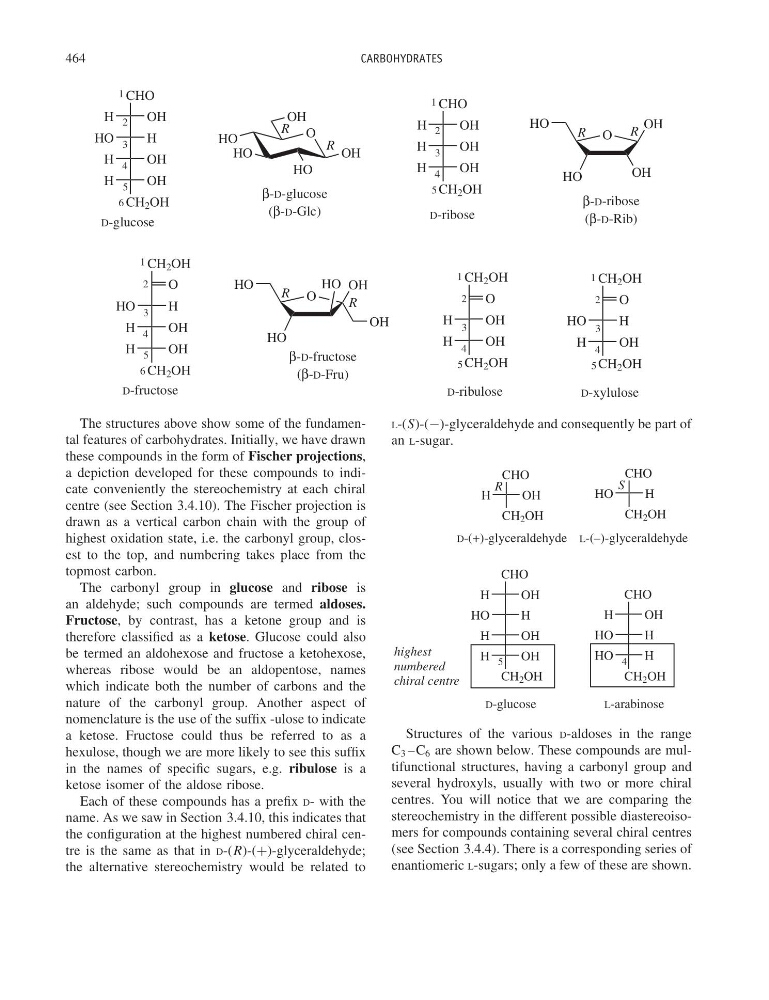
The structures above show some of the fundamental features of carbohydrates. Initially, we have drawn
these compounds in the form of Fischer projections,
a depiction developed for these compounds to indicate conveniently the stereochemistry at each chiral
centre (see Section 3.4.10). The Fischer projection is
drawn as a vertical carbon chain with the group of
highest oxidation state, i.e. the carbonyl group, closest to the top, and numbering takes place from the
topmost carbon.
The carbonyl group in glucose and ribose is
an aldehyde; such compounds are termed aldoses.
Fructose, by contrast, has a ketone group and is
therefore classified as a ketose. Glucose could also
be termed an aldohexose and fructose a ketohexose,
whereas ribose would be an aldopentose, names
which indicate both the number of carbons and the
nature of the carbonyl group. Another aspect of
nomenclature is the use of the suffix -ulose to indicate
a ketose. Fructose could thus be referred to as a
hexulose, though we are more likely to see this suffix
in the names of specific sugars, e.g. ribulose is a
ketose isomer of the aldose ribose.
Each of these compounds has a prefix D- with the
name. As we saw in Section 3.4.10, this indicates that
the configuration at the highest numbered chiral centre is the same as that in D-(R)-(+)-glyceraldehyde;
the alternative stereochemistry would be related to
L-(S)-(−)-glyceraldehyde and consequently be part of
an L-sugar.
CHO
H
OH
CH 2 OH
CHO
HO
H
CH 2 OH
CHO
OH
H
HO
H
H
OH
H
CH 2 OH
OH
CHO
OH
H
HO
H
HO
CH 2 OH
H
D-(+)-glyceraldehyde L-(–)-glyceraldehyde
L-arabinose
D-glucose
5
4
highest
numbered
chiral centre
S
R
Structures of the various D-aldoses in the range
C 3 –C 6 are shown below. These compounds are multifunctional structures, having a carbonyl group and
several hydroxyls, usually with two or more chiral
centres. You will notice that we are comparing the
stereochemistry in the different possible diastereoisomers for compounds containing several chiral centres
(see Section 3.4.4). There is a corresponding series of
enantiomeric L-sugars; only a few of these are shown.
CARBOHYDRATES
CHO
OH
H
HO
H
H
OH
H
OH
CH 2 OH
CHO
OH
H
OH
H
CH 2 OH
OH
D-glucose
H
D-ribose
O
HO
HO
OH
HO
OH
O
HO
OH
HO
OH
β-D-glucose
(β-D-Glc)
β-D-ribose
(β-D-Rib)
3
4
5
6
1
2
3
4
5
1
2
R
R
R
R
O
HO
HO OH
OH
HO
β-D-fructose
(β-D-Fru)
CH 2 OH
O
HO
H
H
OH
H
OH
CH 2 OH
D-fructose
CH 2 OH
O
H
OH
H
CH 2 OH
OH
D-ribulose
CH 2 OH
O
HO
H
H
CH 2 OH
OH
D-xylulose
3
4
5
6
1
2
3
4
5
1
2
3
4
5
1
2
R
R
The structures above show some of the fundamental features of carbohydrates. Initially, we have drawn
these compounds in the form of Fischer projections,
a depiction developed for these compounds to indicate conveniently the stereochemistry at each chiral
centre (see Section 3.4.10). The Fischer projection is
drawn as a vertical carbon chain with the group of
highest oxidation state, i.e. the carbonyl group, closest to the top, and numbering takes place from the
topmost carbon.
The carbonyl group in glucose and ribose is
an aldehyde; such compounds are termed aldoses.
Fructose, by contrast, has a ketone group and is
therefore classified as a ketose. Glucose could also
be termed an aldohexose and fructose a ketohexose,
whereas ribose would be an aldopentose, names
which indicate both the number of carbons and the
nature of the carbonyl group. Another aspect of
nomenclature is the use of the suffix -ulose to indicate
a ketose. Fructose could thus be referred to as a
hexulose, though we are more likely to see this suffix
in the names of specific sugars, e.g. ribulose is a
ketose isomer of the aldose ribose.
Each of these compounds has a prefix D- with the
name. As we saw in Section 3.4.10, this indicates that
the configuration at the highest numbered chiral centre is the same as that in D-(R)-(+)-glyceraldehyde;
the alternative stereochemistry would be related to
L-(S)-(−)-glyceraldehyde and consequently be part of
an L-sugar.
CHO
H
OH
CH 2 OH
CHO
HO
H
CH 2 OH
CHO
OH
H
HO
H
H
OH
H
CH 2 OH
OH
CHO
OH
H
HO
H
HO
CH 2 OH
H
D-(+)-glyceraldehyde L-(–)-glyceraldehyde
L-arabinose
D-glucose
5
4
highest
numbered
chiral centre
S
R
Structures of the various D-aldoses in the range
C 3 –C 6 are shown below. These compounds are multifunctional structures, having a carbonyl group and
several hydroxyls, usually with two or more chiral
centres. You will notice that we are comparing the
stereochemistry in the different possible diastereoisomers for compounds containing several chiral centres
(see Section 3.4.4). There is a corresponding series of
enantiomeric L-sugars; only a few of these are shown.