

458
HETEROCYCLES
We shall now look at some synthetic procedures
that merit the descriptor ‘classic’ because of their
general application, and their longevity – some have
been around for more than 100 years. Do not worry
about remembering the names: these commemorate
the originators, and we should instead concentrate
on the chemistry, which we shall see is usually a
combination of processes we have already met.
11.10.1 Hantzsch pyridine synthesis
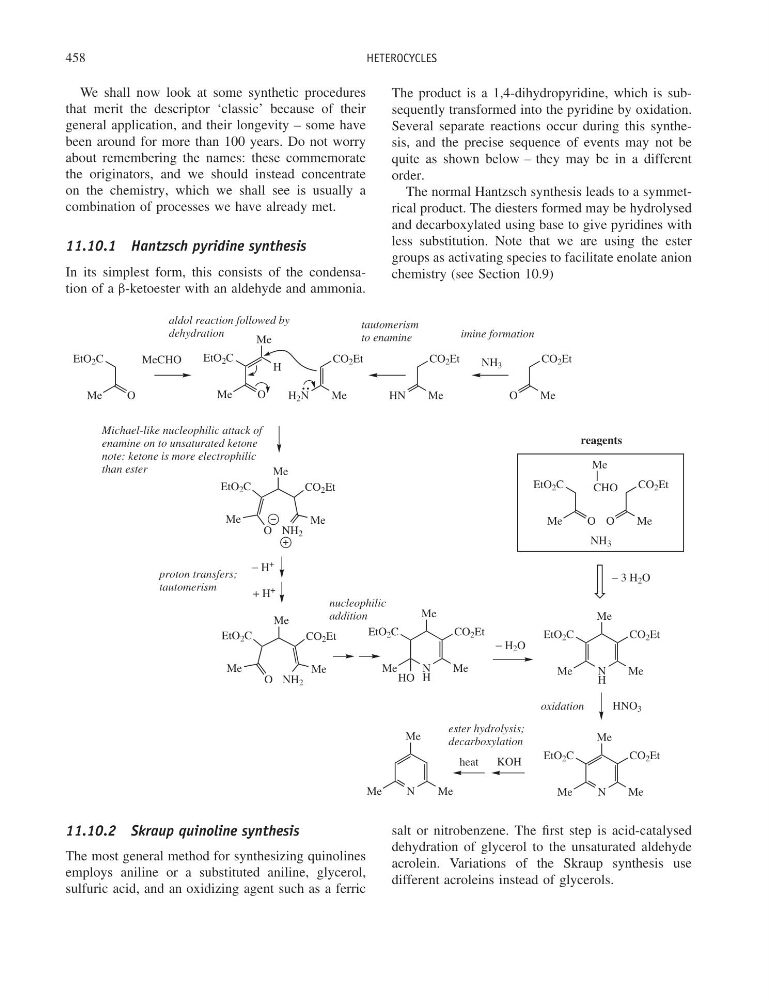
In its simplest form, this consists of the condensation of a β-ketoester with an aldehyde and ammonia.
The product is a 1,4-dihydropyridine, which is subsequently transformed into the pyridine by oxidation.
Several separate reactions occur during this synthesis, and the precise sequence of events may not be
quite as shown below – they may be in a different
order.
The normal Hantzsch synthesis leads to a symmetrical product. The diesters formed may be hydrolysed
and decarboxylated using base to give pyridines with
less substitution. Note that we are using the ester
groups as activating species to facilitate enolate anion
chemistry (see Section 10.9)
Me
EtO 2 C
O
MeCHO
Me
O
EtO 2 C
H
Me
NH 3
aldol reaction followed by
dehydration
imine formation
O
Me
CO 2 Et
HN
Me
CO 2 Et
H 2 N
Me
CO 2 Et
tautomerism
to enamine
Michael-like nucleophilic attack of
enamine on to unsaturated ketone
note: ketone is more electrophilic
than ester
O NH 2
Me
CO 2 Et
Me
Me
EtO 2 C
O NH 2
Me
CO 2 Et
Me
Me
EtO 2 C
N
H
Me
CO 2 Et
Me
Me
HO
EtO 2 C
N
H
Me
CO 2 Et
Me
Me
EtO 2 C
N
Me
CO 2 Et
Me
Me
EtO 2 C
proton transfers;
tautomerism
HNO 3
oxidation
N
Me
Me
Me
ester hydrolysis;
decarboxylation
KOH
heat
nucleophilic
addition
− H 2 O
− H
+
+ H
+
Me
EtO 2 C
O O
Me
CO 2 Et
Me
CHO
NH 3
− 3 H 2 O
reagents
11.10.2 Skraup quinoline synthesis
The most general method for synthesizing quinolines
employs aniline or a substituted aniline, glycerol,
sulfuric acid, and an oxidizing agent such as a ferric
salt or nitrobenzene. The first step is acid-catalysed
dehydration of glycerol to the unsaturated aldehyde
acrolein. Variations of the Skraup synthesis use
different acroleins instead of glycerols.
HETEROCYCLES
We shall now look at some synthetic procedures
that merit the descriptor ‘classic’ because of their
general application, and their longevity – some have
been around for more than 100 years. Do not worry
about remembering the names: these commemorate
the originators, and we should instead concentrate
on the chemistry, which we shall see is usually a
combination of processes we have already met.
11.10.1 Hantzsch pyridine synthesis
In its simplest form, this consists of the condensation of a β-ketoester with an aldehyde and ammonia.
The product is a 1,4-dihydropyridine, which is subsequently transformed into the pyridine by oxidation.
Several separate reactions occur during this synthesis, and the precise sequence of events may not be
quite as shown below – they may be in a different
order.
The normal Hantzsch synthesis leads to a symmetrical product. The diesters formed may be hydrolysed
and decarboxylated using base to give pyridines with
less substitution. Note that we are using the ester
groups as activating species to facilitate enolate anion
chemistry (see Section 10.9)
Me
EtO 2 C
O
MeCHO
Me
O
EtO 2 C
H
Me
NH 3
aldol reaction followed by
dehydration
imine formation
O
Me
CO 2 Et
HN
Me
CO 2 Et
H 2 N
Me
CO 2 Et
tautomerism
to enamine
Michael-like nucleophilic attack of
enamine on to unsaturated ketone
note: ketone is more electrophilic
than ester
O NH 2
Me
CO 2 Et
Me
Me
EtO 2 C
O NH 2
Me
CO 2 Et
Me
Me
EtO 2 C
N
H
Me
CO 2 Et
Me
Me
HO
EtO 2 C
N
H
Me
CO 2 Et
Me
Me
EtO 2 C
N
Me
CO 2 Et
Me
Me
EtO 2 C
proton transfers;
tautomerism
HNO 3
oxidation
N
Me
Me
Me
ester hydrolysis;
decarboxylation
KOH
heat
nucleophilic
addition
− H 2 O
− H
+
+ H
+
Me
EtO 2 C
O O
Me
CO 2 Et
Me
CHO
NH 3
− 3 H 2 O
reagents
11.10.2 Skraup quinoline synthesis
The most general method for synthesizing quinolines
employs aniline or a substituted aniline, glycerol,
sulfuric acid, and an oxidizing agent such as a ferric
salt or nitrobenzene. The first step is acid-catalysed
dehydration of glycerol to the unsaturated aldehyde
acrolein. Variations of the Skraup synthesis use
different acroleins instead of glycerols.