

SOME CLASSIC AROMATIC HETEROCYCLE SYNTHESES
457
11.10 Some classic aromatic
heterocycle syntheses
Our study of heterocyclic compounds is directed primarily to an understanding of their reactivity and
importance in biochemistry and medicine. The synthesis of aromatic heterocycles is not, therefore, a
main theme, but it is useful to consider just a
few examples to underline the application of reactions we have considered in earlier chapters. From
the beginning, we should appreciate that the synthesis of substituted heterocycles is probably not
best achieved by carrying out substitution reactions
on the simple heterocycle. It is often much easier and more convenient to design the synthesis
so that the heterocycle already carries the required
substituents, or has easily modified functions. We
can consider two main approaches for heterocycle synthesis, here using pyridine and pyrrole as
targets.
N
N
N
N
H
N
N
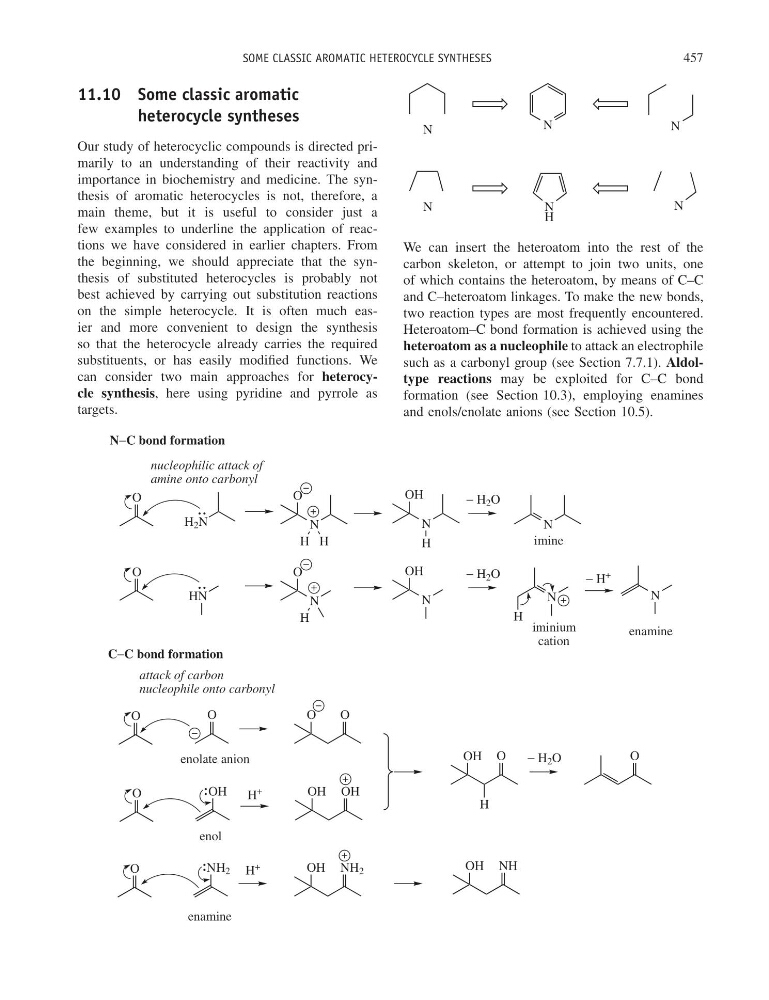
We can insert the heteroatom into the rest of the
carbon skeleton, or attempt to join two units, one
of which contains the heteroatom, by means of C–C
and C–heteroatom linkages. To make the new bonds,
two reaction types are most frequently encountered.
Heteroatom–C bond formation is achieved using the
heteroatom as a nucleophile to attack an electrophile
such as a carbonyl group (see Section 7.7.1). Aldoltype reactions may be exploited for C–C bond
formation (see Section 10.3), employing enamines
and enols/enolate anions (see Section 10.5).
O
H 2 N
N
O
H
H
N
OH
H
N
N
imine
enamine
O
O
O
O
− H 2 O
OH O
H
− H 2 O
O
O
OH
OH OH
H
+
O
NH 2
OH NH 2
H
+
enol
enolate anion
enamine
OH NH
O
HN
N
O
H
N
OH
− H 2 O
N
iminium
cation
H
− H
+
N−C bond formation
C−C bond formation
nucleophilic attack of
amine onto carbonyl
attack of carbon
nucleophile onto carbonyl
457
11.10 Some classic aromatic
heterocycle syntheses
Our study of heterocyclic compounds is directed primarily to an understanding of their reactivity and
importance in biochemistry and medicine. The synthesis of aromatic heterocycles is not, therefore, a
main theme, but it is useful to consider just a
few examples to underline the application of reactions we have considered in earlier chapters. From
the beginning, we should appreciate that the synthesis of substituted heterocycles is probably not
best achieved by carrying out substitution reactions
on the simple heterocycle. It is often much easier and more convenient to design the synthesis
so that the heterocycle already carries the required
substituents, or has easily modified functions. We
can consider two main approaches for heterocycle synthesis, here using pyridine and pyrrole as
targets.
N
N
N
N
H
N
N
We can insert the heteroatom into the rest of the
carbon skeleton, or attempt to join two units, one
of which contains the heteroatom, by means of C–C
and C–heteroatom linkages. To make the new bonds,
two reaction types are most frequently encountered.
Heteroatom–C bond formation is achieved using the
heteroatom as a nucleophile to attack an electrophile
such as a carbonyl group (see Section 7.7.1). Aldoltype reactions may be exploited for C–C bond
formation (see Section 10.3), employing enamines
and enols/enolate anions (see Section 10.5).
O
H 2 N
N
O
H
H
N
OH
H
N
N
imine
enamine
O
O
O
O
− H 2 O
OH O
H
− H 2 O
O
O
OH
OH OH
H
+
O
NH 2
OH NH 2
H
+
enol
enolate anion
enamine
OH NH
O
HN
N
O
H
N
OH
− H 2 O
N
iminium
cation
H
− H
+
N−C bond formation
C−C bond formation
nucleophilic attack of
amine onto carbonyl
attack of carbon
nucleophile onto carbonyl