

456
HETEROCYCLES
Box 11.14 (continued)
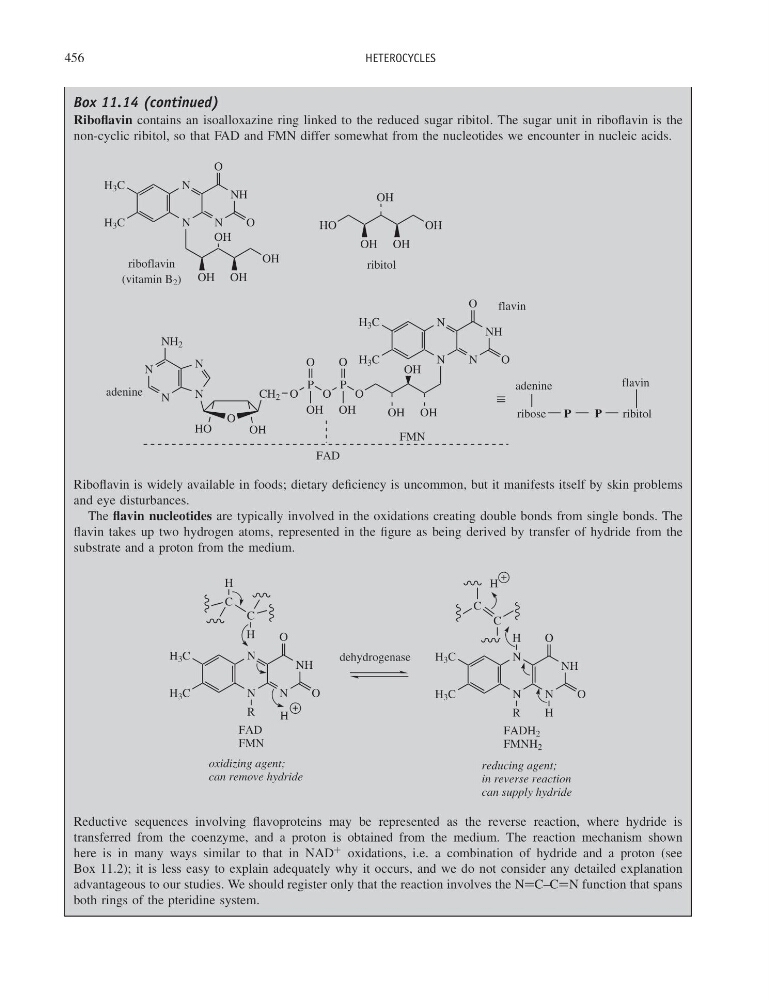
Riboflavin contains an isoalloxazine ring linked to the reduced sugar ribitol. The sugar unit in riboflavin is the
non-cyclic ribitol, so that FAD and FMN differ somewhat from the nucleotides we encounter in nucleic acids.
≡
N
N
N
NH
H 3 C
H 3 C
O
O
OH
OH OH
OH
riboflavin
(vitamin B 2 )
OH
OH OH
ribitol
OH
HO
N
N
N
NH 2
HO
OH
O
N
N
N
N
NH
H 3 C
H 3 C
O
O
OH OH
OH
CH 2
FMN
adenine
flavin
adenine
ribose
ribitol
flavin
O
P
O
O
P
O
O
OH OH
FAD
P
P
Riboflavin is widely available in foods; dietary deficiency is uncommon, but it manifests itself by skin problems
and eye disturbances.
The flavin nucleotides are typically involved in the oxidations creating double bonds from single bonds. The
flavin takes up two hydrogen atoms, represented in the figure as being derived by transfer of hydride from the
substrate and a proton from the medium.
N
N
N
NH
H 3 C
H 3 C
O
O
N
N
N
NH
H 3 C
H 3 C
O
O
R
R
H
H
C
C
H
H
C
C
FAD
FMN
FADH 2
FMNH 2
dehydrogenase
reducing agent;
in reverse reaction
can supply hydride
oxidizing agent;
can remove hydride
H
H
Reductive sequences involving flavoproteins may be represented as the reverse reaction, where hydride is
transferred from the coenzyme, and a proton is obtained from the medium. The reaction mechanism shown
here is in many ways similar to that in NAD
+ oxidations, i.e. a combination of hydride and a proton (see
Box 11.2); it is less easy to explain adequately why it occurs, and we do not consider any detailed explanation
advantageous to our studies. We should register only that the reaction involves the N=C–C=N function that spans
both rings of the pteridine system.
HETEROCYCLES
Box 11.14 (continued)
Riboflavin contains an isoalloxazine ring linked to the reduced sugar ribitol. The sugar unit in riboflavin is the
non-cyclic ribitol, so that FAD and FMN differ somewhat from the nucleotides we encounter in nucleic acids.
≡
N
N
N
NH
H 3 C
H 3 C
O
O
OH
OH OH
OH
riboflavin
(vitamin B 2 )
OH
OH OH
ribitol
OH
HO
N
N
N
NH 2
HO
OH
O
N
N
N
N
NH
H 3 C
H 3 C
O
O
OH OH
OH
CH 2
FMN
adenine
flavin
adenine
ribose
ribitol
flavin
O
P
O
O
P
O
O
OH OH
FAD
P
P
Riboflavin is widely available in foods; dietary deficiency is uncommon, but it manifests itself by skin problems
and eye disturbances.
The flavin nucleotides are typically involved in the oxidations creating double bonds from single bonds. The
flavin takes up two hydrogen atoms, represented in the figure as being derived by transfer of hydride from the
substrate and a proton from the medium.
N
N
N
NH
H 3 C
H 3 C
O
O
N
N
N
NH
H 3 C
H 3 C
O
O
R
R
H
H
C
C
H
H
C
C
FAD
FMN
FADH 2
FMNH 2
dehydrogenase
reducing agent;
in reverse reaction
can supply hydride
oxidizing agent;
can remove hydride
H
H
Reductive sequences involving flavoproteins may be represented as the reverse reaction, where hydride is
transferred from the coenzyme, and a proton is obtained from the medium. The reaction mechanism shown
here is in many ways similar to that in NAD
+ oxidations, i.e. a combination of hydride and a proton (see
Box 11.2); it is less easy to explain adequately why it occurs, and we do not consider any detailed explanation
advantageous to our studies. We should register only that the reaction involves the N=C–C=N function that spans
both rings of the pteridine system.