

SOME CLASSIC AROMATIC HETEROCYCLE SYNTHESES
459
OH
OH
OH
glycerol
H 2 SO 4
O
acrolein
(propenal)
NH 2
OH
H
+
Michael-like nucleophilic
addition onto unsaturated
aldehyde
acid-catalysed
dehydration
N
OH
H H
− H +
N
H
O
N
H
OH
H +
N
H
OH
H
N
OH
H
− H
+
− H 2 O
N
H
N
O
proton loss and
tautomerism of enol
electrophilic cyclization,
promoted by amino
susbstituent
acid-catalysed
dehydration
oxidation of
dihydroquinoline
to quinoline
NH 2
O
reagents
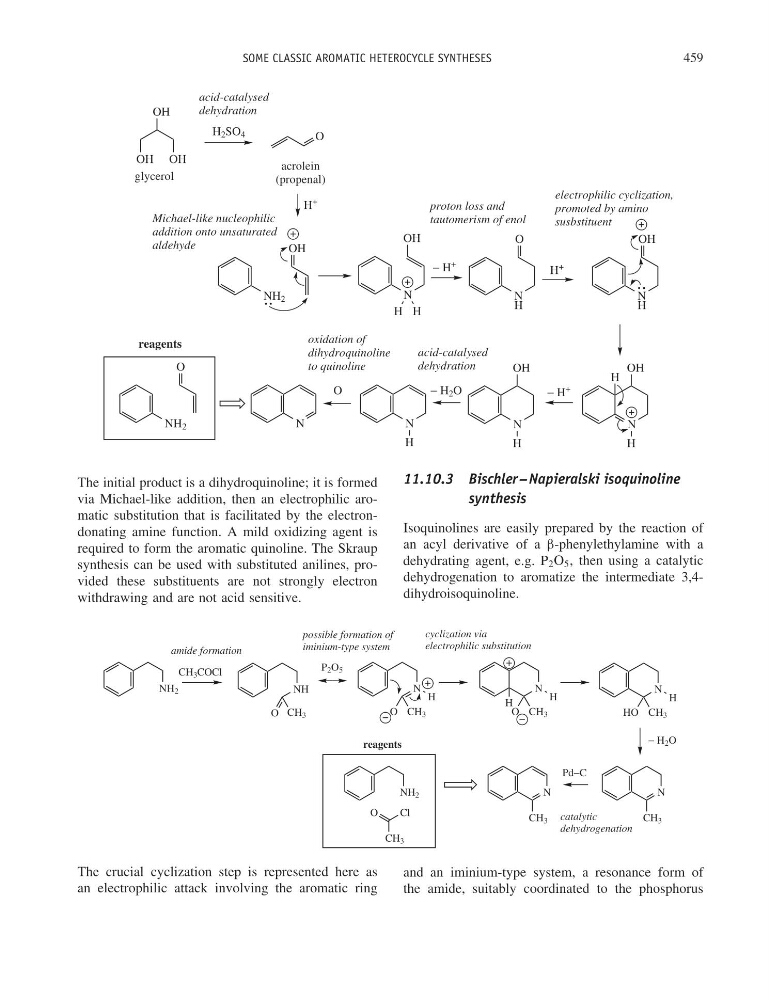
The initial product is a dihydroquinoline; it is formed
via Michael-like addition, then an electrophilic aromatic substitution that is facilitated by the electrondonating amine function. A mild oxidizing agent is
required to form the aromatic quinoline. The Skraup
synthesis can be used with substituted anilines, provided these substituents are not strongly electron
withdrawing and are not acid sensitive.
11.10.3 Bischler–Napieralski isoquinoline
synthesis
Isoquinolines are easily prepared by the reaction of
an acyl derivative of a β-phenylethylamine with a
dehydrating agent, e.g. P 2 O 5 , then using a catalytic
dehydrogenation to aromatize the intermediate 3,4dihydroisoquinoline.
NH 2
NH
CH 3 COCl
O CH 3
N
O CH 3
H
N
O CH 3
H
H
N
HO CH 3
H
− H 2 O
N
CH 3
Pd−C
N
CH 3
amide formation
possible formation of
iminium-type system
cyclization via
electrophilic substitution
catalytic
dehydrogenation
NH 2
CH 3
O
Cl
reagents
P 2 O 5
The crucial cyclization step is represented here as
an electrophilic attack involving the aromatic ring
and an iminium-type system, a resonance form of
the amide, suitably coordinated to the phosphorus
459
OH
OH
OH
glycerol
H 2 SO 4
O
acrolein
(propenal)
NH 2
OH
H
+
Michael-like nucleophilic
addition onto unsaturated
aldehyde
acid-catalysed
dehydration
N
OH
H H
− H +
N
H
O
N
H
OH
H +
N
H
OH
H
N
OH
H
− H
+
− H 2 O
N
H
N
O
proton loss and
tautomerism of enol
electrophilic cyclization,
promoted by amino
susbstituent
acid-catalysed
dehydration
oxidation of
dihydroquinoline
to quinoline
NH 2
O
reagents
The initial product is a dihydroquinoline; it is formed
via Michael-like addition, then an electrophilic aromatic substitution that is facilitated by the electrondonating amine function. A mild oxidizing agent is
required to form the aromatic quinoline. The Skraup
synthesis can be used with substituted anilines, provided these substituents are not strongly electron
withdrawing and are not acid sensitive.
11.10.3 Bischler–Napieralski isoquinoline
synthesis
Isoquinolines are easily prepared by the reaction of
an acyl derivative of a β-phenylethylamine with a
dehydrating agent, e.g. P 2 O 5 , then using a catalytic
dehydrogenation to aromatize the intermediate 3,4dihydroisoquinoline.
NH 2
NH
CH 3 COCl
O CH 3
N
O CH 3
H
N
O CH 3
H
H
N
HO CH 3
H
− H 2 O
N
CH 3
Pd−C
N
CH 3
amide formation
possible formation of
iminium-type system
cyclization via
electrophilic substitution
catalytic
dehydrogenation
NH 2
CH 3
O
Cl
reagents
P 2 O 5
The crucial cyclization step is represented here as
an electrophilic attack involving the aromatic ring
and an iminium-type system, a resonance form of
the amide, suitably coordinated to the phosphorus