

450
HETEROCYCLES
N
N
N
H
N
N
N
N
N
H
N
N
N
N
H
H
pK a 2.5
H
N
N
N
N
H
H
N
N
pyrimidine
pK a 1.3
1
2
3
4
5
6
imidazole
1
7
N
N
N
NH 2
N
H
adenine
N
HN
N
O
N
H
H 2 N
guanine
N
N
H
1
2
3
pK a 7.0
pK a 4.3
pK a 3.3
protonation at N-1
protonation at N-7
purine
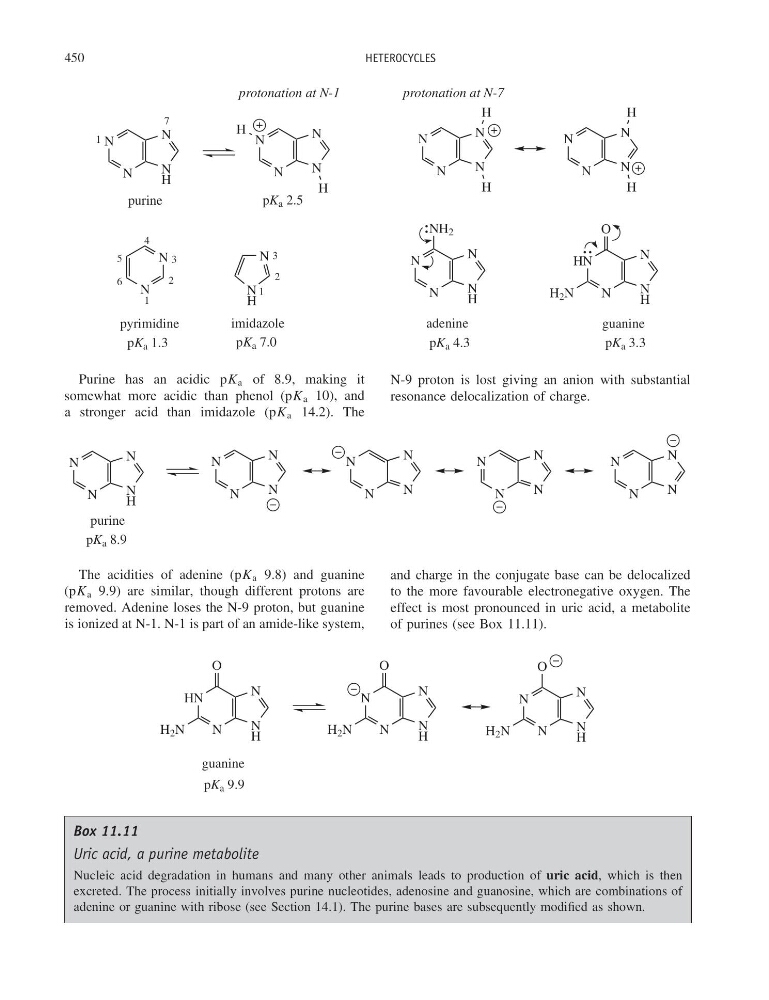
Purine has an acidic pK a of 8.9, making it
somewhat more acidic than phenol (pK a 10), and
a stronger acid than imidazole (pK a 14.2). The
N-9 proton is lost giving an anion with substantial
resonance delocalization of charge.
N
N
N
H
N
N
N
N
N
N
N
N
N
N
N
N
N
N
N
N
N
pK a 8.9
purine
The acidities of adenine (pK a 9.8) and guanine
(pK a 9.9) are similar, though different protons are
removed. Adenine loses the N-9 proton, but guanine
is ionized at N-1. N-1 is part of an amide-like system,
and charge in the conjugate base can be delocalized
to the more favourable electronegative oxygen. The
effect is most pronounced in uric acid, a metabolite
of purines (see Box 11.11).
N
HN
N
O
N
H
H 2 N
guanine
pK a 9.9
N
N
N
O
N
H
H 2 N
N
N
N
O
N
H
H 2 N
Box 11.11
Uric acid, a purine metabolite
Nucleic acid degradation in humans and many other animals leads to production of uric acid, which is then
excreted. The process initially involves purine nucleotides, adenosine and guanosine, which are combinations of
adenine or guanine with ribose (see Section 14.1). The purine bases are subsequently modified as shown.
HETEROCYCLES
N
N
N
H
N
N
N
N
N
H
N
N
N
N
H
H
pK a 2.5
H
N
N
N
N
H
H
N
N
pyrimidine
pK a 1.3
1
2
3
4
5
6
imidazole
1
7
N
N
N
NH 2
N
H
adenine
N
HN
N
O
N
H
H 2 N
guanine
N
N
H
1
2
3
pK a 7.0
pK a 4.3
pK a 3.3
protonation at N-1
protonation at N-7
purine
Purine has an acidic pK a of 8.9, making it
somewhat more acidic than phenol (pK a 10), and
a stronger acid than imidazole (pK a 14.2). The
N-9 proton is lost giving an anion with substantial
resonance delocalization of charge.
N
N
N
H
N
N
N
N
N
N
N
N
N
N
N
N
N
N
N
N
N
pK a 8.9
purine
The acidities of adenine (pK a 9.8) and guanine
(pK a 9.9) are similar, though different protons are
removed. Adenine loses the N-9 proton, but guanine
is ionized at N-1. N-1 is part of an amide-like system,
and charge in the conjugate base can be delocalized
to the more favourable electronegative oxygen. The
effect is most pronounced in uric acid, a metabolite
of purines (see Box 11.11).
N
HN
N
O
N
H
H 2 N
guanine
pK a 9.9
N
N
N
O
N
H
H 2 N
N
N
N
O
N
H
H 2 N
Box 11.11
Uric acid, a purine metabolite
Nucleic acid degradation in humans and many other animals leads to production of uric acid, which is then
excreted. The process initially involves purine nucleotides, adenosine and guanosine, which are combinations of
adenine or guanine with ribose (see Section 14.1). The purine bases are subsequently modified as shown.