

FUSED HETEROCYCLES
449
N
N
N
N
pyrimidine
pyrazine
a
b
c
d
1
2
3
4
N
N
N
N
pyrazino[2,3-d]pyrimidine
pteridine
6
5
7
8
1
2
3
4
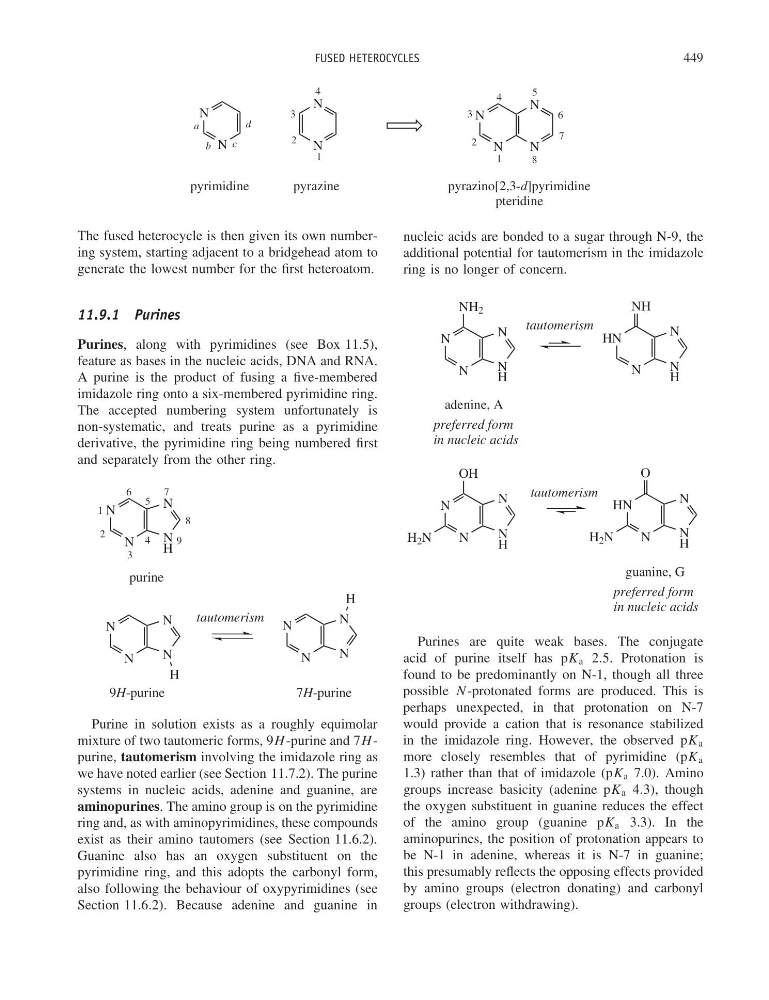
The fused heterocycle is then given its own numbering system, starting adjacent to a bridgehead atom to
generate the lowest number for the first heteroatom.
11.9.1 Purines
Purines, along with pyrimidines (see Box 11.5),
feature as bases in the nucleic acids, DNA and RNA.
A purine is the product of fusing a five-membered
imidazole ring onto a six-membered pyrimidine ring.
The accepted numbering system unfortunately is
non-systematic, and treats purine as a pyrimidine
derivative, the pyrimidine ring being numbered first
and separately from the other ring.
N
N
N
H
N
purine
1
2
3
4
5
6
7
8
9
N
N
N
N
N
N
N
N
H
H
9H-purine
7H-purine
tautomerism
Purine in solution exists as a roughly equimolar
mixture of two tautomeric forms, 9H -purine and 7H -
purine, tautomerism involving the imidazole ring as
we have noted earlier (see Section 11.7.2). The purine
systems in nucleic acids, adenine and guanine, are
aminopurines. The amino group is on the pyrimidine
ring and, as with aminopyrimidines, these compounds
exist as their amino tautomers (see Section 11.6.2).
Guanine also has an oxygen substituent on the
pyrimidine ring, and this adopts the carbonyl form,
also following the behaviour of oxypyrimidines (see
Section 11.6.2). Because adenine and guanine in
nucleic acids are bonded to a sugar through N-9, the
additional potential for tautomerism in the imidazole
ring is no longer of concern.
N
N
N
NH 2
N
H
N
HN
N
O
N
H
H 2 N
adenine, A
guanine, G
N
HN
N
NH
N
H
preferred form
in nucleic acids
N
N
N
OH
N
H
H 2 N
preferred form
in nucleic acids
tautomerism
tautomerism
Purines are quite weak bases. The conjugate
acid of purine itself has pK a 2.5. Protonation is
found to be predominantly on N-1, though all three
possible N -protonated forms are produced. This is
perhaps unexpected, in that protonation on N-7
would provide a cation that is resonance stabilized
in the imidazole ring. However, the observed pK a
more closely resembles that of pyrimidine (pK a
1.3) rather than that of imidazole (pK a 7.0). Amino
groups increase basicity (adenine pK a 4.3), though
the oxygen substituent in guanine reduces the effect
of the amino group (guanine pK a 3.3). In the
aminopurines, the position of protonation appears to
be N-1 in adenine, whereas it is N-7 in guanine;
this presumably reflects the opposing effects provided
by amino groups (electron donating) and carbonyl
groups (electron withdrawing).
449
N
N
N
N
pyrimidine
pyrazine
a
b
c
d
1
2
3
4
N
N
N
N
pyrazino[2,3-d]pyrimidine
pteridine
6
5
7
8
1
2
3
4
The fused heterocycle is then given its own numbering system, starting adjacent to a bridgehead atom to
generate the lowest number for the first heteroatom.
11.9.1 Purines
Purines, along with pyrimidines (see Box 11.5),
feature as bases in the nucleic acids, DNA and RNA.
A purine is the product of fusing a five-membered
imidazole ring onto a six-membered pyrimidine ring.
The accepted numbering system unfortunately is
non-systematic, and treats purine as a pyrimidine
derivative, the pyrimidine ring being numbered first
and separately from the other ring.
N
N
N
H
N
purine
1
2
3
4
5
6
7
8
9
N
N
N
N
N
N
N
N
H
H
9H-purine
7H-purine
tautomerism
Purine in solution exists as a roughly equimolar
mixture of two tautomeric forms, 9H -purine and 7H -
purine, tautomerism involving the imidazole ring as
we have noted earlier (see Section 11.7.2). The purine
systems in nucleic acids, adenine and guanine, are
aminopurines. The amino group is on the pyrimidine
ring and, as with aminopyrimidines, these compounds
exist as their amino tautomers (see Section 11.6.2).
Guanine also has an oxygen substituent on the
pyrimidine ring, and this adopts the carbonyl form,
also following the behaviour of oxypyrimidines (see
Section 11.6.2). Because adenine and guanine in
nucleic acids are bonded to a sugar through N-9, the
additional potential for tautomerism in the imidazole
ring is no longer of concern.
N
N
N
NH 2
N
H
N
HN
N
O
N
H
H 2 N
adenine, A
guanine, G
N
HN
N
NH
N
H
preferred form
in nucleic acids
N
N
N
OH
N
H
H 2 N
preferred form
in nucleic acids
tautomerism
tautomerism
Purines are quite weak bases. The conjugate
acid of purine itself has pK a 2.5. Protonation is
found to be predominantly on N-1, though all three
possible N -protonated forms are produced. This is
perhaps unexpected, in that protonation on N-7
would provide a cation that is resonance stabilized
in the imidazole ring. However, the observed pK a
more closely resembles that of pyrimidine (pK a
1.3) rather than that of imidazole (pK a 7.0). Amino
groups increase basicity (adenine pK a 4.3), though
the oxygen substituent in guanine reduces the effect
of the amino group (guanine pK a 3.3). In the
aminopurines, the position of protonation appears to
be N-1 in adenine, whereas it is N-7 in guanine;
this presumably reflects the opposing effects provided
by amino groups (electron donating) and carbonyl
groups (electron withdrawing).