

448
HETEROCYCLES
rhythm, the ability to sleep during the night, and to stay awake during the day. When given as a drug, melatonin
induces sleep, and adjusts the internal body clock. It is now used as a means of reducing the effects of jet-lag.
Plants also require hormones to trigger their growth patterns. One of these is indole-3-acetic acid, which
controls cell elongation and is produced in the growing shoot tips.
One of the major subdivisions of plant alkaloids is termed the indole alkaloid group. All contain the basic
indole heterocycle, and many have valuable pharmacological activity that can be exploited in drug materials. The
indole portion is very often fused to another heterocycle; we shall see some typical structures in Section 11.9,
where we shall consider them under fused heterocycles.
11.9 Fused heterocycles
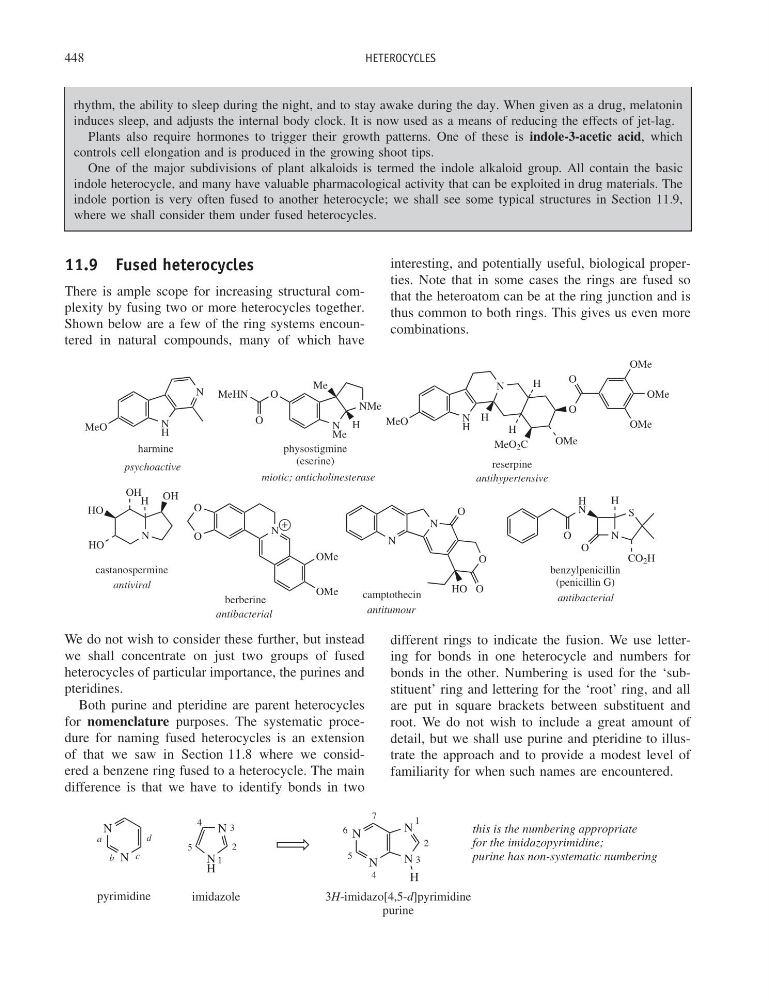
There is ample scope for increasing structural complexity by fusing two or more heterocycles together.
Shown below are a few of the ring systems encountered in natural compounds, many of which have
interesting, and potentially useful, biological properties. Note that in some cases the rings are fused so
that the heteroatom can be at the ring junction and is
thus common to both rings. This gives us even more
combinations.
N
Me
NMe
Me
H
O
MeHN
O
physostigmine
(eserine)
N
H
N
MeO 2 C
H
H
OMe
H
O
OMe
OMe
OMe
O
MeO
reserpine
N
H
N
MeO
harmine
N
OH
HO
HO
H OH
castanospermine
N
OMe
OMe
O
O
berberine
N
N
O
O
O
HO
camptothecin
psychoactive
antibacterial
antihypertensive
antitumour
miotic; anticholinesterase
antiviral
H
N
N
O
S
CO 2 H
H
O
benzylpenicillin
(penicillin G)
antibacterial
We do not wish to consider these further, but instead
we shall concentrate on just two groups of fused
heterocycles of particular importance, the purines and
pteridines.
Both purine and pteridine are parent heterocycles
for nomenclature purposes. The systematic procedure for naming fused heterocycles is an extension
of that we saw in Section 11.8 where we considered a benzene ring fused to a heterocycle. The main
difference is that we have to identify bonds in two
different rings to indicate the fusion. We use lettering for bonds in one heterocycle and numbers for
bonds in the other. Numbering is used for the ‘substituent’ ring and lettering for the ‘root’ ring, and all
are put in square brackets between substituent and
root. We do not wish to include a great amount of
detail, but we shall use purine and pteridine to illustrate the approach and to provide a modest level of
familiarity for when such names are encountered.
N
N
pyrimidine
a
b
c
d
N
N
N
N
H
imidazole
N
N
H
1
2
3
4
5
3H-imidazo[4,5-d]pyrimidine
purine
1
2
3
4
6
5
7
this is the numbering appropriate
for the imidazopyrimidine;
purine has non-systematic numbering
HETEROCYCLES
rhythm, the ability to sleep during the night, and to stay awake during the day. When given as a drug, melatonin
induces sleep, and adjusts the internal body clock. It is now used as a means of reducing the effects of jet-lag.
Plants also require hormones to trigger their growth patterns. One of these is indole-3-acetic acid, which
controls cell elongation and is produced in the growing shoot tips.
One of the major subdivisions of plant alkaloids is termed the indole alkaloid group. All contain the basic
indole heterocycle, and many have valuable pharmacological activity that can be exploited in drug materials. The
indole portion is very often fused to another heterocycle; we shall see some typical structures in Section 11.9,
where we shall consider them under fused heterocycles.
11.9 Fused heterocycles
There is ample scope for increasing structural complexity by fusing two or more heterocycles together.
Shown below are a few of the ring systems encountered in natural compounds, many of which have
interesting, and potentially useful, biological properties. Note that in some cases the rings are fused so
that the heteroatom can be at the ring junction and is
thus common to both rings. This gives us even more
combinations.
N
Me
NMe
Me
H
O
MeHN
O
physostigmine
(eserine)
N
H
N
MeO 2 C
H
H
OMe
H
O
OMe
OMe
OMe
O
MeO
reserpine
N
H
N
MeO
harmine
N
OH
HO
HO
H OH
castanospermine
N
OMe
OMe
O
O
berberine
N
N
O
O
O
HO
camptothecin
psychoactive
antibacterial
antihypertensive
antitumour
miotic; anticholinesterase
antiviral
H
N
N
O
S
CO 2 H
H
O
benzylpenicillin
(penicillin G)
antibacterial
We do not wish to consider these further, but instead
we shall concentrate on just two groups of fused
heterocycles of particular importance, the purines and
pteridines.
Both purine and pteridine are parent heterocycles
for nomenclature purposes. The systematic procedure for naming fused heterocycles is an extension
of that we saw in Section 11.8 where we considered a benzene ring fused to a heterocycle. The main
difference is that we have to identify bonds in two
different rings to indicate the fusion. We use lettering for bonds in one heterocycle and numbers for
bonds in the other. Numbering is used for the ‘substituent’ ring and lettering for the ‘root’ ring, and all
are put in square brackets between substituent and
root. We do not wish to include a great amount of
detail, but we shall use purine and pteridine to illustrate the approach and to provide a modest level of
familiarity for when such names are encountered.
N
N
pyrimidine
a
b
c
d
N
N
N
N
H
imidazole
N
N
H
1
2
3
4
5
3H-imidazo[4,5-d]pyrimidine
purine
1
2
3
4
6
5
7
this is the numbering appropriate
for the imidazopyrimidine;
purine has non-systematic numbering