

FUSED HETEROCYCLES
451
N
HN
N
O
N
H
H 2 N
N
H
HN
N
O
N
H
O
xanthine
N
H
HN
H
N
O
N
H
O
O
uric acid
xanthine
oxidase
N
N
N
NH 2
N
H
guanine
adenine
N
HN
N
O
N
H
hypoxanthine
xanthine
oxidase
N
HN
N
O
N
H
allopurinol
N
H
HN
N
O
N
H
alloxanthine
xanthine
oxidase
O
alloxanthine is
an inhibitor of
xanthine oxidase
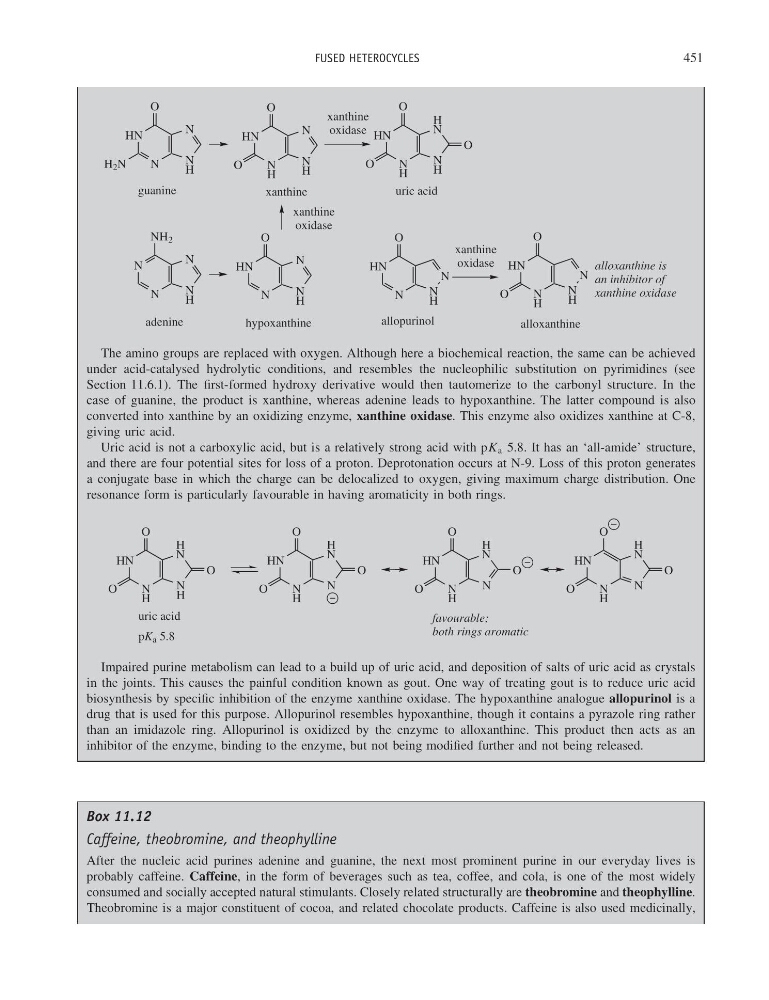
The amino groups are replaced with oxygen. Although here a biochemical reaction, the same can be achieved
under acid-catalysed hydrolytic conditions, and resembles the nucleophilic substitution on pyrimidines (see
Section 11.6.1). The first-formed hydroxy derivative would then tautomerize to the carbonyl structure. In the
case of guanine, the product is xanthine, whereas adenine leads to hypoxanthine. The latter compound is also
converted into xanthine by an oxidizing enzyme, xanthine oxidase. This enzyme also oxidizes xanthine at C-8,
giving uric acid.
Uric acid is not a carboxylic acid, but is a relatively strong acid with pK a 5.8. It has an ‘all-amide’ structure,
and there are four potential sites for loss of a proton. Deprotonation occurs at N-9. Loss of this proton generates
a conjugate base in which the charge can be delocalized to oxygen, giving maximum charge distribution. One
resonance form is particularly favourable in having aromaticity in both rings.
N
H
HN
H
N
O
N
O
O
N
H
HN
H
N
O
N
O
O
N
H
HN
H
N
O
N
O
O
N
H
HN
H
N
O
N
H
O
O
uric acid
pK a 5.8
favourable;
both rings aromatic
Impaired purine metabolism can lead to a build up of uric acid, and deposition of salts of uric acid as crystals
in the joints. This causes the painful condition known as gout. One way of treating gout is to reduce uric acid
biosynthesis by specific inhibition of the enzyme xanthine oxidase. The hypoxanthine analogue allopurinol is a
drug that is used for this purpose. Allopurinol resembles hypoxanthine, though it contains a pyrazole ring rather
than an imidazole ring. Allopurinol is oxidized by the enzyme to alloxanthine. This product then acts as an
inhibitor of the enzyme, binding to the enzyme, but not being modified further and not being released.
Box 11.12
Caffeine, theobromine, and theophylline
After the nucleic acid purines adenine and guanine, the next most prominent purine in our everyday lives is
probably caffeine. Caffeine, in the form of beverages such as tea, coffee, and cola, is one of the most widely
consumed and socially accepted natural stimulants. Closely related structurally are theobromine and theophylline.
Theobromine is a major constituent of cocoa, and related chocolate products. Caffeine is also used medicinally,
451
N
HN
N
O
N
H
H 2 N
N
H
HN
N
O
N
H
O
xanthine
N
H
HN
H
N
O
N
H
O
O
uric acid
xanthine
oxidase
N
N
N
NH 2
N
H
guanine
adenine
N
HN
N
O
N
H
hypoxanthine
xanthine
oxidase
N
HN
N
O
N
H
allopurinol
N
H
HN
N
O
N
H
alloxanthine
xanthine
oxidase
O
alloxanthine is
an inhibitor of
xanthine oxidase
The amino groups are replaced with oxygen. Although here a biochemical reaction, the same can be achieved
under acid-catalysed hydrolytic conditions, and resembles the nucleophilic substitution on pyrimidines (see
Section 11.6.1). The first-formed hydroxy derivative would then tautomerize to the carbonyl structure. In the
case of guanine, the product is xanthine, whereas adenine leads to hypoxanthine. The latter compound is also
converted into xanthine by an oxidizing enzyme, xanthine oxidase. This enzyme also oxidizes xanthine at C-8,
giving uric acid.
Uric acid is not a carboxylic acid, but is a relatively strong acid with pK a 5.8. It has an ‘all-amide’ structure,
and there are four potential sites for loss of a proton. Deprotonation occurs at N-9. Loss of this proton generates
a conjugate base in which the charge can be delocalized to oxygen, giving maximum charge distribution. One
resonance form is particularly favourable in having aromaticity in both rings.
N
H
HN
H
N
O
N
O
O
N
H
HN
H
N
O
N
O
O
N
H
HN
H
N
O
N
O
O
N
H
HN
H
N
O
N
H
O
O
uric acid
pK a 5.8
favourable;
both rings aromatic
Impaired purine metabolism can lead to a build up of uric acid, and deposition of salts of uric acid as crystals
in the joints. This causes the painful condition known as gout. One way of treating gout is to reduce uric acid
biosynthesis by specific inhibition of the enzyme xanthine oxidase. The hypoxanthine analogue allopurinol is a
drug that is used for this purpose. Allopurinol resembles hypoxanthine, though it contains a pyrazole ring rather
than an imidazole ring. Allopurinol is oxidized by the enzyme to alloxanthine. This product then acts as an
inhibitor of the enzyme, binding to the enzyme, but not being modified further and not being released.
Box 11.12
Caffeine, theobromine, and theophylline
After the nucleic acid purines adenine and guanine, the next most prominent purine in our everyday lives is
probably caffeine. Caffeine, in the form of beverages such as tea, coffee, and cola, is one of the most widely
consumed and socially accepted natural stimulants. Closely related structurally are theobromine and theophylline.
Theobromine is a major constituent of cocoa, and related chocolate products. Caffeine is also used medicinally,