

442
HETEROCYCLES
N
4-aminoquinoline
NH 2
H
+
N
NH 2
H
N
NH 2
H
pK a 9.2
Box 11.9
Quinolone antibiotics
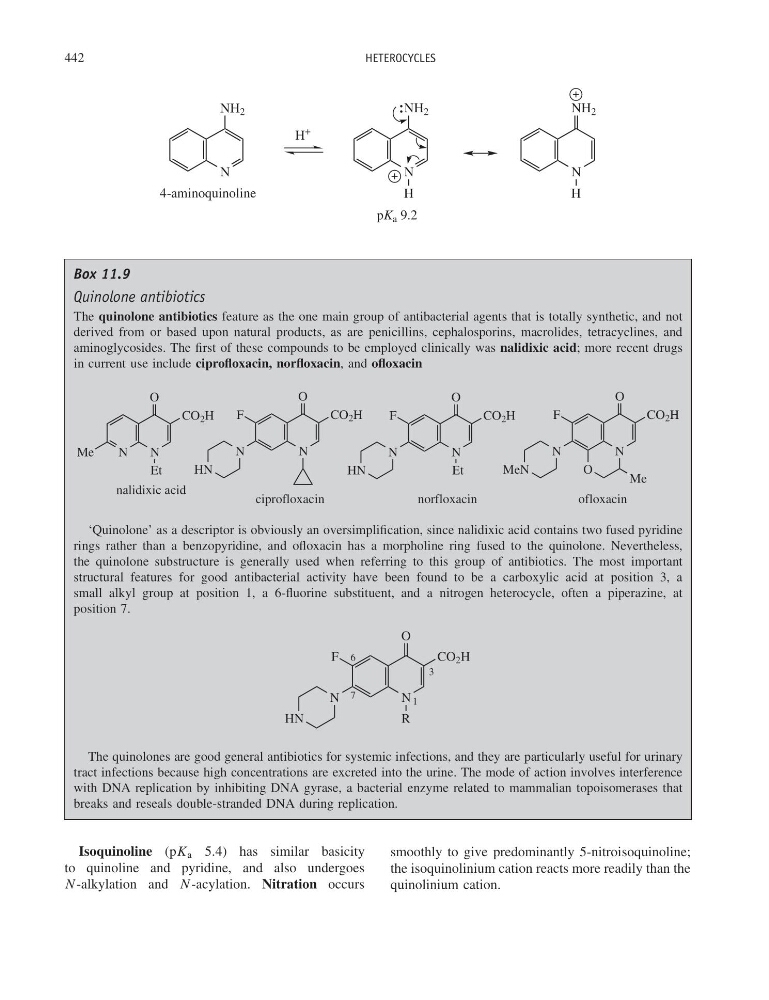
The quinolone antibiotics feature as the one main group of antibacterial agents that is totally synthetic, and not
derived from or based upon natural products, as are penicillins, cephalosporins, macrolides, tetracyclines, and
aminoglycosides. The first of these compounds to be employed clinically was nalidixic acid; more recent drugs
in current use include ciprofloxacin, norfloxacin, and ofloxacin
N
N
O
Me
CO 2 H
Et
nalidixic acid
ciprofloxacin
N
O
N
CO 2 H
F
HN
norfloxacin
N
O
N
CO 2 H
Et
F
HN
ofloxacin
N
O
N
CO 2 H
F
MeN
O
Me
‘Quinolone’ as a descriptor is obviously an oversimplification, since nalidixic acid contains two fused pyridine
rings rather than a benzopyridine, and ofloxacin has a morpholine ring fused to the quinolone. Nevertheless,
the quinolone substructure is generally used when referring to this group of antibiotics. The most important
structural features for good antibacterial activity have been found to be a carboxylic acid at position 3, a
small alkyl group at position 1, a 6-fluorine substituent, and a nitrogen heterocycle, often a piperazine, at
position 7.
N
O
CO 2 H
R
F
N
HN
1
3
6
7
The quinolones are good general antibiotics for systemic infections, and they are particularly useful for urinary
tract infections because high concentrations are excreted into the urine. The mode of action involves interference
with DNA replication by inhibiting DNA gyrase, a bacterial enzyme related to mammalian topoisomerases that
breaks and reseals double-stranded DNA during replication.
Isoquinoline (pK a 5.4) has similar basicity
to quinoline and pyridine, and also undergoes
N -alkylation and N -acylation. Nitration occurs
smoothly to give predominantly 5-nitroisoquinoline;
the isoquinolinium cation reacts more readily than the
quinolinium cation.
HETEROCYCLES
N
4-aminoquinoline
NH 2
H
+
N
NH 2
H
N
NH 2
H
pK a 9.2
Box 11.9
Quinolone antibiotics
The quinolone antibiotics feature as the one main group of antibacterial agents that is totally synthetic, and not
derived from or based upon natural products, as are penicillins, cephalosporins, macrolides, tetracyclines, and
aminoglycosides. The first of these compounds to be employed clinically was nalidixic acid; more recent drugs
in current use include ciprofloxacin, norfloxacin, and ofloxacin
N
N
O
Me
CO 2 H
Et
nalidixic acid
ciprofloxacin
N
O
N
CO 2 H
F
HN
norfloxacin
N
O
N
CO 2 H
Et
F
HN
ofloxacin
N
O
N
CO 2 H
F
MeN
O
Me
‘Quinolone’ as a descriptor is obviously an oversimplification, since nalidixic acid contains two fused pyridine
rings rather than a benzopyridine, and ofloxacin has a morpholine ring fused to the quinolone. Nevertheless,
the quinolone substructure is generally used when referring to this group of antibiotics. The most important
structural features for good antibacterial activity have been found to be a carboxylic acid at position 3, a
small alkyl group at position 1, a 6-fluorine substituent, and a nitrogen heterocycle, often a piperazine, at
position 7.
N
O
CO 2 H
R
F
N
HN
1
3
6
7
The quinolones are good general antibiotics for systemic infections, and they are particularly useful for urinary
tract infections because high concentrations are excreted into the urine. The mode of action involves interference
with DNA replication by inhibiting DNA gyrase, a bacterial enzyme related to mammalian topoisomerases that
breaks and reseals double-stranded DNA during replication.
Isoquinoline (pK a 5.4) has similar basicity
to quinoline and pyridine, and also undergoes
N -alkylation and N -acylation. Nitration occurs
smoothly to give predominantly 5-nitroisoquinoline;
the isoquinolinium cation reacts more readily than the
quinolinium cation.