

HETEROCYCLES FUSED TO A BENZENE RING
443
N
H 2 SO 4
HNO 3
N
N
NO 2
NO 2
+
5-nitroisoquinoline
8-nitroisoquinoline
approx 9:1
0˚C
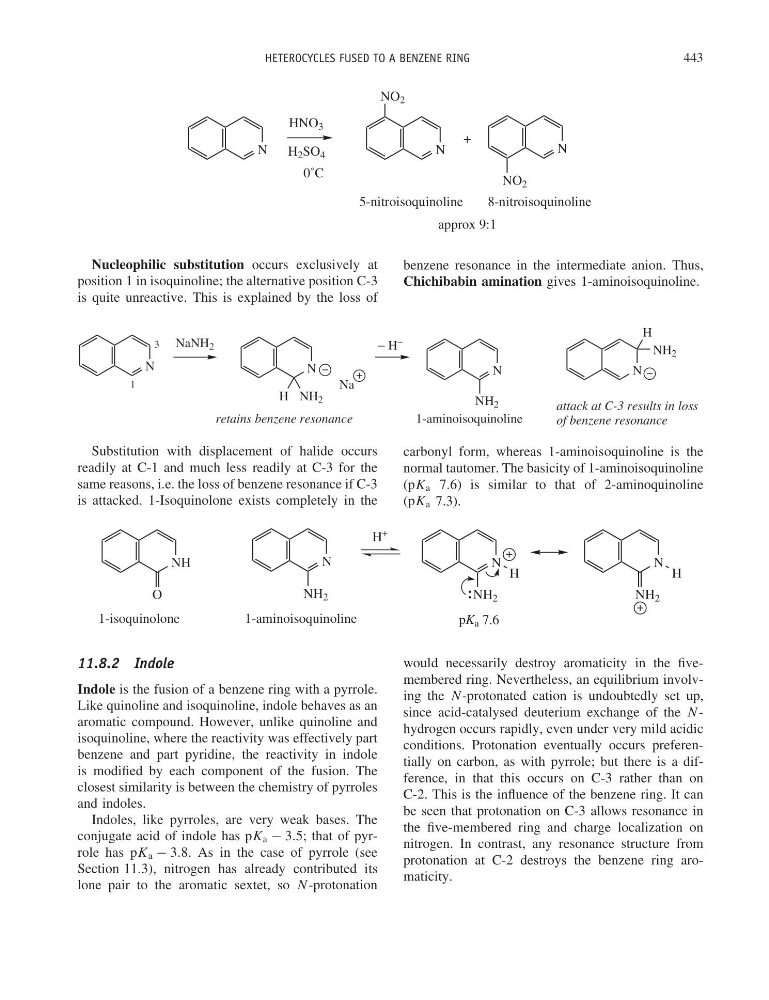
Nucleophilic substitution occurs exclusively at
position 1 in isoquinoline; the alternative position C-3
is quite unreactive. This is explained by the loss of
benzene resonance in the intermediate anion. Thus,
Chichibabin amination gives 1-aminoisoquinoline.
N
NaNH 2
N
Na
N
− H −
H NH 2
NH 2
N
NH 2
H
attack at C-3 results in loss
of benzene resonance
retains benzene resonance
1
3
1-aminoisoquinoline
Substitution with displacement of halide occurs
readily at C-1 and much less readily at C-3 for the
same reasons, i.e. the loss of benzene resonance if C-3
is attacked. 1-Isoquinolone exists completely in the
carbonyl form, whereas 1-aminoisoquinoline is the
normal tautomer. The basicity of 1-aminoisoquinoline
(pK a 7.6) is similar to that of 2-aminoquinoline
(pK a 7.3).
N
NH 2
NH
O
1-isoquinolone
1-aminoisoquinoline
pK a 7.6
H +
N
NH 2
H
N
NH 2
H
11.8.2 Indole
Indole is the fusion of a benzene ring with a pyrrole.
Like quinoline and isoquinoline, indole behaves as an
aromatic compound. However, unlike quinoline and
isoquinoline, where the reactivity was effectively part
benzene and part pyridine, the reactivity in indole
is modified by each component of the fusion. The
closest similarity is between the chemistry of pyrroles
and indoles.
Indoles, like pyrroles, are very weak bases. The
conjugate acid of indole has pK a − 3.5; that of pyrrole has pK a − 3.8. As in the case of pyrrole (see
Section 11.3), nitrogen has already contributed its
lone pair to the aromatic sextet, so N -protonation
would necessarily destroy aromaticity in the fivemembered ring. Nevertheless, an equilibrium involving the N -protonated cation is undoubtedly set up,
since acid-catalysed deuterium exchange of the N -
hydrogen occurs rapidly, even under very mild acidic
conditions. Protonation eventually occurs preferentially on carbon, as with pyrrole; but there is a difference, in that this occurs on C-3 rather than on
C-2. This is the influence of the benzene ring. It can
be seen that protonation on C-3 allows resonance in
the five-membered ring and charge localization on
nitrogen. In contrast, any resonance structure from
protonation at C-2 destroys the benzene ring aromaticity.
443
N
H 2 SO 4
HNO 3
N
N
NO 2
NO 2
+
5-nitroisoquinoline
8-nitroisoquinoline
approx 9:1
0˚C
Nucleophilic substitution occurs exclusively at
position 1 in isoquinoline; the alternative position C-3
is quite unreactive. This is explained by the loss of
benzene resonance in the intermediate anion. Thus,
Chichibabin amination gives 1-aminoisoquinoline.
N
NaNH 2
N
Na
N
− H −
H NH 2
NH 2
N
NH 2
H
attack at C-3 results in loss
of benzene resonance
retains benzene resonance
1
3
1-aminoisoquinoline
Substitution with displacement of halide occurs
readily at C-1 and much less readily at C-3 for the
same reasons, i.e. the loss of benzene resonance if C-3
is attacked. 1-Isoquinolone exists completely in the
carbonyl form, whereas 1-aminoisoquinoline is the
normal tautomer. The basicity of 1-aminoisoquinoline
(pK a 7.6) is similar to that of 2-aminoquinoline
(pK a 7.3).
N
NH 2
NH
O
1-isoquinolone
1-aminoisoquinoline
pK a 7.6
H +
N
NH 2
H
N
NH 2
H
11.8.2 Indole
Indole is the fusion of a benzene ring with a pyrrole.
Like quinoline and isoquinoline, indole behaves as an
aromatic compound. However, unlike quinoline and
isoquinoline, where the reactivity was effectively part
benzene and part pyridine, the reactivity in indole
is modified by each component of the fusion. The
closest similarity is between the chemistry of pyrroles
and indoles.
Indoles, like pyrroles, are very weak bases. The
conjugate acid of indole has pK a − 3.5; that of pyrrole has pK a − 3.8. As in the case of pyrrole (see
Section 11.3), nitrogen has already contributed its
lone pair to the aromatic sextet, so N -protonation
would necessarily destroy aromaticity in the fivemembered ring. Nevertheless, an equilibrium involving the N -protonated cation is undoubtedly set up,
since acid-catalysed deuterium exchange of the N -
hydrogen occurs rapidly, even under very mild acidic
conditions. Protonation eventually occurs preferentially on carbon, as with pyrrole; but there is a difference, in that this occurs on C-3 rather than on
C-2. This is the influence of the benzene ring. It can
be seen that protonation on C-3 allows resonance in
the five-membered ring and charge localization on
nitrogen. In contrast, any resonance structure from
protonation at C-2 destroys the benzene ring aromaticity.