

HETEROCYCLES FUSED TO A BENZENE RING
441
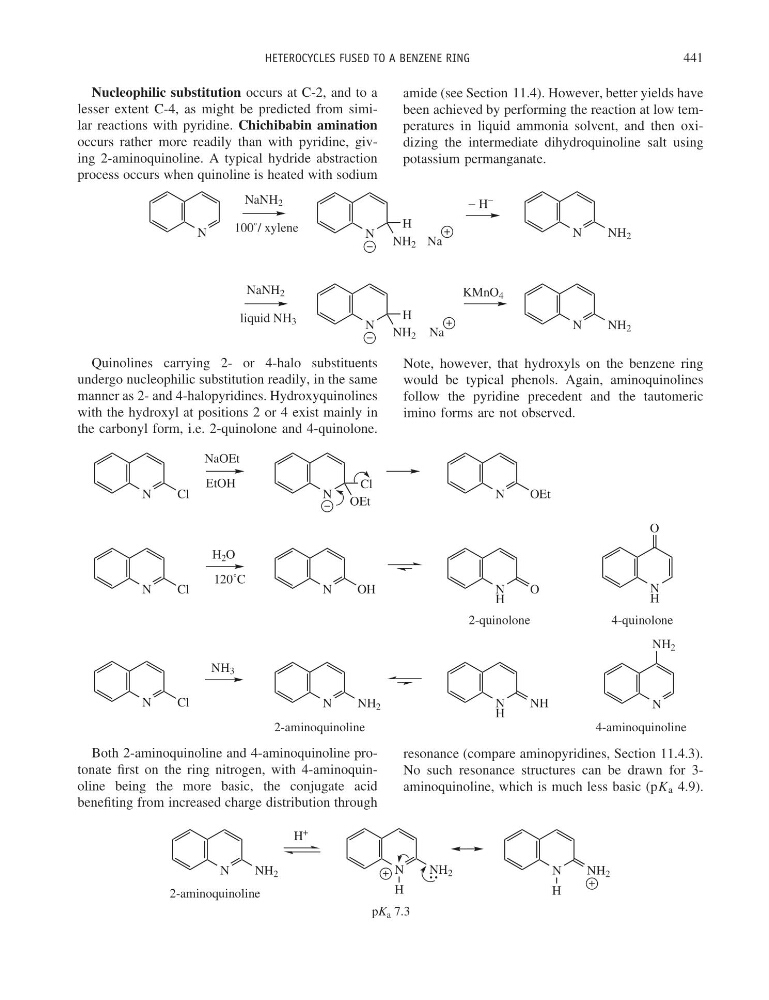
Nucleophilic substitution occurs at C-2, and to a
lesser extent C-4, as might be predicted from similar reactions with pyridine. Chichibabin amination
occurs rather more readily than with pyridine, giving 2-aminoquinoline. A typical hydride abstraction
process occurs when quinoline is heated with sodium
amide (see Section 11.4). However, better yields have
been achieved by performing the reaction at low temperatures in liquid ammonia solvent, and then oxidizing the intermediate dihydroquinoline salt using
potassium permanganate.
N
NaNH 2
N
H
NH 2 Na
N
NH 2
− H −
NaNH 2
N
H
NH 2 Na
liquid NH 3
KMnO 4
N
NH 2
100˚/ xylene
Quinolines carrying 2- or 4-halo substituents
undergo nucleophilic substitution readily, in the same
manner as 2- and 4-halopyridines. Hydroxyquinolines
with the hydroxyl at positions 2 or 4 exist mainly in
the carbonyl form, i.e. 2-quinolone and 4-quinolone.
Note, however, that hydroxyls on the benzene ring
would be typical phenols. Again, aminoquinolines
follow the pyridine precedent and the tautomeric
imino forms are not observed.
N
Cl
NaOEt
EtOH
N
Cl
OEt
N
OEt
N
Cl
H 2 O
120˚C
N
OH
N
H
O
2-quinolone
N
NH 3
N
N
H
4-quinolone
O
Cl
NH 2
N
H
NH
2-aminoquinoline
N
4-aminoquinoline
NH 2
Both 2-aminoquinoline and 4-aminoquinoline protonate first on the ring nitrogen, with 4-aminoquinoline being the more basic, the conjugate acid
benefiting from increased charge distribution through
resonance (compare aminopyridines, Section 11.4.3).
No such resonance structures can be drawn for 3aminoquinoline, which is much less basic (pK a 4.9).
N
NH 2
2-aminoquinoline
H +
N
NH 2
H
N
NH 2
H
pK a 7.3
441
Nucleophilic substitution occurs at C-2, and to a
lesser extent C-4, as might be predicted from similar reactions with pyridine. Chichibabin amination
occurs rather more readily than with pyridine, giving 2-aminoquinoline. A typical hydride abstraction
process occurs when quinoline is heated with sodium
amide (see Section 11.4). However, better yields have
been achieved by performing the reaction at low temperatures in liquid ammonia solvent, and then oxidizing the intermediate dihydroquinoline salt using
potassium permanganate.
N
NaNH 2
N
H
NH 2 Na
N
NH 2
− H −
NaNH 2
N
H
NH 2 Na
liquid NH 3
KMnO 4
N
NH 2
100˚/ xylene
Quinolines carrying 2- or 4-halo substituents
undergo nucleophilic substitution readily, in the same
manner as 2- and 4-halopyridines. Hydroxyquinolines
with the hydroxyl at positions 2 or 4 exist mainly in
the carbonyl form, i.e. 2-quinolone and 4-quinolone.
Note, however, that hydroxyls on the benzene ring
would be typical phenols. Again, aminoquinolines
follow the pyridine precedent and the tautomeric
imino forms are not observed.
N
Cl
NaOEt
EtOH
N
Cl
OEt
N
OEt
N
Cl
H 2 O
120˚C
N
OH
N
H
O
2-quinolone
N
NH 3
N
N
H
4-quinolone
O
Cl
NH 2
N
H
NH
2-aminoquinoline
N
4-aminoquinoline
NH 2
Both 2-aminoquinoline and 4-aminoquinoline protonate first on the ring nitrogen, with 4-aminoquinoline being the more basic, the conjugate acid
benefiting from increased charge distribution through
resonance (compare aminopyridines, Section 11.4.3).
No such resonance structures can be drawn for 3aminoquinoline, which is much less basic (pK a 4.9).
N
NH 2
2-aminoquinoline
H +
N
NH 2
H
N
NH 2
H
pK a 7.3