

440
HETEROCYCLES
11.8.1 Quinoline and isoquinoline
Quinoline and isoquinoline are benzopyridines. They
behave by showing the reactivity associated with
either the benzene or the pyridine rings.
Quinoline is basic with a pK a of 4.9, similar
to that of pyridine (pK a 5.2). As with pyridine,
the nitrogen carries a lone pair in an sp
2 orbital
(see Section 11.3). Alkyl halides and acyl halides
also react at nitrogen to give N -alkyl- and N -acylquinolinium salts. The N -alkyl salts are stable, but
the N -acyl salts hydrolyse rapidly in the presence of
water.
N
N
N
RX
RCOX
R
R
O
X
X
H 2 O
N-alkylquinolinium halide
N-acylquinolinium halide
Quinoline is much more reactive towards electrophilic substitution than pyridine, but this is
because substitution occurs on the benzene ring, not
on the pyridine. We have already seen that pyridine
carbons are unreactive towards electrophilic reagents,
with strongly acidic systems protonating the nitrogen
first, further inhibiting reaction (see Section 11.4).
This is again true in quinoline, so that the protonated system is involved in the reaction, and the
benzene ring undergoes substitution. With a nitrating mixture of HNO 3 –H 2 SO 4 , the products are 5and 8-nitroquinoline in roughly equivalent amounts.
N
H 2 SO 4
HNO 3
N
N
NO 2
NO 2
+
5-nitroquinoline
8-nitroquinoline
approx 1:1
0˚C
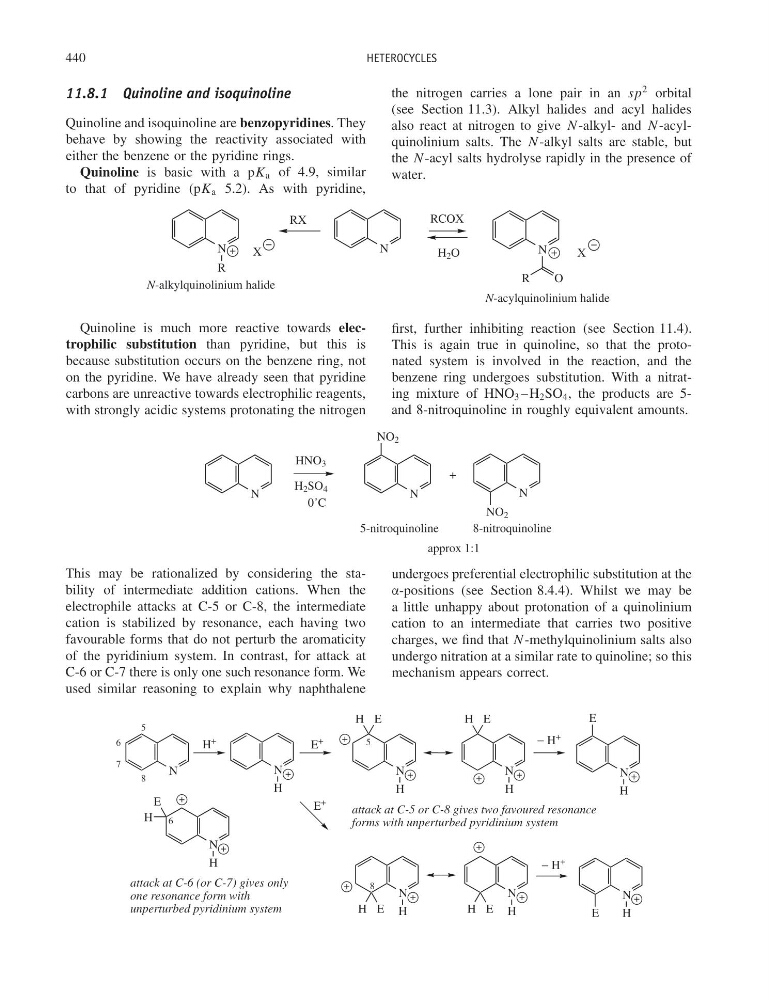
This may be rationalized by considering the stability of intermediate addition cations. When the
electrophile attacks at C-5 or C-8, the intermediate
cation is stabilized by resonance, each having two
favourable forms that do not perturb the aromaticity
of the pyridinium system. In contrast, for attack at
C-6 or C-7 there is only one such resonance form. We
used similar reasoning to explain why naphthalene
undergoes preferential electrophilic substitution at the
α-positions (see Section 8.4.4). Whilst we may be
a little unhappy about protonation of a quinolinium
cation to an intermediate that carries two positive
charges, we find that N -methylquinolinium salts also
undergo nitration at a similar rate to quinoline; so this
mechanism appears correct.
N
H +
N
H
E
+
N
H
E
H
N
H
E
H
− H +
N
H
E
N
H
N
H
− H
+
N
H
E
H
E
E
H
N
H
H
E
E
+
attack at C-5 or C-8 gives two favoured resonance
forms with unperturbed pyridinium system
attack at C-6 (or C-7) gives only
one resonance form with
unperturbed pyridinium system
5
8
6
7
5
8
6
HETEROCYCLES
11.8.1 Quinoline and isoquinoline
Quinoline and isoquinoline are benzopyridines. They
behave by showing the reactivity associated with
either the benzene or the pyridine rings.
Quinoline is basic with a pK a of 4.9, similar
to that of pyridine (pK a 5.2). As with pyridine,
the nitrogen carries a lone pair in an sp
2 orbital
(see Section 11.3). Alkyl halides and acyl halides
also react at nitrogen to give N -alkyl- and N -acylquinolinium salts. The N -alkyl salts are stable, but
the N -acyl salts hydrolyse rapidly in the presence of
water.
N
N
N
RX
RCOX
R
R
O
X
X
H 2 O
N-alkylquinolinium halide
N-acylquinolinium halide
Quinoline is much more reactive towards electrophilic substitution than pyridine, but this is
because substitution occurs on the benzene ring, not
on the pyridine. We have already seen that pyridine
carbons are unreactive towards electrophilic reagents,
with strongly acidic systems protonating the nitrogen
first, further inhibiting reaction (see Section 11.4).
This is again true in quinoline, so that the protonated system is involved in the reaction, and the
benzene ring undergoes substitution. With a nitrating mixture of HNO 3 –H 2 SO 4 , the products are 5and 8-nitroquinoline in roughly equivalent amounts.
N
H 2 SO 4
HNO 3
N
N
NO 2
NO 2
+
5-nitroquinoline
8-nitroquinoline
approx 1:1
0˚C
This may be rationalized by considering the stability of intermediate addition cations. When the
electrophile attacks at C-5 or C-8, the intermediate
cation is stabilized by resonance, each having two
favourable forms that do not perturb the aromaticity
of the pyridinium system. In contrast, for attack at
C-6 or C-7 there is only one such resonance form. We
used similar reasoning to explain why naphthalene
undergoes preferential electrophilic substitution at the
α-positions (see Section 8.4.4). Whilst we may be
a little unhappy about protonation of a quinolinium
cation to an intermediate that carries two positive
charges, we find that N -methylquinolinium salts also
undergo nitration at a similar rate to quinoline; so this
mechanism appears correct.
N
H +
N
H
E
+
N
H
E
H
N
H
E
H
− H +
N
H
E
N
H
N
H
− H
+
N
H
E
H
E
E
H
N
H
H
E
E
+
attack at C-5 or C-8 gives two favoured resonance
forms with unperturbed pyridinium system
attack at C-6 (or C-7) gives only
one resonance form with
unperturbed pyridinium system
5
8
6
7
5
8
6