

HETEROCYCLES FUSED TO A BENZENE RING
439
N
H
N
a
b
c
a
b
c
N
H
N
N
indole
benzo[b]pyrrole
quinoline
benzo[b]pyridine
isoquinoline
benzo[c]pyridine
pyrrole
pyridine
1
2
3
4
5
6
7
1
2
3
4
5
6
7
8
1
2
3
4
5
6
7
8
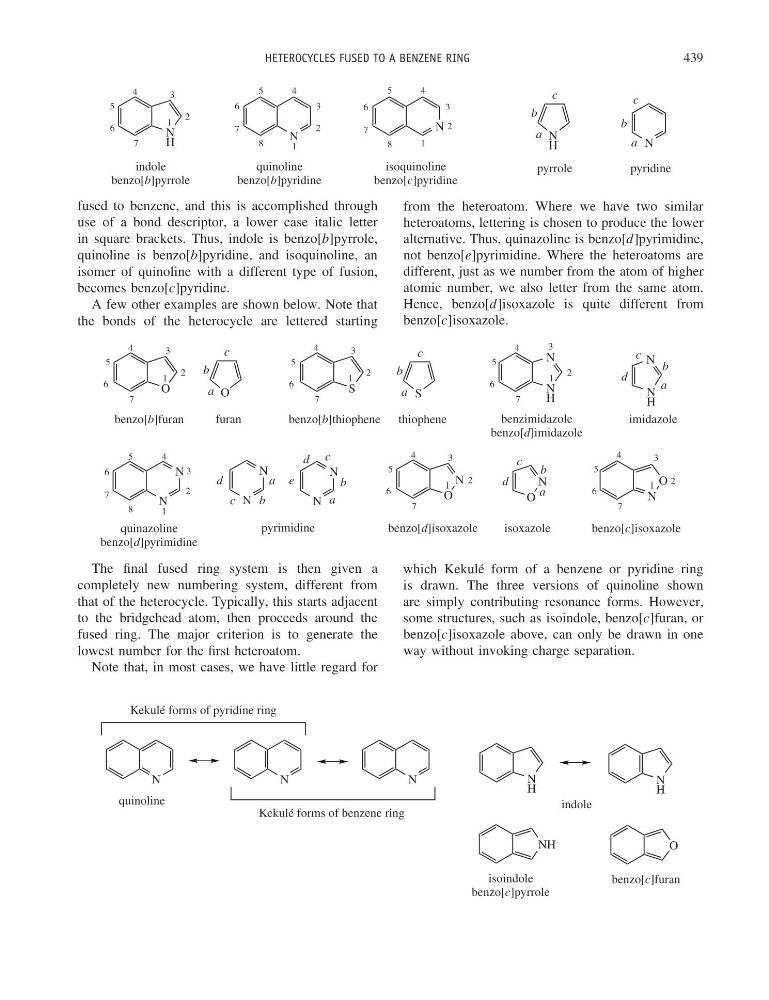
fused to benzene, and this is accomplished through
use of a bond descriptor, a lower case italic letter
in square brackets. Thus, indole is benzo[b]pyrrole,
quinoline is benzo[b]pyridine, and isoquinoline, an
isomer of quinoline with a different type of fusion,
becomes benzo[c]pyridine.
A few other examples are shown below. Note that
the bonds of the heterocycle are lettered starting
from the heteroatom. Where we have two similar
heteroatoms, lettering is chosen to produce the lower
alternative. Thus, quinazoline is benzo[d]pyrimidine,
not benzo[e]pyrimidine. Where the heteroatoms are
different, just as we number from the atom of higher
atomic number, we also letter from the same atom.
Hence, benzo[d]isoxazole is quite different from
benzo[c]isoxazole.
O
a
b
c
furan
O
benzo[b]furan
S
benzo[b]thiophene
N
H
N
benzimidazole
benzo[d]imidazole
imidazole
N
N
H
a
b
c
d
N
N
quinazoline
benzo[d]pyrimidine
N
N
a
b
c
d
pyrimidine
N
N
a
b
c
d
e
S
a
b
c
thiophene
O
N
N
O
benzo[c]isoxazole
benzo[d]isoxazole
O
N
a
b
c
d
isoxazole
1
2
3
4
5
6
7
1
2
3
4
5
6
7
1
2
3
4
5
6
7
1
2
3
4
5
6
7
1
2
3
4
5
6
7
1
2
3
4
5
6
7
8
The final fused ring system is then given a
completely new numbering system, different from
that of the heterocycle. Typically, this starts adjacent
to the bridgehead atom, then proceeds around the
fused ring. The major criterion is to generate the
lowest number for the first heteroatom.
Note that, in most cases, we have little regard for
which Kekul´ e form of a benzene or pyridine ring
is drawn. The three versions of quinoline shown
are simply contributing resonance forms. However,
some structures, such as isoindole, benzo[c]furan, or
benzo[c]isoxazole above, can only be drawn in one
way without invoking charge separation.
N
H
N
H
NH
isoindole
benzo[c]pyrrole
O
benzo[c]furan
indole
N
N
N
quinoline
Kekulé forms of pyridine ring
Kekulé forms of benzene ring
439
N
H
N
a
b
c
a
b
c
N
H
N
N
indole
benzo[b]pyrrole
quinoline
benzo[b]pyridine
isoquinoline
benzo[c]pyridine
pyrrole
pyridine
1
2
3
4
5
6
7
1
2
3
4
5
6
7
8
1
2
3
4
5
6
7
8
fused to benzene, and this is accomplished through
use of a bond descriptor, a lower case italic letter
in square brackets. Thus, indole is benzo[b]pyrrole,
quinoline is benzo[b]pyridine, and isoquinoline, an
isomer of quinoline with a different type of fusion,
becomes benzo[c]pyridine.
A few other examples are shown below. Note that
the bonds of the heterocycle are lettered starting
from the heteroatom. Where we have two similar
heteroatoms, lettering is chosen to produce the lower
alternative. Thus, quinazoline is benzo[d]pyrimidine,
not benzo[e]pyrimidine. Where the heteroatoms are
different, just as we number from the atom of higher
atomic number, we also letter from the same atom.
Hence, benzo[d]isoxazole is quite different from
benzo[c]isoxazole.
O
a
b
c
furan
O
benzo[b]furan
S
benzo[b]thiophene
N
H
N
benzimidazole
benzo[d]imidazole
imidazole
N
N
H
a
b
c
d
N
N
quinazoline
benzo[d]pyrimidine
N
N
a
b
c
d
pyrimidine
N
N
a
b
c
d
e
S
a
b
c
thiophene
O
N
N
O
benzo[c]isoxazole
benzo[d]isoxazole
O
N
a
b
c
d
isoxazole
1
2
3
4
5
6
7
1
2
3
4
5
6
7
1
2
3
4
5
6
7
1
2
3
4
5
6
7
1
2
3
4
5
6
7
1
2
3
4
5
6
7
8
The final fused ring system is then given a
completely new numbering system, different from
that of the heterocycle. Typically, this starts adjacent
to the bridgehead atom, then proceeds around the
fused ring. The major criterion is to generate the
lowest number for the first heteroatom.
Note that, in most cases, we have little regard for
which Kekul´ e form of a benzene or pyridine ring
is drawn. The three versions of quinoline shown
are simply contributing resonance forms. However,
some structures, such as isoindole, benzo[c]furan, or
benzo[c]isoxazole above, can only be drawn in one
way without invoking charge separation.
N
H
N
H
NH
isoindole
benzo[c]pyrrole
O
benzo[c]furan
indole
N
N
N
quinoline
Kekulé forms of pyridine ring
Kekulé forms of benzene ring