

438
HETEROCYCLES
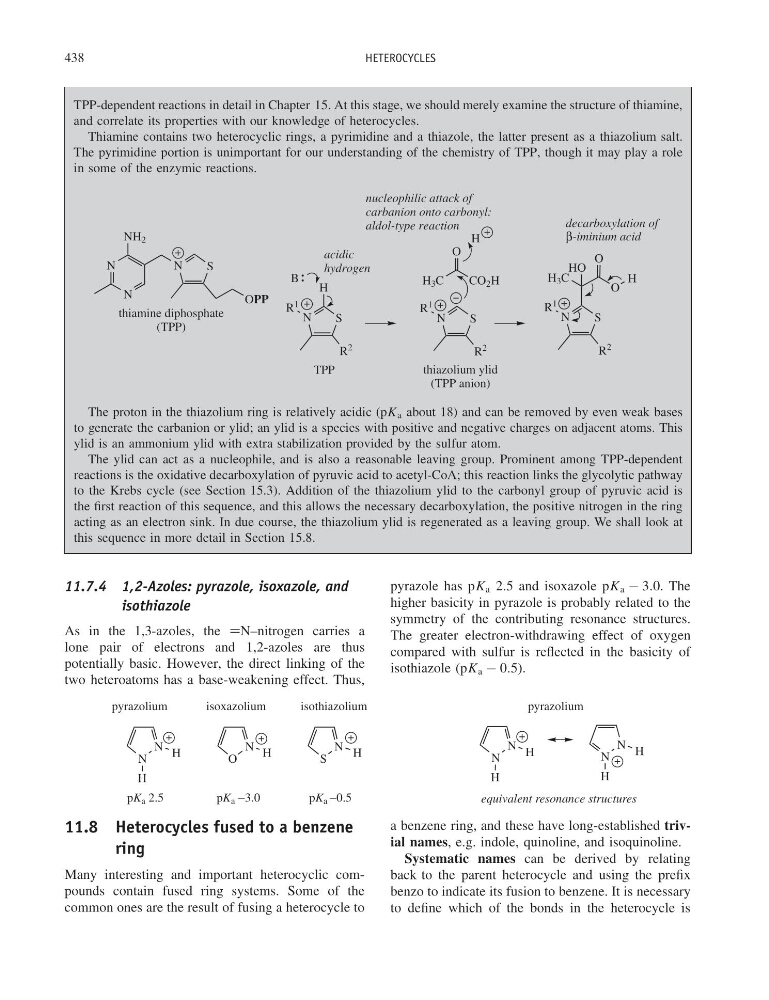
TPP-dependent reactions in detail in Chapter 15. At this stage, we should merely examine the structure of thiamine,
and correlate its properties with our knowledge of heterocycles.
Thiamine contains two heterocyclic rings, a pyrimidine and a thiazole, the latter present as a thiazolium salt.
The pyrimidine portion is unimportant for our understanding of the chemistry of TPP, though it may play a role
in some of the enzymic reactions.
N
N
N
S
OPP
NH 2
thiamine diphosphate
(TPP)
R 1
N
S
R 2
H
R 1
N
S
R 2
H 3 C
CO 2 H
O
R 1
N
S
R 2
H 3 C
HO
nucleophilic attack of
carbanion onto carbonyl:
aldol-type reaction
acidic
hydrogen
thiazolium ylid
(TPP anion)
O
O
H
decarboxylation of
β-iminium acid
B
H
TPP
The proton in the thiazolium ring is relatively acidic (pK a about 18) and can be removed by even weak bases
to generate the carbanion or ylid; an ylid is a species with positive and negative charges on adjacent atoms. This
ylid is an ammonium ylid with extra stabilization provided by the sulfur atom.
The ylid can act as a nucleophile, and is also a reasonable leaving group. Prominent among TPP-dependent
reactions is the oxidative decarboxylation of pyruvic acid to acetyl-CoA; this reaction links the glycolytic pathway
to the Krebs cycle (see Section 15.3). Addition of the thiazolium ylid to the carbonyl group of pyruvic acid is
the first reaction of this sequence, and this allows the necessary decarboxylation, the positive nitrogen in the ring
acting as an electron sink. In due course, the thiazolium ylid is regenerated as a leaving group. We shall look at
this sequence in more detail in Section 15.8.
11.7.4 1,2-Azoles: pyrazole, isoxazole, and
isothiazole
As in the 1,3-azoles, the =N–nitrogen carries a
lone pair of electrons and 1,2-azoles are thus
potentially basic. However, the direct linking of the
two heteroatoms has a base-weakening effect. Thus,
pyrazole has pK a 2.5 and isoxazole pK a − 3.0. The
higher basicity in pyrazole is probably related to the
symmetry of the contributing resonance structures.
The greater electron-withdrawing effect of oxygen
compared with sulfur is reflected in the basicity of
isothiazole (pK a − 0.5).
N
N
N
O
N
S
pK a 2.5
pK a −3.0
pK a −0.5
H
H
H
pyrazolium
isothiazolium
isoxazolium
N
N
H
pyrazolium
N
N
H
H
H
equivalent resonance structures
H
11.8 Heterocycles fused to a benzene
ring
Many interesting and important heterocyclic compounds contain fused ring systems. Some of the
common ones are the result of fusing a heterocycle to
a benzene ring, and these have long-established trivial names, e.g. indole, quinoline, and isoquinoline.
Systematic names can be derived by relating
back to the parent heterocycle and using the prefix
benzo to indicate its fusion to benzene. It is necessary
to define which of the bonds in the heterocycle is
HETEROCYCLES
TPP-dependent reactions in detail in Chapter 15. At this stage, we should merely examine the structure of thiamine,
and correlate its properties with our knowledge of heterocycles.
Thiamine contains two heterocyclic rings, a pyrimidine and a thiazole, the latter present as a thiazolium salt.
The pyrimidine portion is unimportant for our understanding of the chemistry of TPP, though it may play a role
in some of the enzymic reactions.
N
N
N
S
OPP
NH 2
thiamine diphosphate
(TPP)
R 1
N
S
R 2
H
R 1
N
S
R 2
H 3 C
CO 2 H
O
R 1
N
S
R 2
H 3 C
HO
nucleophilic attack of
carbanion onto carbonyl:
aldol-type reaction
acidic
hydrogen
thiazolium ylid
(TPP anion)
O
O
H
decarboxylation of
β-iminium acid
B
H
TPP
The proton in the thiazolium ring is relatively acidic (pK a about 18) and can be removed by even weak bases
to generate the carbanion or ylid; an ylid is a species with positive and negative charges on adjacent atoms. This
ylid is an ammonium ylid with extra stabilization provided by the sulfur atom.
The ylid can act as a nucleophile, and is also a reasonable leaving group. Prominent among TPP-dependent
reactions is the oxidative decarboxylation of pyruvic acid to acetyl-CoA; this reaction links the glycolytic pathway
to the Krebs cycle (see Section 15.3). Addition of the thiazolium ylid to the carbonyl group of pyruvic acid is
the first reaction of this sequence, and this allows the necessary decarboxylation, the positive nitrogen in the ring
acting as an electron sink. In due course, the thiazolium ylid is regenerated as a leaving group. We shall look at
this sequence in more detail in Section 15.8.
11.7.4 1,2-Azoles: pyrazole, isoxazole, and
isothiazole
As in the 1,3-azoles, the =N–nitrogen carries a
lone pair of electrons and 1,2-azoles are thus
potentially basic. However, the direct linking of the
two heteroatoms has a base-weakening effect. Thus,
pyrazole has pK a 2.5 and isoxazole pK a − 3.0. The
higher basicity in pyrazole is probably related to the
symmetry of the contributing resonance structures.
The greater electron-withdrawing effect of oxygen
compared with sulfur is reflected in the basicity of
isothiazole (pK a − 0.5).
N
N
N
O
N
S
pK a 2.5
pK a −3.0
pK a −0.5
H
H
H
pyrazolium
isothiazolium
isoxazolium
N
N
H
pyrazolium
N
N
H
H
H
equivalent resonance structures
H
11.8 Heterocycles fused to a benzene
ring
Many interesting and important heterocyclic compounds contain fused ring systems. Some of the
common ones are the result of fusing a heterocycle to
a benzene ring, and these have long-established trivial names, e.g. indole, quinoline, and isoquinoline.
Systematic names can be derived by relating
back to the parent heterocycle and using the prefix
benzo to indicate its fusion to benzene. It is necessary
to define which of the bonds in the heterocycle is