

FIVE-MEMBERED RINGS WITH TWO HETEROATOMS
437
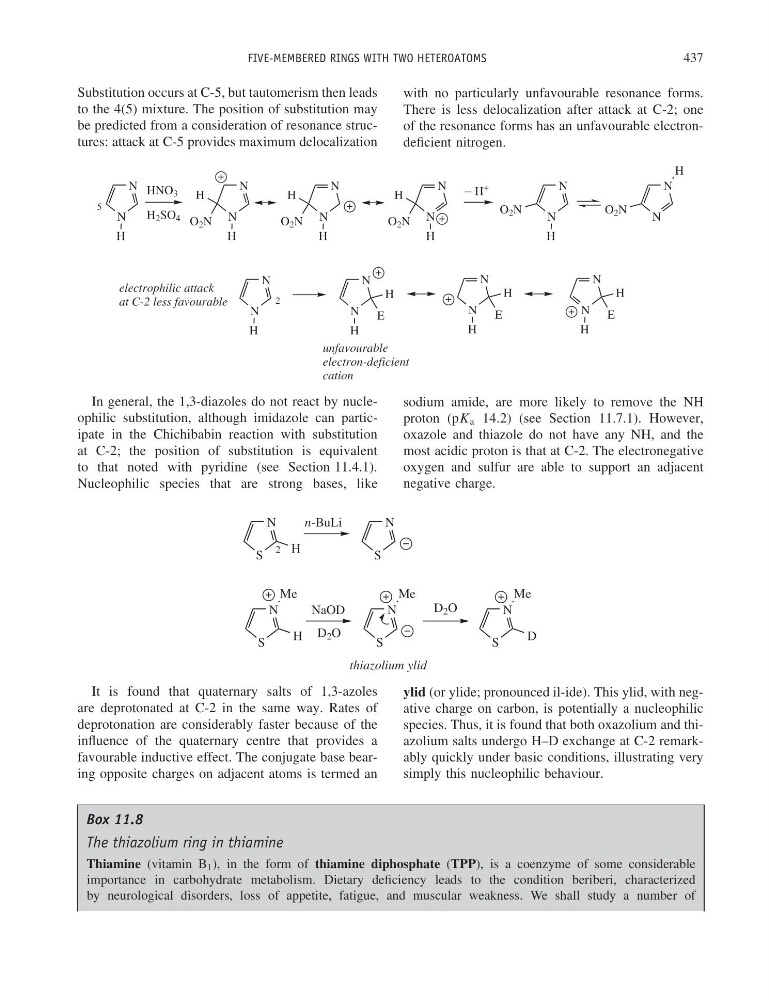
Substitution occurs at C-5, but tautomerism then leads
to the 4(5) mixture. The position of substitution may
be predicted from a consideration of resonance structures: attack at C-5 provides maximum delocalization
with no particularly unfavourable resonance forms.
There is less delocalization after attack at C-2; one
of the resonance forms has an unfavourable electrondeficient nitrogen.
N
N
H
N
N
H
O 2 N
H
HNO 3
H 2 SO 4
N
N
H
O 2 N
H
N
N
H
O 2 N
H
N
N
H
O 2 N
− H +
N
N
O 2 N
H
5
N
N
H
2
N
N
H
E
H
N
N
H
E
H
N
N
H
E
H
unfavourable
electron-deficient
cation
electrophilic attack
at C-2 less favourable
In general, the 1,3-diazoles do not react by nucleophilic substitution, although imidazole can participate in the Chichibabin reaction with substitution
at C-2; the position of substitution is equivalent
to that noted with pyridine (see Section 11.4.1).
Nucleophilic species that are strong bases, like
sodium amide, are more likely to remove the NH
proton (pK a 14.2) (see Section 11.7.1). However,
oxazole and thiazole do not have any NH, and the
most acidic proton is that at C-2. The electronegative
oxygen and sulfur are able to support an adjacent
negative charge.
N
S
H
N
S
N
S
H
N
S
Me
Me
NaOD
D 2 O
N
S
D
Me
D 2 O
n-BuLi
2
thiazolium ylid
It is found that quaternary salts of 1,3-azoles
are deprotonated at C-2 in the same way. Rates of
deprotonation are considerably faster because of the
influence of the quaternary centre that provides a
favourable inductive effect. The conjugate base bearing opposite charges on adjacent atoms is termed an
ylid (or ylide; pronounced il-ide). This ylid, with negative charge on carbon, is potentially a nucleophilic
species. Thus, it is found that both oxazolium and thiazolium salts undergo H–D exchange at C-2 remarkably quickly under basic conditions, illustrating very
simply this nucleophilic behaviour.
Box 11.8
The thiazolium ring in thiamine
Thiamine (vitamin B 1 ), in the form of thiamine diphosphate (TPP), is a coenzyme of some considerable
importance in carbohydrate metabolism. Dietary deficiency leads to the condition beriberi, characterized
by neurological disorders, loss of appetite, fatigue, and muscular weakness. We shall study a number of
437
Substitution occurs at C-5, but tautomerism then leads
to the 4(5) mixture. The position of substitution may
be predicted from a consideration of resonance structures: attack at C-5 provides maximum delocalization
with no particularly unfavourable resonance forms.
There is less delocalization after attack at C-2; one
of the resonance forms has an unfavourable electrondeficient nitrogen.
N
N
H
N
N
H
O 2 N
H
HNO 3
H 2 SO 4
N
N
H
O 2 N
H
N
N
H
O 2 N
H
N
N
H
O 2 N
− H +
N
N
O 2 N
H
5
N
N
H
2
N
N
H
E
H
N
N
H
E
H
N
N
H
E
H
unfavourable
electron-deficient
cation
electrophilic attack
at C-2 less favourable
In general, the 1,3-diazoles do not react by nucleophilic substitution, although imidazole can participate in the Chichibabin reaction with substitution
at C-2; the position of substitution is equivalent
to that noted with pyridine (see Section 11.4.1).
Nucleophilic species that are strong bases, like
sodium amide, are more likely to remove the NH
proton (pK a 14.2) (see Section 11.7.1). However,
oxazole and thiazole do not have any NH, and the
most acidic proton is that at C-2. The electronegative
oxygen and sulfur are able to support an adjacent
negative charge.
N
S
H
N
S
N
S
H
N
S
Me
Me
NaOD
D 2 O
N
S
D
Me
D 2 O
n-BuLi
2
thiazolium ylid
It is found that quaternary salts of 1,3-azoles
are deprotonated at C-2 in the same way. Rates of
deprotonation are considerably faster because of the
influence of the quaternary centre that provides a
favourable inductive effect. The conjugate base bearing opposite charges on adjacent atoms is termed an
ylid (or ylide; pronounced il-ide). This ylid, with negative charge on carbon, is potentially a nucleophilic
species. Thus, it is found that both oxazolium and thiazolium salts undergo H–D exchange at C-2 remarkably quickly under basic conditions, illustrating very
simply this nucleophilic behaviour.
Box 11.8
The thiazolium ring in thiamine
Thiamine (vitamin B 1 ), in the form of thiamine diphosphate (TPP), is a coenzyme of some considerable
importance in carbohydrate metabolism. Dietary deficiency leads to the condition beriberi, characterized
by neurological disorders, loss of appetite, fatigue, and muscular weakness. We shall study a number of