

436
HETEROCYCLES
Box 11.7 (continued)
S
HN
N
H 3 C
H
N
H
N
N
CN
cimetidine
S
O
H
N
H
N
NO 2
ranitidine
N
H 3 C
H 3 C
S
S
N
H
N
H
N
NO 2
nizatidine
N
H 3 C
H 3 C
CH 3
CH 3
CH 3
O
diphenhydramine
NMe 2
H 1 receptor antagonist
H 2 receptor antagonists
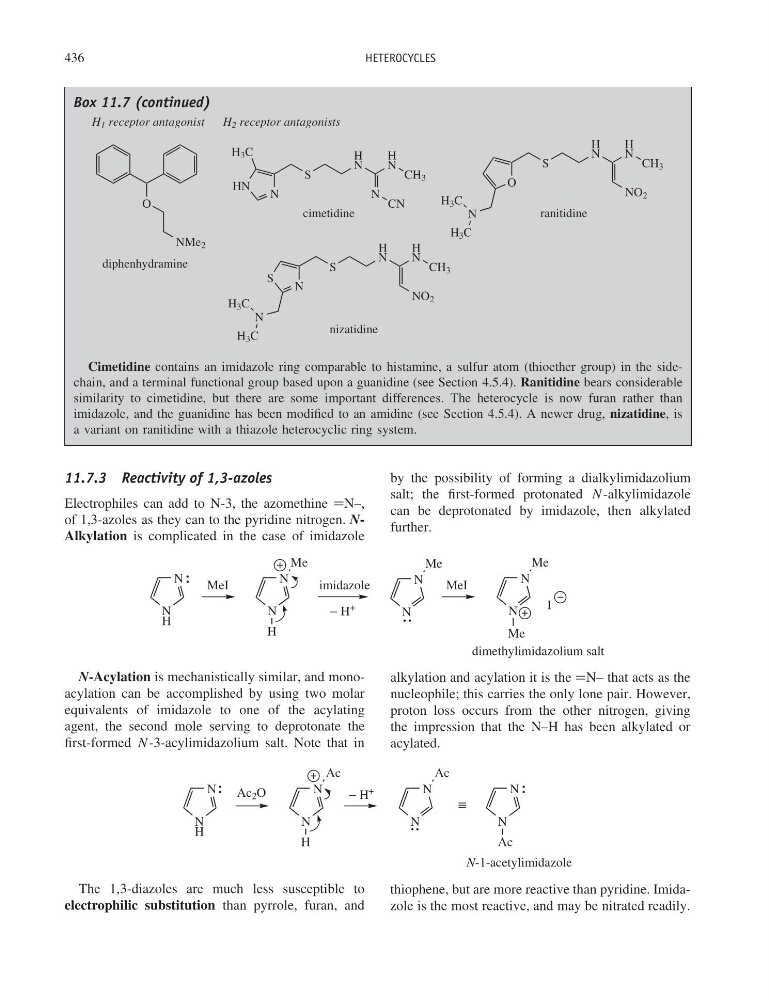
Cimetidine contains an imidazole ring comparable to histamine, a sulfur atom (thioether group) in the sidechain, and a terminal functional group based upon a guanidine (see Section 4.5.4). Ranitidine bears considerable
similarity to cimetidine, but there are some important differences. The heterocycle is now furan rather than
imidazole, and the guanidine has been modified to an amidine (see Section 4.5.4). A newer drug, nizatidine, is
a variant on ranitidine with a thiazole heterocyclic ring system.
11.7.3 Reactivity of 1,3-azoles
Electrophiles can add to N-3, the azomethine =N–,
of 1,3-azoles as they can to the pyridine nitrogen. NAlkylation is complicated in the case of imidazole
by the possibility of forming a dialkylimidazolium
salt; the first-formed protonated N -alkylimidazole
can be deprotonated by imidazole, then alkylated
further.
N
N
H
MeI
N
N
Me
imidazole
− H
+
N
N
Me
MeI
N
N
Me
Me
I
H
dimethylimidazolium salt
N-Acylation is mechanistically similar, and monoacylation can be accomplished by using two molar
equivalents of imidazole to one of the acylating
agent, the second mole serving to deprotonate the
first-formed N -3-acylimidazolium salt. Note that in
alkylation and acylation it is the =N– that acts as the
nucleophile; this carries the only lone pair. However,
proton loss occurs from the other nitrogen, giving
the impression that the N–H has been alkylated or
acylated.
N
N
H
Ac 2 O
N
N
Ac
H
− H
+
N
N
Ac
N
N
Ac
≡
N-1-acetylimidazole
The 1,3-diazoles are much less susceptible to
electrophilic substitution than pyrrole, furan, and
thiophene, but are more reactive than pyridine. Imidazole is the most reactive, and may be nitrated readily.
HETEROCYCLES
Box 11.7 (continued)
S
HN
N
H 3 C
H
N
H
N
N
CN
cimetidine
S
O
H
N
H
N
NO 2
ranitidine
N
H 3 C
H 3 C
S
S
N
H
N
H
N
NO 2
nizatidine
N
H 3 C
H 3 C
CH 3
CH 3
CH 3
O
diphenhydramine
NMe 2
H 1 receptor antagonist
H 2 receptor antagonists
Cimetidine contains an imidazole ring comparable to histamine, a sulfur atom (thioether group) in the sidechain, and a terminal functional group based upon a guanidine (see Section 4.5.4). Ranitidine bears considerable
similarity to cimetidine, but there are some important differences. The heterocycle is now furan rather than
imidazole, and the guanidine has been modified to an amidine (see Section 4.5.4). A newer drug, nizatidine, is
a variant on ranitidine with a thiazole heterocyclic ring system.
11.7.3 Reactivity of 1,3-azoles
Electrophiles can add to N-3, the azomethine =N–,
of 1,3-azoles as they can to the pyridine nitrogen. NAlkylation is complicated in the case of imidazole
by the possibility of forming a dialkylimidazolium
salt; the first-formed protonated N -alkylimidazole
can be deprotonated by imidazole, then alkylated
further.
N
N
H
MeI
N
N
Me
imidazole
− H
+
N
N
Me
MeI
N
N
Me
Me
I
H
dimethylimidazolium salt
N-Acylation is mechanistically similar, and monoacylation can be accomplished by using two molar
equivalents of imidazole to one of the acylating
agent, the second mole serving to deprotonate the
first-formed N -3-acylimidazolium salt. Note that in
alkylation and acylation it is the =N– that acts as the
nucleophile; this carries the only lone pair. However,
proton loss occurs from the other nitrogen, giving
the impression that the N–H has been alkylated or
acylated.
N
N
H
Ac 2 O
N
N
Ac
H
− H
+
N
N
Ac
N
N
Ac
≡
N-1-acetylimidazole
The 1,3-diazoles are much less susceptible to
electrophilic substitution than pyrrole, furan, and
thiophene, but are more reactive than pyridine. Imidazole is the most reactive, and may be nitrated readily.