

FIVE-MEMBERED RINGS WITH TWO HETEROATOMS
435
ion. The beauty of this is that we effectively have the same mechanism as in the hydrolysis of an ester using
aqueous sodium hydroxide (see Section 7.9.2). However, with the enzyme catalyst, this is all taking place at pH
7 or thereabouts.
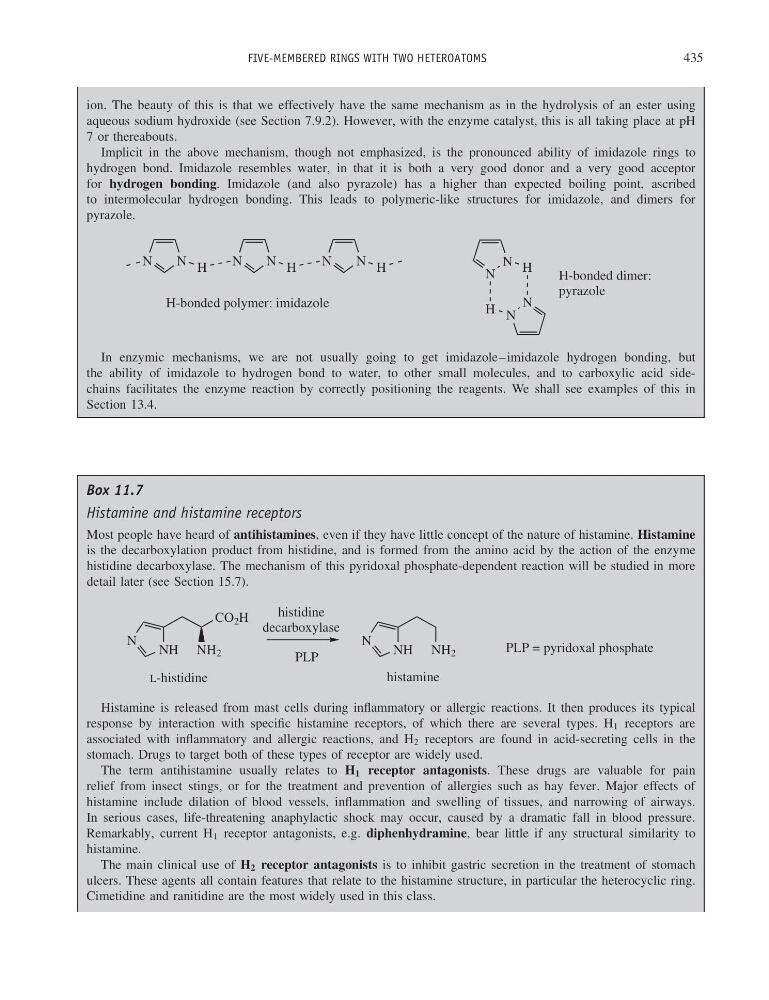
Implicit in the above mechanism, though not emphasized, is the pronounced ability of imidazole rings to
hydrogen bond. Imidazole resembles water, in that it is both a very good donor and a very good acceptor
for hydrogen bonding. Imidazole (and also pyrazole) has a higher than expected boiling point, ascribed
to intermolecular hydrogen bonding. This leads to polymeric-like structures for imidazole, and dimers for
pyrazole.
N
N
N
N
H
N
N H
H
N
N
N
N
H
H
H-bonded dimer:
pyrazole
H-bonded polymer: imidazole
In enzymic mechanisms, we are not usually going to get imidazole–imidazole hydrogen bonding, but
the ability of imidazole to hydrogen bond to water, to other small molecules, and to carboxylic acid sidechains facilitates the enzyme reaction by correctly positioning the reagents. We shall see examples of this in
Section 13.4.
Box 11.7
Histamine and histamine receptors
Most people have heard of antihistamines, even if they have little concept of the nature of histamine. Histamine
is the decarboxylation product from histidine, and is formed from the amino acid by the action of the enzyme
histidine decarboxylase. The mechanism of this pyridoxal phosphate-dependent reaction will be studied in more
detail later (see Section 15.7).
L-histidine
histamine
histidine
decarboxylase
PLP
CO 2 H
NH 2
N
NH
NH 2
N
NH
PLP = pyridoxal phosphate
Histamine is released from mast cells during inflammatory or allergic reactions. It then produces its typical
response by interaction with specific histamine receptors, of which there are several types. H 1 receptors are
associated with inflammatory and allergic reactions, and H 2 receptors are found in acid-secreting cells in the
stomach. Drugs to target both of these types of receptor are widely used.
The term antihistamine usually relates to H 1 receptor antagonists. These drugs are valuable for pain
relief from insect stings, or for the treatment and prevention of allergies such as hay fever. Major effects of
histamine include dilation of blood vessels, inflammation and swelling of tissues, and narrowing of airways.
In serious cases, life-threatening anaphylactic shock may occur, caused by a dramatic fall in blood pressure.
Remarkably, current H 1 receptor antagonists, e.g. diphenhydramine, bear little if any structural similarity to
histamine.
The main clinical use of H 2 receptor antagonists is to inhibit gastric secretion in the treatment of stomach
ulcers. These agents all contain features that relate to the histamine structure, in particular the heterocyclic ring.
Cimetidine and ranitidine are the most widely used in this class.
435
ion. The beauty of this is that we effectively have the same mechanism as in the hydrolysis of an ester using
aqueous sodium hydroxide (see Section 7.9.2). However, with the enzyme catalyst, this is all taking place at pH
7 or thereabouts.
Implicit in the above mechanism, though not emphasized, is the pronounced ability of imidazole rings to
hydrogen bond. Imidazole resembles water, in that it is both a very good donor and a very good acceptor
for hydrogen bonding. Imidazole (and also pyrazole) has a higher than expected boiling point, ascribed
to intermolecular hydrogen bonding. This leads to polymeric-like structures for imidazole, and dimers for
pyrazole.
N
N
N
N
H
N
N H
H
N
N
N
N
H
H
H-bonded dimer:
pyrazole
H-bonded polymer: imidazole
In enzymic mechanisms, we are not usually going to get imidazole–imidazole hydrogen bonding, but
the ability of imidazole to hydrogen bond to water, to other small molecules, and to carboxylic acid sidechains facilitates the enzyme reaction by correctly positioning the reagents. We shall see examples of this in
Section 13.4.
Box 11.7
Histamine and histamine receptors
Most people have heard of antihistamines, even if they have little concept of the nature of histamine. Histamine
is the decarboxylation product from histidine, and is formed from the amino acid by the action of the enzyme
histidine decarboxylase. The mechanism of this pyridoxal phosphate-dependent reaction will be studied in more
detail later (see Section 15.7).
L-histidine
histamine
histidine
decarboxylase
PLP
CO 2 H
NH 2
N
NH
NH 2
N
NH
PLP = pyridoxal phosphate
Histamine is released from mast cells during inflammatory or allergic reactions. It then produces its typical
response by interaction with specific histamine receptors, of which there are several types. H 1 receptors are
associated with inflammatory and allergic reactions, and H 2 receptors are found in acid-secreting cells in the
stomach. Drugs to target both of these types of receptor are widely used.
The term antihistamine usually relates to H 1 receptor antagonists. These drugs are valuable for pain
relief from insect stings, or for the treatment and prevention of allergies such as hay fever. Major effects of
histamine include dilation of blood vessels, inflammation and swelling of tissues, and narrowing of airways.
In serious cases, life-threatening anaphylactic shock may occur, caused by a dramatic fall in blood pressure.
Remarkably, current H 1 receptor antagonists, e.g. diphenhydramine, bear little if any structural similarity to
histamine.
The main clinical use of H 2 receptor antagonists is to inhibit gastric secretion in the treatment of stomach
ulcers. These agents all contain features that relate to the histamine structure, in particular the heterocyclic ring.
Cimetidine and ranitidine are the most widely used in this class.