

434
HETEROCYCLES
Box 11.6
The imidazole ring of histidine: acid–base properties
The amino acid histidine contains an imidazole ring. We have just seen that unsubstituted imidazole as a base
has pK a 7.0. From the Henderson–Hasselbalch equation
pH = pK a + log
[base]
[acid]
we can deduce that in water, at pH 7, the concentrations of acid and conjugate base are equal, i.e. imidazole is
50% protonated (see Section 4.9).
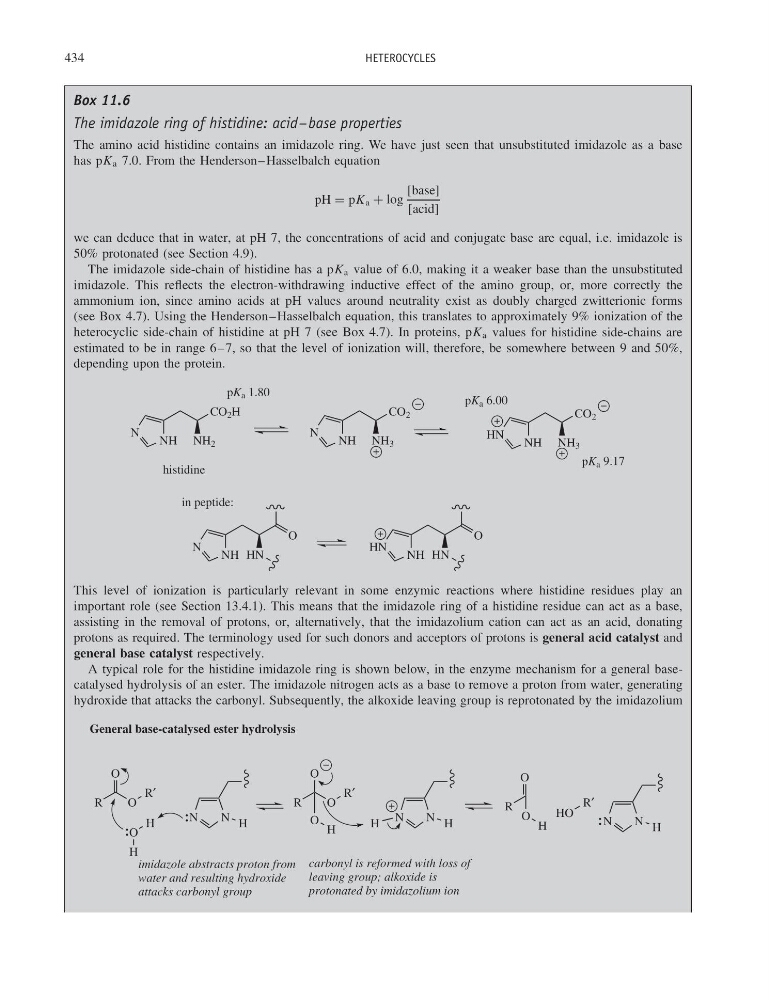
The imidazole side-chain of histidine has a pK a value of 6.0, making it a weaker base than the unsubstituted
imidazole. This reflects the electron-withdrawing inductive effect of the amino group, or, more correctly the
ammonium ion, since amino acids at pH values around neutrality exist as doubly charged zwitterionic forms
(see Box 4.7). Using the Henderson–Hasselbalch equation, this translates to approximately 9% ionization of the
heterocyclic side-chain of histidine at pH 7 (see Box 4.7). In proteins, pK a values for histidine side-chains are
estimated to be in range 6–7, so that the level of ionization will, therefore, be somewhere between 9 and 50%,
depending upon the protein.
CO 2 H
NH 2
N
NH
histidine
pK a 6.00
pK a 1.80
pK a 9.17
CO 2
NH 3
HN
NH
HN
N
NH
O
HN
HN
NH
O
in peptide:
CO 2
NH 3
N
NH
This level of ionization is particularly relevant in some enzymic reactions where histidine residues play an
important role (see Section 13.4.1). This means that the imidazole ring of a histidine residue can act as a base,
assisting in the removal of protons, or, alternatively, that the imidazolium cation can act as an acid, donating
protons as required. The terminology used for such donors and acceptors of protons is general acid catalyst and
general base catalyst respectively.
A typical role for the histidine imidazole ring is shown below, in the enzyme mechanism for a general basecatalysed hydrolysis of an ester. The imidazole nitrogen acts as a base to remove a proton from water, generating
hydroxide that attacks the carbonyl. Subsequently, the alkoxide leaving group is reprotonated by the imidazolium
N
N H
General base-catalysed ester hydrolysis
O
R
O
R′
O
H
H
N
N H
O
R
O
R′
H
O
H
N
N H
O
R
HO
R′
O
H
imidazole abstracts proton from
water and resulting hydroxide
attacks carbonyl group
carbonyl is reformed with loss of
leaving group; alkoxide is
protonated by imidazolium ion
HETEROCYCLES
Box 11.6
The imidazole ring of histidine: acid–base properties
The amino acid histidine contains an imidazole ring. We have just seen that unsubstituted imidazole as a base
has pK a 7.0. From the Henderson–Hasselbalch equation
pH = pK a + log
[base]
[acid]
we can deduce that in water, at pH 7, the concentrations of acid and conjugate base are equal, i.e. imidazole is
50% protonated (see Section 4.9).
The imidazole side-chain of histidine has a pK a value of 6.0, making it a weaker base than the unsubstituted
imidazole. This reflects the electron-withdrawing inductive effect of the amino group, or, more correctly the
ammonium ion, since amino acids at pH values around neutrality exist as doubly charged zwitterionic forms
(see Box 4.7). Using the Henderson–Hasselbalch equation, this translates to approximately 9% ionization of the
heterocyclic side-chain of histidine at pH 7 (see Box 4.7). In proteins, pK a values for histidine side-chains are
estimated to be in range 6–7, so that the level of ionization will, therefore, be somewhere between 9 and 50%,
depending upon the protein.
CO 2 H
NH 2
N
NH
histidine
pK a 6.00
pK a 1.80
pK a 9.17
CO 2
NH 3
HN
NH
HN
N
NH
O
HN
HN
NH
O
in peptide:
CO 2
NH 3
N
NH
This level of ionization is particularly relevant in some enzymic reactions where histidine residues play an
important role (see Section 13.4.1). This means that the imidazole ring of a histidine residue can act as a base,
assisting in the removal of protons, or, alternatively, that the imidazolium cation can act as an acid, donating
protons as required. The terminology used for such donors and acceptors of protons is general acid catalyst and
general base catalyst respectively.
A typical role for the histidine imidazole ring is shown below, in the enzyme mechanism for a general basecatalysed hydrolysis of an ester. The imidazole nitrogen acts as a base to remove a proton from water, generating
hydroxide that attacks the carbonyl. Subsequently, the alkoxide leaving group is reprotonated by the imidazolium
N
N H
General base-catalysed ester hydrolysis
O
R
O
R′
O
H
H
N
N H
O
R
O
R′
H
O
H
N
N H
O
R
HO
R′
O
H
imidazole abstracts proton from
water and resulting hydroxide
attacks carbonyl group
carbonyl is reformed with loss of
leaving group; alkoxide is
protonated by imidazolium ion