

SIX-MEMBERED RINGS WITH TWO HETEROATOMS
429
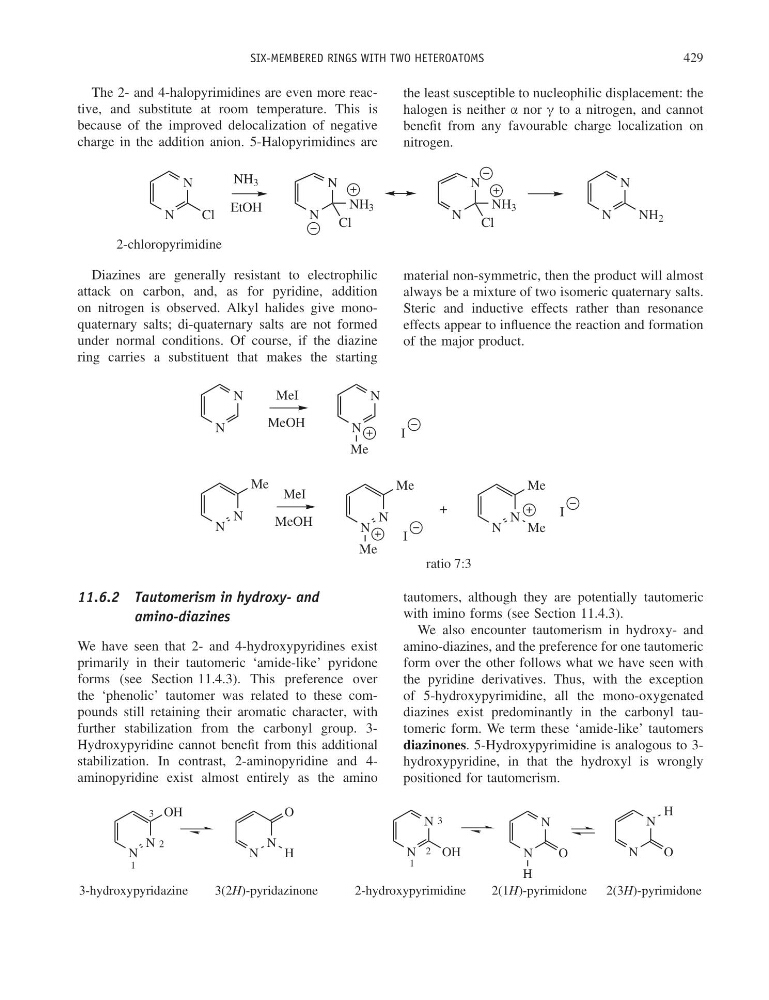
The 2- and 4-halopyrimidines are even more reactive, and substitute at room temperature. This is
because of the improved delocalization of negative
charge in the addition anion. 5-Halopyrimidines are
the least susceptible to nucleophilic displacement: the
halogen is neither α nor γ to a nitrogen, and cannot
benefit from any favourable charge localization on
nitrogen.
N
N
N
N
NH 3
Cl
N
N
NH 3
Cl
Cl
NH 3
EtOH
N
N
NH 2
2-chloropyrimidine
Diazines are generally resistant to electrophilic
attack on carbon, and, as for pyridine, addition
on nitrogen is observed. Alkyl halides give monoquaternary salts; di-quaternary salts are not formed
under normal conditions. Of course, if the diazine
ring carries a substituent that makes the starting
material non-symmetric, then the product will almost
always be a mixture of two isomeric quaternary salts.
Steric and inductive effects rather than resonance
effects appear to influence the reaction and formation
of the major product.
N
N
MeI
MeOH
N
N
Me
I
N
N
Me
MeI
MeOH
N
N
Me
N
N
Me
Me
Me
I
I
+
ratio 7:3
11.6.2 Tautomerism in hydroxy- and
amino-diazines
We have seen that 2- and 4-hydroxypyridines exist
primarily in their tautomeric ‘amide-like’ pyridone
forms (see Section 11.4.3). This preference over
the ‘phenolic’ tautomer was related to these compounds still retaining their aromatic character, with
further stabilization from the carbonyl group. 3Hydroxypyridine cannot benefit from this additional
stabilization. In contrast, 2-aminopyridine and 4aminopyridine exist almost entirely as the amino
tautomers, although they are potentially tautomeric
with imino forms (see Section 11.4.3).
We also encounter tautomerism in hydroxy- and
amino-diazines, and the preference for one tautomeric
form over the other follows what we have seen with
the pyridine derivatives. Thus, with the exception
of 5-hydroxypyrimidine, all the mono-oxygenated
diazines exist predominantly in the carbonyl tautomeric form. We term these ‘amide-like’ tautomers
diazinones. 5-Hydroxypyrimidine is analogous to 3hydroxypyridine, in that the hydroxyl is wrongly
positioned for tautomerism.
N
N
N
N
OH
N
N
N
N
O
H
OH
O
H
3(2H)-pyridazinone
2(1H)-pyrimidone 2(3H)-pyrimidone
N
N
O
H
3-hydroxypyridazine
2-hydroxypyrimidine
3
1
2
1
2
3
429
The 2- and 4-halopyrimidines are even more reactive, and substitute at room temperature. This is
because of the improved delocalization of negative
charge in the addition anion. 5-Halopyrimidines are
the least susceptible to nucleophilic displacement: the
halogen is neither α nor γ to a nitrogen, and cannot
benefit from any favourable charge localization on
nitrogen.
N
N
N
N
NH 3
Cl
N
N
NH 3
Cl
Cl
NH 3
EtOH
N
N
NH 2
2-chloropyrimidine
Diazines are generally resistant to electrophilic
attack on carbon, and, as for pyridine, addition
on nitrogen is observed. Alkyl halides give monoquaternary salts; di-quaternary salts are not formed
under normal conditions. Of course, if the diazine
ring carries a substituent that makes the starting
material non-symmetric, then the product will almost
always be a mixture of two isomeric quaternary salts.
Steric and inductive effects rather than resonance
effects appear to influence the reaction and formation
of the major product.
N
N
MeI
MeOH
N
N
Me
I
N
N
Me
MeI
MeOH
N
N
Me
N
N
Me
Me
Me
I
I
+
ratio 7:3
11.6.2 Tautomerism in hydroxy- and
amino-diazines
We have seen that 2- and 4-hydroxypyridines exist
primarily in their tautomeric ‘amide-like’ pyridone
forms (see Section 11.4.3). This preference over
the ‘phenolic’ tautomer was related to these compounds still retaining their aromatic character, with
further stabilization from the carbonyl group. 3Hydroxypyridine cannot benefit from this additional
stabilization. In contrast, 2-aminopyridine and 4aminopyridine exist almost entirely as the amino
tautomers, although they are potentially tautomeric
with imino forms (see Section 11.4.3).
We also encounter tautomerism in hydroxy- and
amino-diazines, and the preference for one tautomeric
form over the other follows what we have seen with
the pyridine derivatives. Thus, with the exception
of 5-hydroxypyrimidine, all the mono-oxygenated
diazines exist predominantly in the carbonyl tautomeric form. We term these ‘amide-like’ tautomers
diazinones. 5-Hydroxypyrimidine is analogous to 3hydroxypyridine, in that the hydroxyl is wrongly
positioned for tautomerism.
N
N
N
N
OH
N
N
N
N
O
H
OH
O
H
3(2H)-pyridazinone
2(1H)-pyrimidone 2(3H)-pyrimidone
N
N
O
H
3-hydroxypyridazine
2-hydroxypyrimidine
3
1
2
1
2
3