

430
HETEROCYCLES
N
N
N
N
N
N
N
N
N
N
N
N
OH
H
O
OH
O
H
OH
O
H
N
N
O
H
2(1H)-pyrazinone
4(1H)-pyridazinone
4(3H)-pyrimidone
4(1H)-pyrimidone
4-hydroxypyridazine
4-hydroxypyrimidine
2-hydroxypyrazine
1
2
4
1
4
2
1
3
4
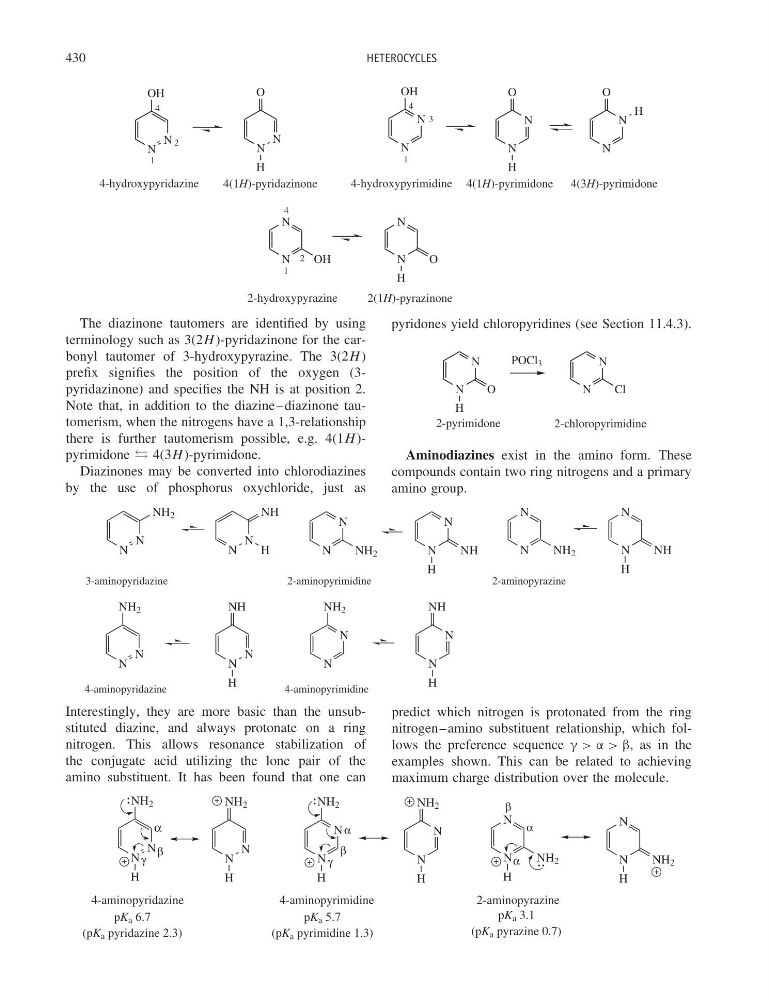
The diazinone tautomers are identified by using
terminology such as 3(2H )-pyridazinone for the carbonyl tautomer of 3-hydroxypyrazine. The 3(2H )
prefix signifies the position of the oxygen (3pyridazinone) and specifies the NH is at position 2.
Note that, in addition to the diazine–diazinone tautomerism, when the nitrogens have a 1,3-relationship
there is further tautomerism possible, e.g. 4(1H )pyrimidone 4(3H )-pyrimidone.
Diazinones may be converted into chlorodiazines
by the use of phosphorus oxychloride, just as
pyridones yield chloropyridines (see Section 11.4.3).
N
N
O
H
2-pyrimidone
POCl 3
N
N
Cl
2-chloropyrimidine
Aminodiazines exist in the amino form. These
compounds contain two ring nitrogens and a primary
amino group.
N
N
N
N
N
N
NH 2
N
N
N
N
N
N
NH
H
N
N
N
N
N
N
N
N
NH 2
H
NH
NH 2
NH
H
NH 2
NH
NH 2
NH
H
H
3-aminopyridazine
4-aminopyridazine
2-aminopyrimidine
4-aminopyrimidine
2-aminopyrazine
Interestingly, they are more basic than the unsubstituted diazine, and always protonate on a ring
nitrogen. This allows resonance stabilization of
the conjugate acid utilizing the lone pair of the
amino substituent. It has been found that one can
predict which nitrogen is protonated from the ring
nitrogen–amino substituent relationship, which follows the preference sequence γ > α > β, as in the
examples shown. This can be related to achieving
maximum charge distribution over the molecule.
N
N
N
N
NH 2
NH 2
H
H
N
N
N
N
NH 2
NH 2
H
H
N
N
NH 2
N
N
H
NH 2
H
pK a 3.1
(pK a pyrazine 0.7)
4-aminopyrimidine
2-aminopyrazine
4-aminopyridazine
pK a 5.7
(pK a pyrimidine 1.3)
pK a 6.7
(pK a pyridazine 2.3)
α
β
γ
α
β
γ
α
α
β
HETEROCYCLES
N
N
N
N
N
N
N
N
N
N
N
N
OH
H
O
OH
O
H
OH
O
H
N
N
O
H
2(1H)-pyrazinone
4(1H)-pyridazinone
4(3H)-pyrimidone
4(1H)-pyrimidone
4-hydroxypyridazine
4-hydroxypyrimidine
2-hydroxypyrazine
1
2
4
1
4
2
1
3
4
The diazinone tautomers are identified by using
terminology such as 3(2H )-pyridazinone for the carbonyl tautomer of 3-hydroxypyrazine. The 3(2H )
prefix signifies the position of the oxygen (3pyridazinone) and specifies the NH is at position 2.
Note that, in addition to the diazine–diazinone tautomerism, when the nitrogens have a 1,3-relationship
there is further tautomerism possible, e.g. 4(1H )pyrimidone 4(3H )-pyrimidone.
Diazinones may be converted into chlorodiazines
by the use of phosphorus oxychloride, just as
pyridones yield chloropyridines (see Section 11.4.3).
N
N
O
H
2-pyrimidone
POCl 3
N
N
Cl
2-chloropyrimidine
Aminodiazines exist in the amino form. These
compounds contain two ring nitrogens and a primary
amino group.
N
N
N
N
N
N
NH 2
N
N
N
N
N
N
NH
H
N
N
N
N
N
N
N
N
NH 2
H
NH
NH 2
NH
H
NH 2
NH
NH 2
NH
H
H
3-aminopyridazine
4-aminopyridazine
2-aminopyrimidine
4-aminopyrimidine
2-aminopyrazine
Interestingly, they are more basic than the unsubstituted diazine, and always protonate on a ring
nitrogen. This allows resonance stabilization of
the conjugate acid utilizing the lone pair of the
amino substituent. It has been found that one can
predict which nitrogen is protonated from the ring
nitrogen–amino substituent relationship, which follows the preference sequence γ > α > β, as in the
examples shown. This can be related to achieving
maximum charge distribution over the molecule.
N
N
N
N
NH 2
NH 2
H
H
N
N
N
N
NH 2
NH 2
H
H
N
N
NH 2
N
N
H
NH 2
H
pK a 3.1
(pK a pyrazine 0.7)
4-aminopyrimidine
2-aminopyrazine
4-aminopyridazine
pK a 5.7
(pK a pyrimidine 1.3)
pK a 6.7
(pK a pyridazine 2.3)
α
β
γ
α
β
γ
α
α
β