

428
HETEROCYCLES
diazines are much weaker bases than pyridine (pK a
5.2). If we consider the inductive and resonance
effects in pyridine, we have seen that these both draw
electrons towards the nitrogen (see Section 11.3).
Therefore, a second nitrogen will have destabilizing
effects on the conjugate acid formed by protonation
of the first nitrogen. The order of basicity in
pyridazine, pyrimidine, and pyrazine is influenced
by secondary effects, which will not be considered
here. Diprotonation is very difficult and would require
extremely strong acids; in the case of pyridazine, it is
essentially impossible because of the need to establish
positive charges on adjacent atoms.
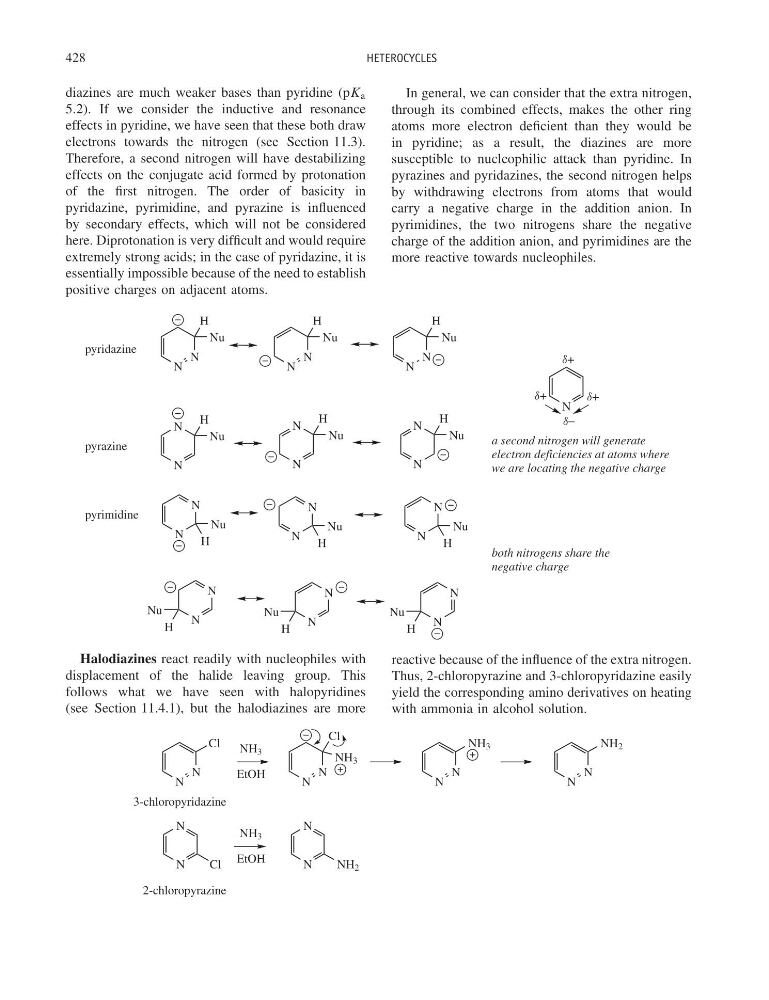
In general, we can consider that the extra nitrogen,
through its combined effects, makes the other ring
atoms more electron deficient than they would be
in pyridine; as a result, the diazines are more
susceptible to nucleophilic attack than pyridine. In
pyrazines and pyridazines, the second nitrogen helps
by withdrawing electrons from atoms that would
carry a negative charge in the addition anion. In
pyrimidines, the two nitrogens share the negative
charge of the addition anion, and pyrimidines are the
more reactive towards nucleophiles.
N
N
N
N
Nu
H
N
N
Nu
H
N
N
Nu
H
Nu
H
N
N
Nu
H
N
N
Nu
H
N
N
Nu
H
N
N
Nu
H
N
N
Nu
H
N
N
N
N
N
N
Nu
H
Nu
Nu
H
H
N
d+
d−
d+
d+
a second nitrogen will generate
electron deficiencies at atoms where
we are locating the negative charge
both nitrogens share the
negative charge
pyridazine
pyrazine
pyrimidine
Halodiazines react readily with nucleophiles with
displacement of the halide leaving group. This
follows what we have seen with halopyridines
(see Section 11.4.1), but the halodiazines are more
reactive because of the influence of the extra nitrogen.
Thus, 2-chloropyrazine and 3-chloropyridazine easily
yield the corresponding amino derivatives on heating
with ammonia in alcohol solution.
N
N
N
N
Cl
Cl
N
N
NH 3
Cl
N
N
NH 3
N
N
NH 2
N
N
NH 2
NH 3
EtOH
NH 3
EtOH
2-chloropyrazine
3-chloropyridazine
HETEROCYCLES
diazines are much weaker bases than pyridine (pK a
5.2). If we consider the inductive and resonance
effects in pyridine, we have seen that these both draw
electrons towards the nitrogen (see Section 11.3).
Therefore, a second nitrogen will have destabilizing
effects on the conjugate acid formed by protonation
of the first nitrogen. The order of basicity in
pyridazine, pyrimidine, and pyrazine is influenced
by secondary effects, which will not be considered
here. Diprotonation is very difficult and would require
extremely strong acids; in the case of pyridazine, it is
essentially impossible because of the need to establish
positive charges on adjacent atoms.
In general, we can consider that the extra nitrogen,
through its combined effects, makes the other ring
atoms more electron deficient than they would be
in pyridine; as a result, the diazines are more
susceptible to nucleophilic attack than pyridine. In
pyrazines and pyridazines, the second nitrogen helps
by withdrawing electrons from atoms that would
carry a negative charge in the addition anion. In
pyrimidines, the two nitrogens share the negative
charge of the addition anion, and pyrimidines are the
more reactive towards nucleophiles.
N
N
N
N
Nu
H
N
N
Nu
H
N
N
Nu
H
Nu
H
N
N
Nu
H
N
N
Nu
H
N
N
Nu
H
N
N
Nu
H
N
N
Nu
H
N
N
N
N
N
N
Nu
H
Nu
Nu
H
H
N
d+
d−
d+
d+
a second nitrogen will generate
electron deficiencies at atoms where
we are locating the negative charge
both nitrogens share the
negative charge
pyridazine
pyrazine
pyrimidine
Halodiazines react readily with nucleophiles with
displacement of the halide leaving group. This
follows what we have seen with halopyridines
(see Section 11.4.1), but the halodiazines are more
reactive because of the influence of the extra nitrogen.
Thus, 2-chloropyrazine and 3-chloropyridazine easily
yield the corresponding amino derivatives on heating
with ammonia in alcohol solution.
N
N
N
N
Cl
Cl
N
N
NH 3
Cl
N
N
NH 3
N
N
NH 2
N
N
NH 2
NH 3
EtOH
NH 3
EtOH
2-chloropyrazine
3-chloropyridazine