

SIX-MEMBERED RINGS WITH TWO HETEROATOMS
427
O
furan
S
thiophene
N
H
dipole
dipole
in pyrrole, larger
resonance effect opposes
inductive effect
dipole
pyrrole
O
tetrahydrofuran
S
tetrahydrothiophene
N
H
dipole
dipole
in saturated compounds,
heteroatom is at negative
end of dipole
dipole
pyrrolidine
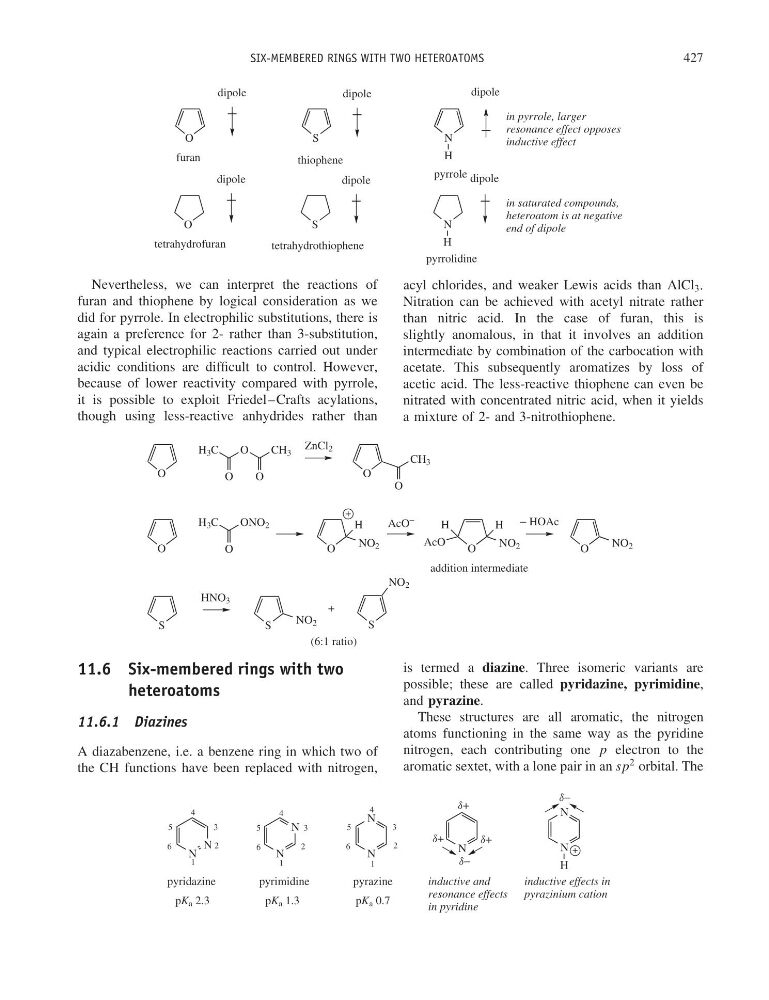
Nevertheless, we can interpret the reactions of
furan and thiophene by logical consideration as we
did for pyrrole. In electrophilic substitutions, there is
again a preference for 2- rather than 3-substitution,
and typical electrophilic reactions carried out under
acidic conditions are difficult to control. However,
because of lower reactivity compared with pyrrole,
it is possible to exploit Friedel–Crafts acylations,
though using less-reactive anhydrides rather than
acyl chlorides, and weaker Lewis acids than AlCl 3 .
Nitration can be achieved with acetyl nitrate rather
than nitric acid. In the case of furan, this is
slightly anomalous, in that it involves an addition
intermediate by combination of the carbocation with
acetate. This subsequently aromatizes by loss of
acetic acid. The less-reactive thiophene can even be
nitrated with concentrated nitric acid, when it yields
a mixture of 2- and 3-nitrothiophene.
O
O
O
CH 3
H 3 C
O
CH 3
O
O
ZnCl 2
O
O
H 3 C
ONO 2
O
NO 2
S
HNO 3
S
S
NO 2
NO 2
(6:1 ratio)
+
O
NO 2
AcO
H
AcO
−
O
NO 2
− HOAc
H
H
addition intermediate
11.6 Six-membered rings with two
heteroatoms
11.6.1 Diazines
A diazabenzene, i.e. a benzene ring in which two of
the CH functions have been replaced with nitrogen,
is termed a diazine. Three isomeric variants are
possible; these are called pyridazine, pyrimidine,
and pyrazine.
These structures are all aromatic, the nitrogen
atoms functioning in the same way as the pyridine
nitrogen, each contributing one p electron to the
aromatic sextet, with a lone pair in an sp
2 orbital. The
N
N
N
N
N
N
pyridazine
pyrimidine
pyrazine
pK a 2.3
pK a 1.3
pK a 0.7
N
N
N
H
inductive and
resonance effects
in pyridine
d+
d−
d+
d+
d−
1
2
3
4
5
6
1
2
3
4
5
6
1
2
3
4
5
6
inductive effects in
pyrazinium cation
427
O
furan
S
thiophene
N
H
dipole
dipole
in pyrrole, larger
resonance effect opposes
inductive effect
dipole
pyrrole
O
tetrahydrofuran
S
tetrahydrothiophene
N
H
dipole
dipole
in saturated compounds,
heteroatom is at negative
end of dipole
dipole
pyrrolidine
Nevertheless, we can interpret the reactions of
furan and thiophene by logical consideration as we
did for pyrrole. In electrophilic substitutions, there is
again a preference for 2- rather than 3-substitution,
and typical electrophilic reactions carried out under
acidic conditions are difficult to control. However,
because of lower reactivity compared with pyrrole,
it is possible to exploit Friedel–Crafts acylations,
though using less-reactive anhydrides rather than
acyl chlorides, and weaker Lewis acids than AlCl 3 .
Nitration can be achieved with acetyl nitrate rather
than nitric acid. In the case of furan, this is
slightly anomalous, in that it involves an addition
intermediate by combination of the carbocation with
acetate. This subsequently aromatizes by loss of
acetic acid. The less-reactive thiophene can even be
nitrated with concentrated nitric acid, when it yields
a mixture of 2- and 3-nitrothiophene.
O
O
O
CH 3
H 3 C
O
CH 3
O
O
ZnCl 2
O
O
H 3 C
ONO 2
O
NO 2
S
HNO 3
S
S
NO 2
NO 2
(6:1 ratio)
+
O
NO 2
AcO
H
AcO
−
O
NO 2
− HOAc
H
H
addition intermediate
11.6 Six-membered rings with two
heteroatoms
11.6.1 Diazines
A diazabenzene, i.e. a benzene ring in which two of
the CH functions have been replaced with nitrogen,
is termed a diazine. Three isomeric variants are
possible; these are called pyridazine, pyrimidine,
and pyrazine.
These structures are all aromatic, the nitrogen
atoms functioning in the same way as the pyridine
nitrogen, each contributing one p electron to the
aromatic sextet, with a lone pair in an sp
2 orbital. The
N
N
N
N
N
N
pyridazine
pyrimidine
pyrazine
pK a 2.3
pK a 1.3
pK a 0.7
N
N
N
H
inductive and
resonance effects
in pyridine
d+
d−
d+
d+
d−
1
2
3
4
5
6
1
2
3
4
5
6
1
2
3
4
5
6
inductive effects in
pyrazinium cation