

426
HETEROCYCLES
Box 11.4 (continued)
porphyrin ring system
corrin ring system
vitamin B 12 (cyanocobalamin)
N
HN
N
NH
NH
N
N
N
N
N
N
N
H
Co
+
CN
CONH 2
CONH 2
H 2 NOC
H 2 NOC
H 2 NOC
CONH 2
O
P
O
OH
O
O
HO
N
N
HO
NH
O
11.5.2 Furan and thiophene
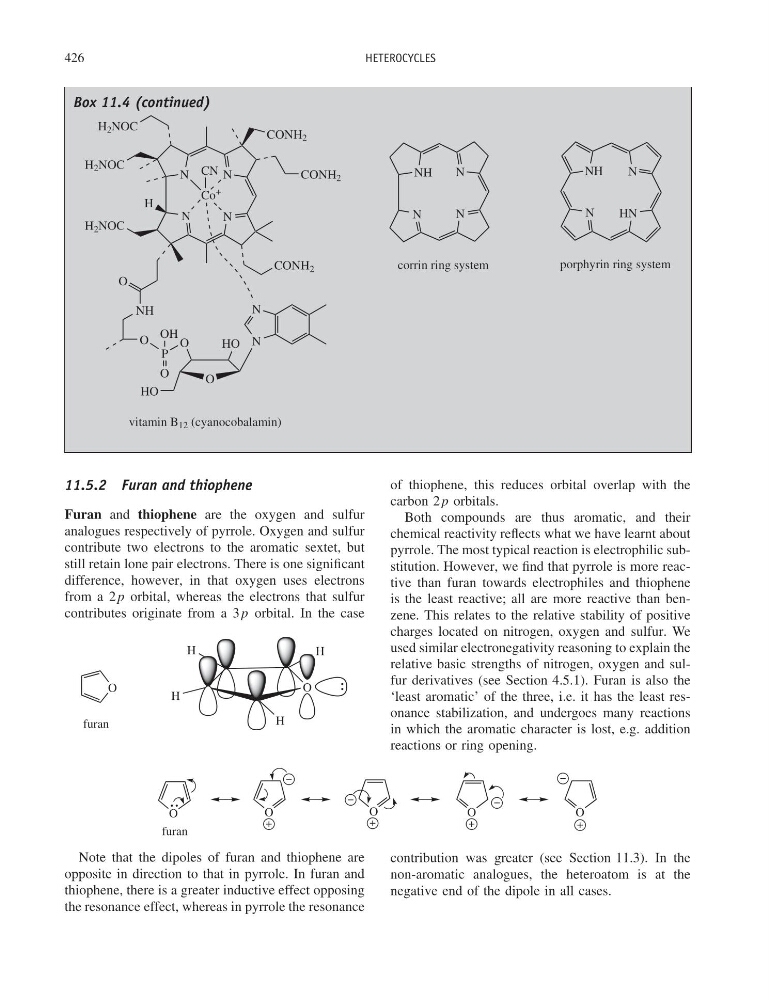
Furan and thiophene are the oxygen and sulfur
analogues respectively of pyrrole. Oxygen and sulfur
contribute two electrons to the aromatic sextet, but
still retain lone pair electrons. There is one significant
difference, however, in that oxygen uses electrons
from a 2p orbital, whereas the electrons that sulfur
contributes originate from a 3p orbital. In the case
O
O
H
H
H
H
furan
of thiophene, this reduces orbital overlap with the
carbon 2p orbitals.
Both compounds are thus aromatic, and their
chemical reactivity reflects what we have learnt about
pyrrole. The most typical reaction is electrophilic substitution. However, we find that pyrrole is more reactive than furan towards electrophiles and thiophene
is the least reactive; all are more reactive than benzene. This relates to the relative stability of positive
charges located on nitrogen, oxygen and sulfur. We
used similar electronegativity reasoning to explain the
relative basic strengths of nitrogen, oxygen and sulfur derivatives (see Section 4.5.1). Furan is also the
‘least aromatic’ of the three, i.e. it has the least resonance stabilization, and undergoes many reactions
in which the aromatic character is lost, e.g. addition
reactions or ring opening.
O
O
O
O
O
furan
Note that the dipoles of furan and thiophene are
opposite in direction to that in pyrrole. In furan and
thiophene, there is a greater inductive effect opposing
the resonance effect, whereas in pyrrole the resonance
contribution was greater (see Section 11.3). In the
non-aromatic analogues, the heteroatom is at the
negative end of the dipole in all cases.
HETEROCYCLES
Box 11.4 (continued)
porphyrin ring system
corrin ring system
vitamin B 12 (cyanocobalamin)
N
HN
N
NH
NH
N
N
N
N
N
N
N
H
Co
+
CN
CONH 2
CONH 2
H 2 NOC
H 2 NOC
H 2 NOC
CONH 2
O
P
O
OH
O
O
HO
N
N
HO
NH
O
11.5.2 Furan and thiophene
Furan and thiophene are the oxygen and sulfur
analogues respectively of pyrrole. Oxygen and sulfur
contribute two electrons to the aromatic sextet, but
still retain lone pair electrons. There is one significant
difference, however, in that oxygen uses electrons
from a 2p orbital, whereas the electrons that sulfur
contributes originate from a 3p orbital. In the case
O
O
H
H
H
H
furan
of thiophene, this reduces orbital overlap with the
carbon 2p orbitals.
Both compounds are thus aromatic, and their
chemical reactivity reflects what we have learnt about
pyrrole. The most typical reaction is electrophilic substitution. However, we find that pyrrole is more reactive than furan towards electrophiles and thiophene
is the least reactive; all are more reactive than benzene. This relates to the relative stability of positive
charges located on nitrogen, oxygen and sulfur. We
used similar electronegativity reasoning to explain the
relative basic strengths of nitrogen, oxygen and sulfur derivatives (see Section 4.5.1). Furan is also the
‘least aromatic’ of the three, i.e. it has the least resonance stabilization, and undergoes many reactions
in which the aromatic character is lost, e.g. addition
reactions or ring opening.
O
O
O
O
O
furan
Note that the dipoles of furan and thiophene are
opposite in direction to that in pyrrole. In furan and
thiophene, there is a greater inductive effect opposing
the resonance effect, whereas in pyrrole the resonance
contribution was greater (see Section 11.3). In the
non-aromatic analogues, the heteroatom is at the
negative end of the dipole in all cases.