

FIVE-MEMBERED AROMATIC HETEROCYCLES
425
Plants and a few microorganisms use photosynthesis to produce organic compounds from inorganic materials
found in the environment, whereas other organisms, such as animals and most microorganisms, rely on obtaining
their raw materials in their diet, e.g. by consuming plants. Haemoglobin, the red pigment in blood, serves to
carry oxygen from the lungs to other parts of the body tissue. This material is made up of the porphyrin haem and
the water-soluble protein globin. The haem component shares many structural features with chlorophyll, one of
the main differences being the use of Fe
2+ as the metal rather than Mg
2+ as in chlorophyll. The oxygen-carrying
ability of haemoglobin involves a six-coordinate iron, with an imidazole ring from the protein (a histidine residue)
occupying the sixth position.
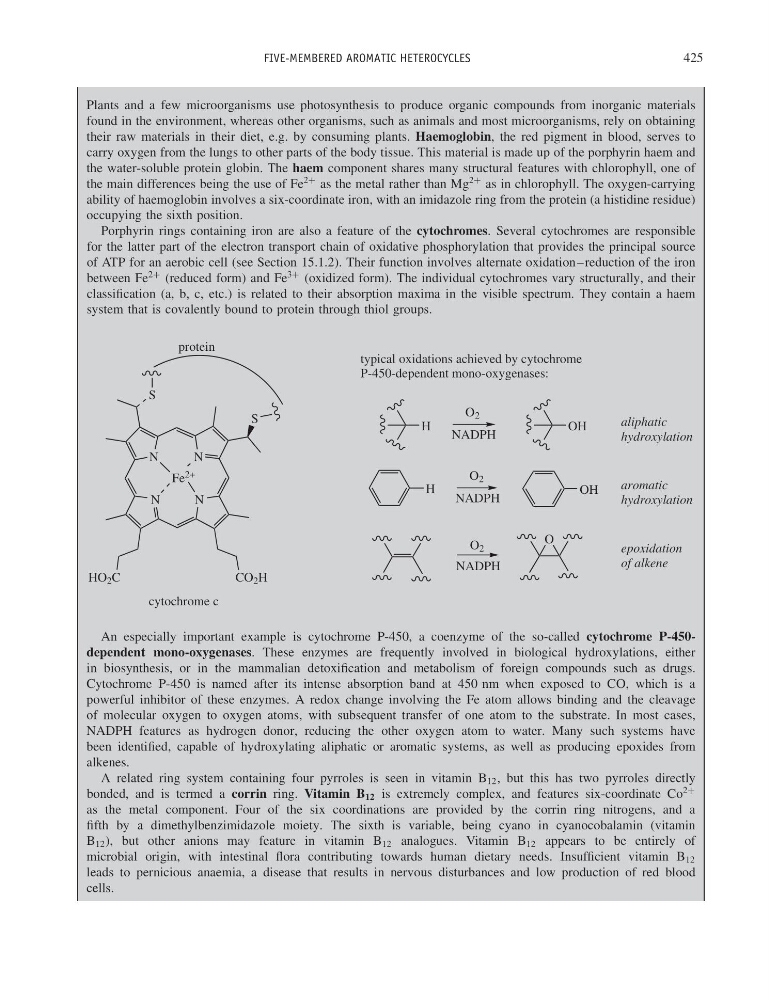
Porphyrin rings containing iron are also a feature of the cytochromes. Several cytochromes are responsible
for the latter part of the electron transport chain of oxidative phosphorylation that provides the principal source
of ATP for an aerobic cell (see Section 15.1.2). Their function involves alternate oxidation–reduction of the iron
between Fe
2+ (reduced form) and Fe
3+ (oxidized form). The individual cytochromes vary structurally, and their
classification (a, b, c, etc.) is related to their absorption maxima in the visible spectrum. They contain a haem
system that is covalently bound to protein through thiol groups.
H
OH
O
NADPH
NADPH
NADPH
typical oxidations achieved by cytochrome
P-450-dependent mono-oxygenases:
H
OH
cytochrome c
N
N
N
N
S
CO 2 H
HO 2 C
Fe 2+
S
protein
aliphatic
hydroxylation
aromatic
hydroxylation
epoxidation
of alkene
O 2
O 2
O 2
An especially important example is cytochrome P-450, a coenzyme of the so-called cytochrome P-450dependent mono-oxygenases. These enzymes are frequently involved in biological hydroxylations, either
in biosynthesis, or in the mammalian detoxification and metabolism of foreign compounds such as drugs.
Cytochrome P-450 is named after its intense absorption band at 450 nm when exposed to CO, which is a
powerful inhibitor of these enzymes. A redox change involving the Fe atom allows binding and the cleavage
of molecular oxygen to oxygen atoms, with subsequent transfer of one atom to the substrate. In most cases,
NADPH features as hydrogen donor, reducing the other oxygen atom to water. Many such systems have
been identified, capable of hydroxylating aliphatic or aromatic systems, as well as producing epoxides from
alkenes.
A related ring system containing four pyrroles is seen in vitamin B 12 , but this has two pyrroles directly
bonded, and is termed a corrin ring. Vitamin B 12 is extremely complex, and features six-coordinate Co
2+
as the metal component. Four of the six coordinations are provided by the corrin ring nitrogens, and a
fifth by a dimethylbenzimidazole moiety. The sixth is variable, being cyano in cyanocobalamin (vitamin
B 12 ), but other anions may feature in vitamin B 12 analogues. Vitamin B 12 appears to be entirely of
microbial origin, with intestinal flora contributing towards human dietary needs. Insufficient vitamin B 12
leads to pernicious anaemia, a disease that results in nervous disturbances and low production of red blood
cells.
425
Plants and a few microorganisms use photosynthesis to produce organic compounds from inorganic materials
found in the environment, whereas other organisms, such as animals and most microorganisms, rely on obtaining
their raw materials in their diet, e.g. by consuming plants. Haemoglobin, the red pigment in blood, serves to
carry oxygen from the lungs to other parts of the body tissue. This material is made up of the porphyrin haem and
the water-soluble protein globin. The haem component shares many structural features with chlorophyll, one of
the main differences being the use of Fe
2+ as the metal rather than Mg
2+ as in chlorophyll. The oxygen-carrying
ability of haemoglobin involves a six-coordinate iron, with an imidazole ring from the protein (a histidine residue)
occupying the sixth position.
Porphyrin rings containing iron are also a feature of the cytochromes. Several cytochromes are responsible
for the latter part of the electron transport chain of oxidative phosphorylation that provides the principal source
of ATP for an aerobic cell (see Section 15.1.2). Their function involves alternate oxidation–reduction of the iron
between Fe
2+ (reduced form) and Fe
3+ (oxidized form). The individual cytochromes vary structurally, and their
classification (a, b, c, etc.) is related to their absorption maxima in the visible spectrum. They contain a haem
system that is covalently bound to protein through thiol groups.
H
OH
O
NADPH
NADPH
NADPH
typical oxidations achieved by cytochrome
P-450-dependent mono-oxygenases:
H
OH
cytochrome c
N
N
N
N
S
CO 2 H
HO 2 C
Fe 2+
S
protein
aliphatic
hydroxylation
aromatic
hydroxylation
epoxidation
of alkene
O 2
O 2
O 2
An especially important example is cytochrome P-450, a coenzyme of the so-called cytochrome P-450dependent mono-oxygenases. These enzymes are frequently involved in biological hydroxylations, either
in biosynthesis, or in the mammalian detoxification and metabolism of foreign compounds such as drugs.
Cytochrome P-450 is named after its intense absorption band at 450 nm when exposed to CO, which is a
powerful inhibitor of these enzymes. A redox change involving the Fe atom allows binding and the cleavage
of molecular oxygen to oxygen atoms, with subsequent transfer of one atom to the substrate. In most cases,
NADPH features as hydrogen donor, reducing the other oxygen atom to water. Many such systems have
been identified, capable of hydroxylating aliphatic or aromatic systems, as well as producing epoxides from
alkenes.
A related ring system containing four pyrroles is seen in vitamin B 12 , but this has two pyrroles directly
bonded, and is termed a corrin ring. Vitamin B 12 is extremely complex, and features six-coordinate Co
2+
as the metal component. Four of the six coordinations are provided by the corrin ring nitrogens, and a
fifth by a dimethylbenzimidazole moiety. The sixth is variable, being cyano in cyanocobalamin (vitamin
B 12 ), but other anions may feature in vitamin B 12 analogues. Vitamin B 12 appears to be entirely of
microbial origin, with intestinal flora contributing towards human dietary needs. Insufficient vitamin B 12
leads to pernicious anaemia, a disease that results in nervous disturbances and low production of red blood
cells.