

424
HETEROCYCLES
Box 11.4 (continued)
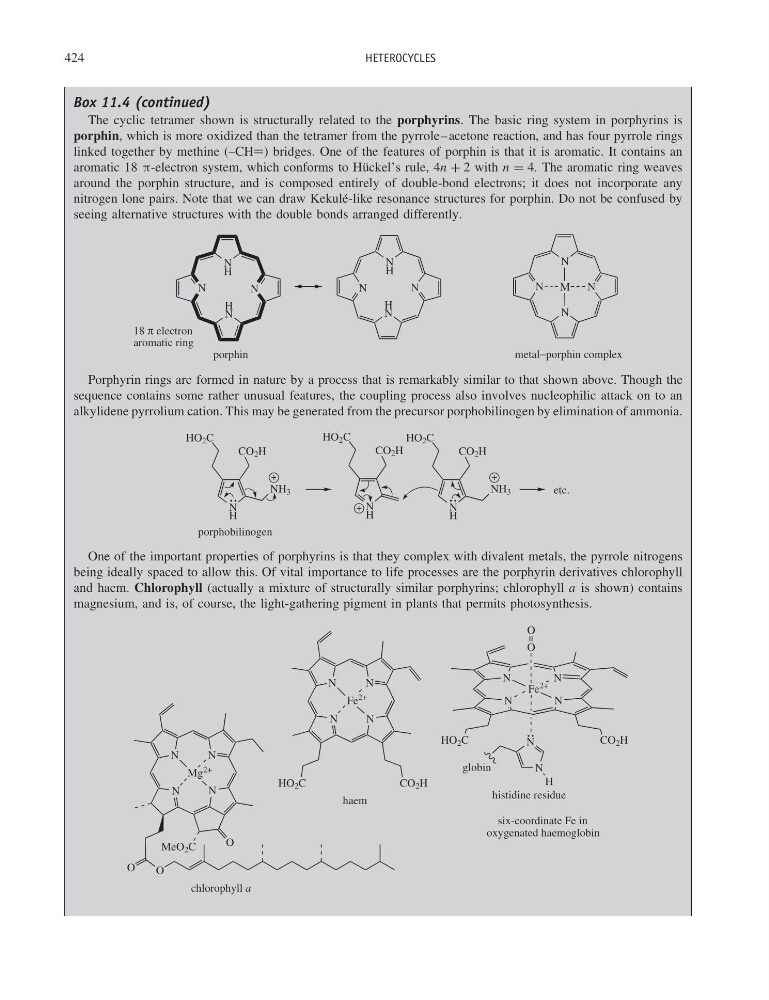
The cyclic tetramer shown is structurally related to the porphyrins. The basic ring system in porphyrins is
porphin, which is more oxidized than the tetramer from the pyrrole–acetone reaction, and has four pyrrole rings
linked together by methine (–CH=) bridges. One of the features of porphin is that it is aromatic. It contains an
aromatic 18 π-electron system, which conforms to H¨ uckel’s rule, 4n + 2 with n = 4. The aromatic ring weaves
around the porphin structure, and is composed entirely of double-bond electrons; it does not incorporate any
nitrogen lone pairs. Note that we can draw Kekul´ e-like resonance structures for porphin. Do not be confused by
seeing alternative structures with the double bonds arranged differently.
porphin
18 π electron
aromatic ring
metal−porphin complex
H
N
N
N
H
N
N
H
N
H
N
N
N
N
N
N M
Porphyrin rings are formed in nature by a process that is remarkably similar to that shown above. Though the
sequence contains some rather unusual features, the coupling process also involves nucleophilic attack on to an
alkylidene pyrrolium cation. This may be generated from the precursor porphobilinogen by elimination of ammonia.
N
H
NH 3
HO 2 C
CO 2 H
N
H
HO 2 C
CO 2 H
N
H
NH 3
HO 2 C
CO 2 H
porphobilinogen
etc.
One of the important properties of porphyrins is that they complex with divalent metals, the pyrrole nitrogens
being ideally spaced to allow this. Of vital importance to life processes are the porphyrin derivatives chlorophyll
and haem. Chlorophyll (actually a mixture of structurally similar porphyrins; chlorophyll a is shown) contains
magnesium, and is, of course, the light-gathering pigment in plants that permits photosynthesis.
chlorophyll a
haem
six-coordinate Fe in
oxygenated haemoglobin
N
N
N
N
CO 2 H
HO 2 C
Fe 2+
N
N
N
N
Mg 2+
O
MeO 2 C
O
O
N
N
N
N
CO 2 H
HO 2 C
Fe
2+
O
O
N
N
H
globin
histidine residue
HETEROCYCLES
Box 11.4 (continued)
The cyclic tetramer shown is structurally related to the porphyrins. The basic ring system in porphyrins is
porphin, which is more oxidized than the tetramer from the pyrrole–acetone reaction, and has four pyrrole rings
linked together by methine (–CH=) bridges. One of the features of porphin is that it is aromatic. It contains an
aromatic 18 π-electron system, which conforms to H¨ uckel’s rule, 4n + 2 with n = 4. The aromatic ring weaves
around the porphin structure, and is composed entirely of double-bond electrons; it does not incorporate any
nitrogen lone pairs. Note that we can draw Kekul´ e-like resonance structures for porphin. Do not be confused by
seeing alternative structures with the double bonds arranged differently.
porphin
18 π electron
aromatic ring
metal−porphin complex
H
N
N
N
H
N
N
H
N
H
N
N
N
N
N
N M
Porphyrin rings are formed in nature by a process that is remarkably similar to that shown above. Though the
sequence contains some rather unusual features, the coupling process also involves nucleophilic attack on to an
alkylidene pyrrolium cation. This may be generated from the precursor porphobilinogen by elimination of ammonia.
N
H
NH 3
HO 2 C
CO 2 H
N
H
HO 2 C
CO 2 H
N
H
NH 3
HO 2 C
CO 2 H
porphobilinogen
etc.
One of the important properties of porphyrins is that they complex with divalent metals, the pyrrole nitrogens
being ideally spaced to allow this. Of vital importance to life processes are the porphyrin derivatives chlorophyll
and haem. Chlorophyll (actually a mixture of structurally similar porphyrins; chlorophyll a is shown) contains
magnesium, and is, of course, the light-gathering pigment in plants that permits photosynthesis.
chlorophyll a
haem
six-coordinate Fe in
oxygenated haemoglobin
N
N
N
N
CO 2 H
HO 2 C
Fe 2+
N
N
N
N
Mg 2+
O
MeO 2 C
O
O
N
N
N
N
CO 2 H
HO 2 C
Fe
2+
O
O
N
N
H
globin
histidine residue