

FIVE-MEMBERED AROMATIC HETEROCYCLES
423
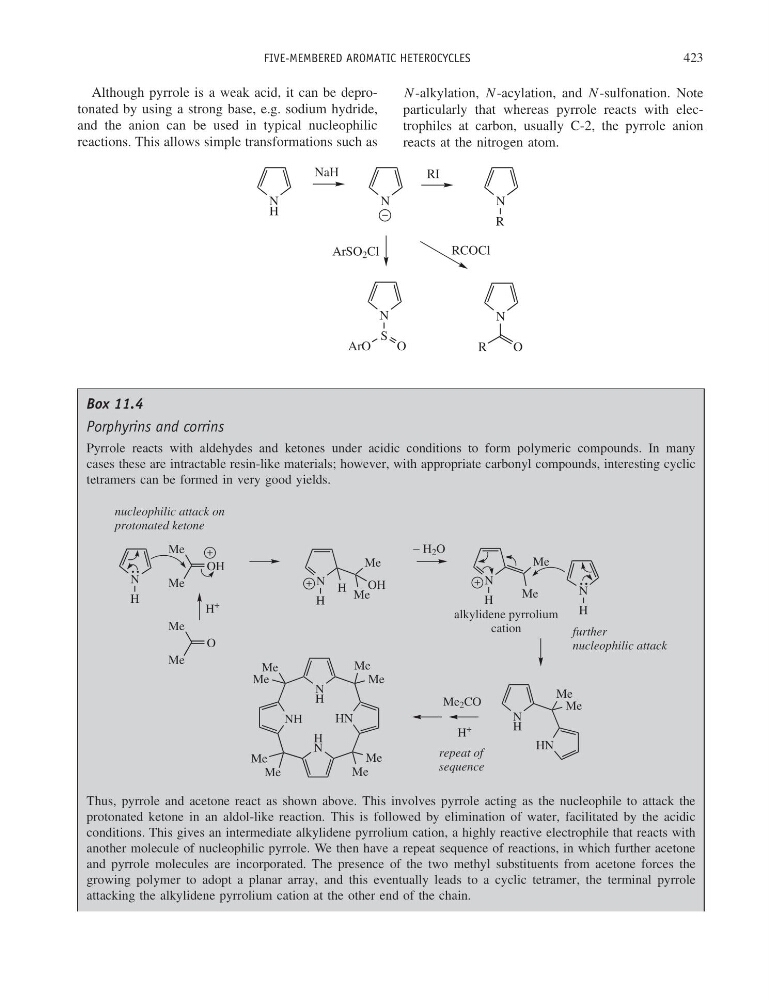
Although pyrrole is a weak acid, it can be deprotonated by using a strong base, e.g. sodium hydride,
and the anion can be used in typical nucleophilic
reactions. This allows simple transformations such as
N -alkylation, N -acylation, and N -sulfonation. Note
particularly that whereas pyrrole reacts with electrophiles at carbon, usually C-2, the pyrrole anion
reacts at the nitrogen atom.
N
H
NaH
N
RI
N
R
N
RCOCl
R
O
N
S
ArO
O
ArSO 2 Cl
Box 11.4
Porphyrins and corrins
Pyrrole reacts with aldehydes and ketones under acidic conditions to form polymeric compounds. In many
cases these are intractable resin-like materials; however, with appropriate carbonyl compounds, interesting cyclic
tetramers can be formed in very good yields.
OH
Me
Me
N
H
O
Me
Me
H
+
N
Me
Me
OH
H
− H 2 O
N
Me
Me
N
H
N
H
HN
H
H
Me
Me
Me 2 CO
H
+
H
N
HN
N
H
NH
Me
Me
Me
Me
Me
Me
Me
Me
nucleophilic attack on
protonated ketone
alkylidene pyrrolium
cation
further
nucleophilic attack
repeat of
sequence
Thus, pyrrole and acetone react as shown above. This involves pyrrole acting as the nucleophile to attack the
protonated ketone in an aldol-like reaction. This is followed by elimination of water, facilitated by the acidic
conditions. This gives an intermediate alkylidene pyrrolium cation, a highly reactive electrophile that reacts with
another molecule of nucleophilic pyrrole. We then have a repeat sequence of reactions, in which further acetone
and pyrrole molecules are incorporated. The presence of the two methyl substituents from acetone forces the
growing polymer to adopt a planar array, and this eventually leads to a cyclic tetramer, the terminal pyrrole
attacking the alkylidene pyrrolium cation at the other end of the chain.
423
Although pyrrole is a weak acid, it can be deprotonated by using a strong base, e.g. sodium hydride,
and the anion can be used in typical nucleophilic
reactions. This allows simple transformations such as
N -alkylation, N -acylation, and N -sulfonation. Note
particularly that whereas pyrrole reacts with electrophiles at carbon, usually C-2, the pyrrole anion
reacts at the nitrogen atom.
N
H
NaH
N
RI
N
R
N
RCOCl
R
O
N
S
ArO
O
ArSO 2 Cl
Box 11.4
Porphyrins and corrins
Pyrrole reacts with aldehydes and ketones under acidic conditions to form polymeric compounds. In many
cases these are intractable resin-like materials; however, with appropriate carbonyl compounds, interesting cyclic
tetramers can be formed in very good yields.
OH
Me
Me
N
H
O
Me
Me
H
+
N
Me
Me
OH
H
− H 2 O
N
Me
Me
N
H
N
H
HN
H
H
Me
Me
Me 2 CO
H
+
H
N
HN
N
H
NH
Me
Me
Me
Me
Me
Me
Me
Me
nucleophilic attack on
protonated ketone
alkylidene pyrrolium
cation
further
nucleophilic attack
repeat of
sequence
Thus, pyrrole and acetone react as shown above. This involves pyrrole acting as the nucleophile to attack the
protonated ketone in an aldol-like reaction. This is followed by elimination of water, facilitated by the acidic
conditions. This gives an intermediate alkylidene pyrrolium cation, a highly reactive electrophile that reacts with
another molecule of nucleophilic pyrrole. We then have a repeat sequence of reactions, in which further acetone
and pyrrole molecules are incorporated. The presence of the two methyl substituents from acetone forces the
growing polymer to adopt a planar array, and this eventually leads to a cyclic tetramer, the terminal pyrrole
attacking the alkylidene pyrrolium cation at the other end of the chain.