

422
HETEROCYCLES
This may reflect that there is more charge dispersion in the addition cation from attack at C-2 than
there is from attack at C-3. This is, of course, exactly
the same argument as used above for C-protonation;
protonation (pyrrole acting as a base) also occurs at
C-2. As with protonation, electrophiles do not react
at the nitrogen centre.
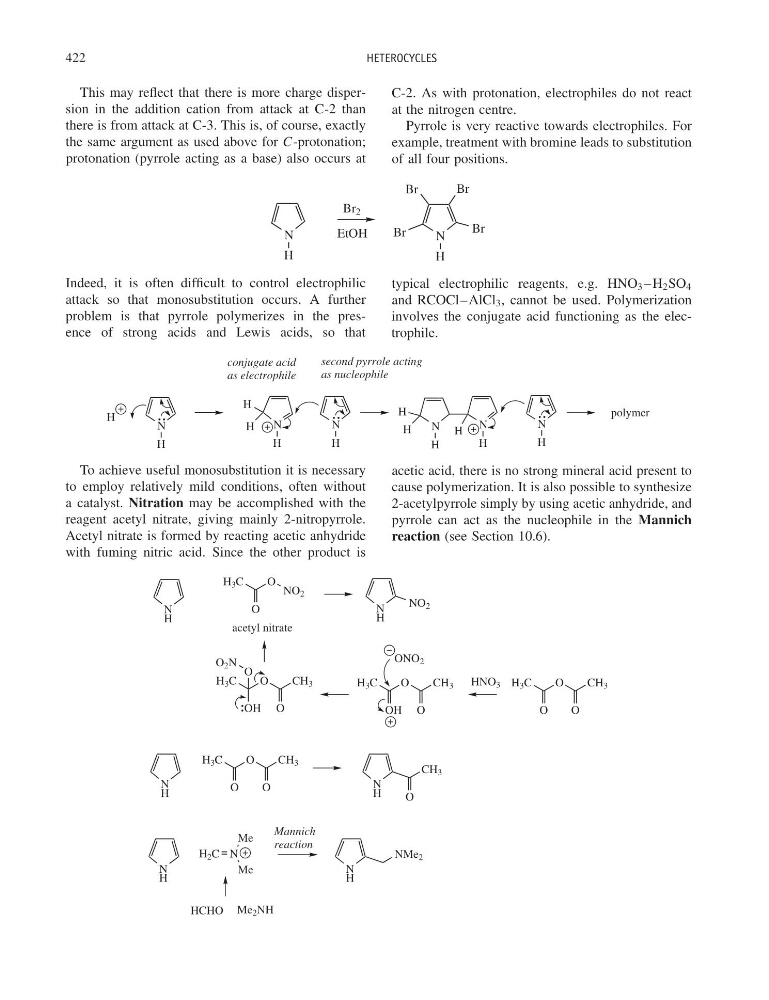
Pyrrole is very reactive towards electrophiles. For
example, treatment with bromine leads to substitution
of all four positions.
N
H
Br 2
EtOH
N
H
Br
Br
Br
Br
Indeed, it is often difficult to control electrophilic
attack so that monosubstitution occurs. A further
problem is that pyrrole polymerizes in the presence of strong acids and Lewis acids, so that
typical electrophilic reagents, e.g. HNO 3 –H 2 SO 4
and RCOCl–AlCl 3 , cannot be used. Polymerization
involves the conjugate acid functioning as the electrophile.
N
H
N
H
H
H
N
H
H
N
N
H
H
H
H
H
N
H
polymer
second pyrrole acting
as nucleophile
conjugate acid
as electrophile
To achieve useful monosubstitution it is necessary
to employ relatively mild conditions, often without
a catalyst. Nitration may be accomplished with the
reagent acetyl nitrate, giving mainly 2-nitropyrrole.
Acetyl nitrate is formed by reacting acetic anhydride
with fuming nitric acid. Since the other product is
acetic acid, there is no strong mineral acid present to
cause polymerization. It is also possible to synthesize
2-acetylpyrrole simply by using acetic anhydride, and
pyrrole can act as the nucleophile in the Mannich
reaction (see Section 10.6).
CH 3
O
H 3 C
OH O
ONO 2
CH 3
O
H 3 C
O
O
HNO 3
CH 3
O
H 3 C
OH O
O
O 2 N
H 3 C
O
O
NO 2
acetyl nitrate
N
H
N
H
NO 2
N
H
N
H
O
CH 3
N
H
Me 2 NH
HCHO
N
H
NMe 2
Mannich
reaction
H 2 C N
Me
Me
H 3 C
O
CH 3
O
O
HETEROCYCLES
This may reflect that there is more charge dispersion in the addition cation from attack at C-2 than
there is from attack at C-3. This is, of course, exactly
the same argument as used above for C-protonation;
protonation (pyrrole acting as a base) also occurs at
C-2. As with protonation, electrophiles do not react
at the nitrogen centre.
Pyrrole is very reactive towards electrophiles. For
example, treatment with bromine leads to substitution
of all four positions.
N
H
Br 2
EtOH
N
H
Br
Br
Br
Br
Indeed, it is often difficult to control electrophilic
attack so that monosubstitution occurs. A further
problem is that pyrrole polymerizes in the presence of strong acids and Lewis acids, so that
typical electrophilic reagents, e.g. HNO 3 –H 2 SO 4
and RCOCl–AlCl 3 , cannot be used. Polymerization
involves the conjugate acid functioning as the electrophile.
N
H
N
H
H
H
N
H
H
N
N
H
H
H
H
H
N
H
polymer
second pyrrole acting
as nucleophile
conjugate acid
as electrophile
To achieve useful monosubstitution it is necessary
to employ relatively mild conditions, often without
a catalyst. Nitration may be accomplished with the
reagent acetyl nitrate, giving mainly 2-nitropyrrole.
Acetyl nitrate is formed by reacting acetic anhydride
with fuming nitric acid. Since the other product is
acetic acid, there is no strong mineral acid present to
cause polymerization. It is also possible to synthesize
2-acetylpyrrole simply by using acetic anhydride, and
pyrrole can act as the nucleophile in the Mannich
reaction (see Section 10.6).
CH 3
O
H 3 C
OH O
ONO 2
CH 3
O
H 3 C
O
O
HNO 3
CH 3
O
H 3 C
OH O
O
O 2 N
H 3 C
O
O
NO 2
acetyl nitrate
N
H
N
H
NO 2
N
H
N
H
O
CH 3
N
H
Me 2 NH
HCHO
N
H
NMe 2
Mannich
reaction
H 2 C N
Me
Me
H 3 C
O
CH 3
O
O