

FIVE-MEMBERED AROMATIC HETEROCYCLES
421
N
H
H
H
N
H
H
H
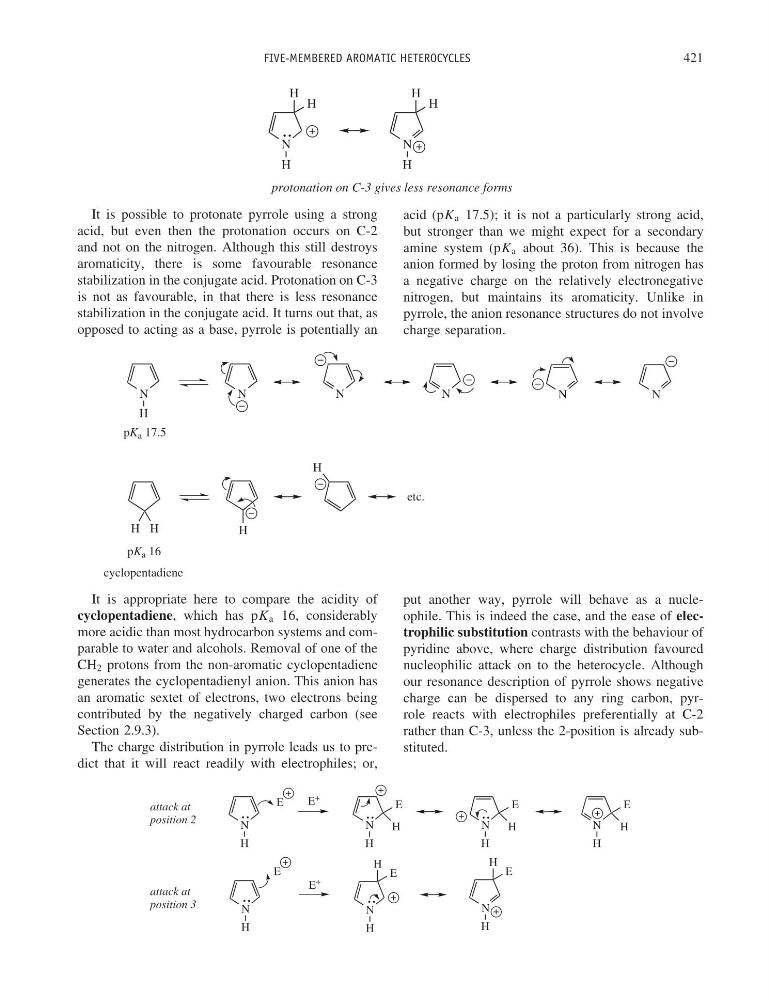
protonation on C-3 gives less resonance forms
It is possible to protonate pyrrole using a strong
acid, but even then the protonation occurs on C-2
and not on the nitrogen. Although this still destroys
aromaticity, there is some favourable resonance
stabilization in the conjugate acid. Protonation on C-3
is not as favourable, in that there is less resonance
stabilization in the conjugate acid. It turns out that, as
opposed to acting as a base, pyrrole is potentially an
acid (pK a 17.5); it is not a particularly strong acid,
but stronger than we might expect for a secondary
amine system (pK a about 36). This is because the
anion formed by losing the proton from nitrogen has
a negative charge on the relatively electronegative
nitrogen, but maintains its aromaticity. Unlike in
pyrrole, the anion resonance structures do not involve
charge separation.
N
H
pK a 17.5
N
N
N
N
N
pK a 16
H
H
H
H
etc.
cyclopentadiene
It is appropriate here to compare the acidity of
cyclopentadiene, which has pK a 16, considerably
more acidic than most hydrocarbon systems and comparable to water and alcohols. Removal of one of the
CH 2 protons from the non-aromatic cyclopentadiene
generates the cyclopentadienyl anion. This anion has
an aromatic sextet of electrons, two electrons being
contributed by the negatively charged carbon (see
Section 2.9.3).
The charge distribution in pyrrole leads us to predict that it will react readily with electrophiles; or,
put another way, pyrrole will behave as a nucleophile. This is indeed the case, and the ease of electrophilic substitution contrasts with the behaviour of
pyridine above, where charge distribution favoured
nucleophilic attack on to the heterocycle. Although
our resonance description of pyrrole shows negative
charge can be dispersed to any ring carbon, pyrrole reacts with electrophiles preferentially at C-2
rather than C-3, unless the 2-position is already substituted.
N
H
N
H
E
H
N
H
E
H
N
H
E
H
E +
E
N
H
E
+
E
N
H
E
H
N
H
E
H
attack at
position 2
attack at
position 3
421
N
H
H
H
N
H
H
H
protonation on C-3 gives less resonance forms
It is possible to protonate pyrrole using a strong
acid, but even then the protonation occurs on C-2
and not on the nitrogen. Although this still destroys
aromaticity, there is some favourable resonance
stabilization in the conjugate acid. Protonation on C-3
is not as favourable, in that there is less resonance
stabilization in the conjugate acid. It turns out that, as
opposed to acting as a base, pyrrole is potentially an
acid (pK a 17.5); it is not a particularly strong acid,
but stronger than we might expect for a secondary
amine system (pK a about 36). This is because the
anion formed by losing the proton from nitrogen has
a negative charge on the relatively electronegative
nitrogen, but maintains its aromaticity. Unlike in
pyrrole, the anion resonance structures do not involve
charge separation.
N
H
pK a 17.5
N
N
N
N
N
pK a 16
H
H
H
H
etc.
cyclopentadiene
It is appropriate here to compare the acidity of
cyclopentadiene, which has pK a 16, considerably
more acidic than most hydrocarbon systems and comparable to water and alcohols. Removal of one of the
CH 2 protons from the non-aromatic cyclopentadiene
generates the cyclopentadienyl anion. This anion has
an aromatic sextet of electrons, two electrons being
contributed by the negatively charged carbon (see
Section 2.9.3).
The charge distribution in pyrrole leads us to predict that it will react readily with electrophiles; or,
put another way, pyrrole will behave as a nucleophile. This is indeed the case, and the ease of electrophilic substitution contrasts with the behaviour of
pyridine above, where charge distribution favoured
nucleophilic attack on to the heterocycle. Although
our resonance description of pyrrole shows negative
charge can be dispersed to any ring carbon, pyrrole reacts with electrophiles preferentially at C-2
rather than C-3, unless the 2-position is already substituted.
N
H
N
H
E
H
N
H
E
H
N
H
E
H
E +
E
N
H
E
+
E
N
H
E
H
N
H
E
H
attack at
position 2
attack at
position 3