

420
HETEROCYCLES
Box 11.3 (continued)
O
OH
O
4-hydroxycoumarin
CHO
O
H 3 C
CH 3
O
CH 3
aldol
reaction
benzalacetone
O
H 3 C
O
OH
O
CH 3
O
warfarin
Michael
reaction
– H 2 O
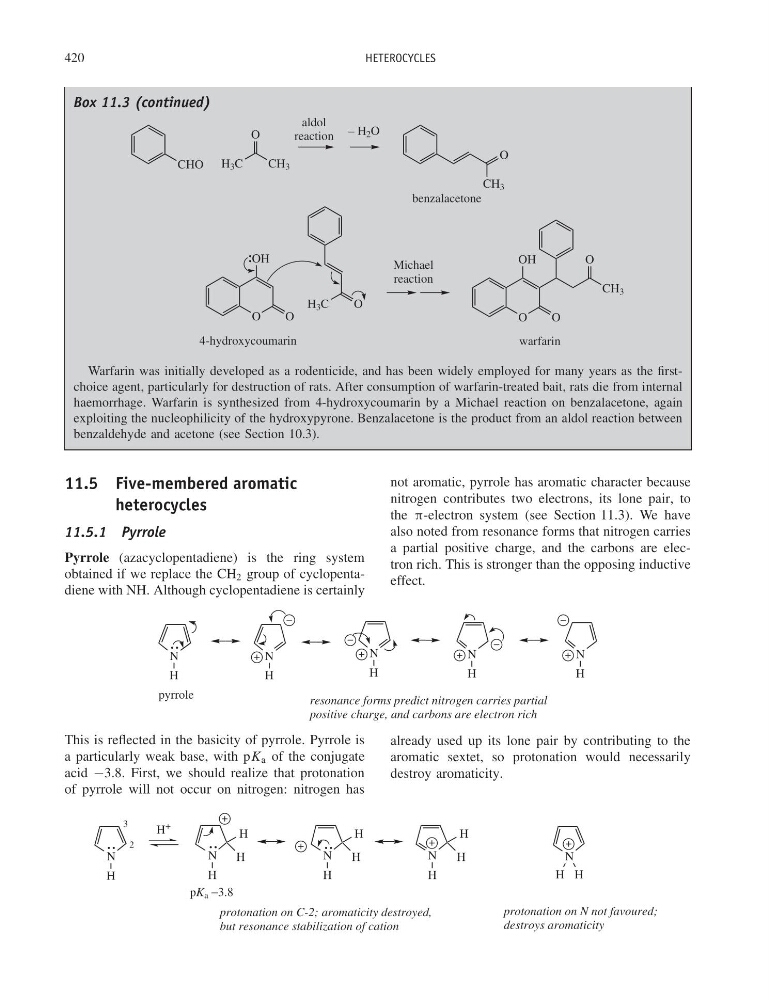
Warfarin was initially developed as a rodenticide, and has been widely employed for many years as the firstchoice agent, particularly for destruction of rats. After consumption of warfarin-treated bait, rats die from internal
haemorrhage. Warfarin is synthesized from 4-hydroxycoumarin by a Michael reaction on benzalacetone, again
exploiting the nucleophilicity of the hydroxypyrone. Benzalacetone is the product from an aldol reaction between
benzaldehyde and acetone (see Section 10.3).
11.5 Five-membered aromatic
heterocycles
11.5.1 Pyrrole
Pyrrole (azacyclopentadiene) is the ring system
obtained if we replace the CH 2 group of cyclopentadiene with NH. Although cyclopentadiene is certainly
not aromatic, pyrrole has aromatic character because
nitrogen contributes two electrons, its lone pair, to
the π-electron system (see Section 11.3). We have
also noted from resonance forms that nitrogen carries
a partial positive charge, and the carbons are electron rich. This is stronger than the opposing inductive
effect.
N
H
N
H
N
H
N
H
N
H
pyrrole
resonance forms predict nitrogen carries partial
positive charge, and carbons are electron rich
This is reflected in the basicity of pyrrole. Pyrrole is
a particularly weak base, with pK a of the conjugate
acid −3.8. First, we should realize that protonation
of pyrrole will not occur on nitrogen: nitrogen has
already used up its lone pair by contributing to the
aromatic sextet, so protonation would necessarily
destroy aromaticity.
N
H
N
H H
pK a −3.8
N
H
H
H
N
H
H
H
N
H
H
H
protonation on N not favoured;
destroys aromaticity
protonation on C-2; aromaticity destroyed,
but resonance stabilization of cation
H
+
2
3
HETEROCYCLES
Box 11.3 (continued)
O
OH
O
4-hydroxycoumarin
CHO
O
H 3 C
CH 3
O
CH 3
aldol
reaction
benzalacetone
O
H 3 C
O
OH
O
CH 3
O
warfarin
Michael
reaction
– H 2 O
Warfarin was initially developed as a rodenticide, and has been widely employed for many years as the firstchoice agent, particularly for destruction of rats. After consumption of warfarin-treated bait, rats die from internal
haemorrhage. Warfarin is synthesized from 4-hydroxycoumarin by a Michael reaction on benzalacetone, again
exploiting the nucleophilicity of the hydroxypyrone. Benzalacetone is the product from an aldol reaction between
benzaldehyde and acetone (see Section 10.3).
11.5 Five-membered aromatic
heterocycles
11.5.1 Pyrrole
Pyrrole (azacyclopentadiene) is the ring system
obtained if we replace the CH 2 group of cyclopentadiene with NH. Although cyclopentadiene is certainly
not aromatic, pyrrole has aromatic character because
nitrogen contributes two electrons, its lone pair, to
the π-electron system (see Section 11.3). We have
also noted from resonance forms that nitrogen carries
a partial positive charge, and the carbons are electron rich. This is stronger than the opposing inductive
effect.
N
H
N
H
N
H
N
H
N
H
pyrrole
resonance forms predict nitrogen carries partial
positive charge, and carbons are electron rich
This is reflected in the basicity of pyrrole. Pyrrole is
a particularly weak base, with pK a of the conjugate
acid −3.8. First, we should realize that protonation
of pyrrole will not occur on nitrogen: nitrogen has
already used up its lone pair by contributing to the
aromatic sextet, so protonation would necessarily
destroy aromaticity.
N
H
N
H H
pK a −3.8
N
H
H
H
N
H
H
H
N
H
H
H
protonation on N not favoured;
destroys aromaticity
protonation on C-2; aromaticity destroyed,
but resonance stabilization of cation
H
+
2
3