

SIX-MEMBERED AROMATIC HETEROCYCLES
419
Box 11.3
Dicoumarol and warfarin
Warfarin provides us with a slightly incongruous state of affairs: it is used as a drug and also as a rat poison. It
was developed from a natural product, dicoumarol, and provides us with a nice example of how pyrone chemistry
resembles that of conjugated lactones rather than aromatic systems.
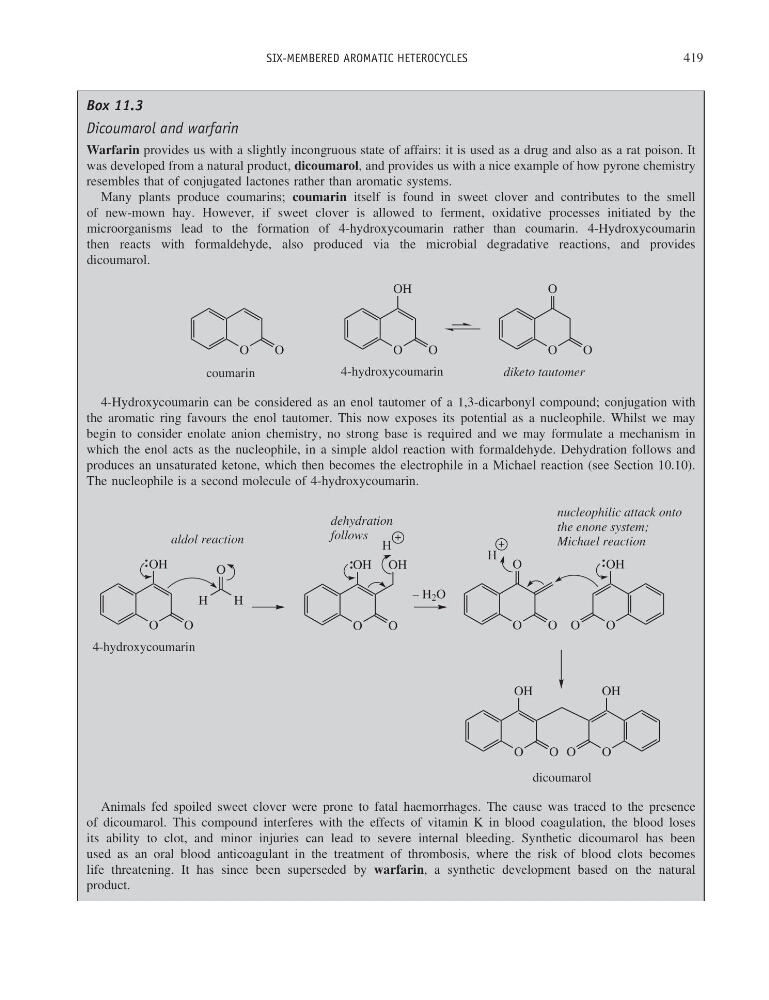
Many plants produce coumarins; coumarin itself is found in sweet clover and contributes to the smell
of new-mown hay. However, if sweet clover is allowed to ferment, oxidative processes initiated by the
microorganisms lead to the formation of 4-hydroxycoumarin rather than coumarin. 4-Hydroxycoumarin
then reacts with formaldehyde, also produced via the microbial degradative reactions, and provides
dicoumarol.
O
O
coumarin
O
OH
O
4-hydroxycoumarin
O
O
O
diketo tautomer
4-Hydroxycoumarin can be considered as an enol tautomer of a 1,3-dicarbonyl compound; conjugation with
the aromatic ring favours the enol tautomer. This now exposes its potential as a nucleophile. Whilst we may
begin to consider enolate anion chemistry, no strong base is required and we may formulate a mechanism in
which the enol acts as the nucleophile, in a simple aldol reaction with formaldehyde. Dehydration follows and
produces an unsaturated ketone, which then becomes the electrophile in a Michael reaction (see Section 10.10).
The nucleophile is a second molecule of 4-hydroxycoumarin.
O
OH
O
O
O
OH
O
OH
O
O
H
H
O
OH
O
OH
O
O
O
O
OH
O
4-hydroxycoumarin
dicoumarol
– H 2 O
aldol reaction
dehydration
follows
nucleophilic attack onto
the enone system;
Michael reaction
H
H
Animals fed spoiled sweet clover were prone to fatal haemorrhages. The cause was traced to the presence
of dicoumarol. This compound interferes with the effects of vitamin K in blood coagulation, the blood loses
its ability to clot, and minor injuries can lead to severe internal bleeding. Synthetic dicoumarol has been
used as an oral blood anticoagulant in the treatment of thrombosis, where the risk of blood clots becomes
life threatening. It has since been superseded by warfarin, a synthetic development based on the natural
product.
419
Box 11.3
Dicoumarol and warfarin
Warfarin provides us with a slightly incongruous state of affairs: it is used as a drug and also as a rat poison. It
was developed from a natural product, dicoumarol, and provides us with a nice example of how pyrone chemistry
resembles that of conjugated lactones rather than aromatic systems.
Many plants produce coumarins; coumarin itself is found in sweet clover and contributes to the smell
of new-mown hay. However, if sweet clover is allowed to ferment, oxidative processes initiated by the
microorganisms lead to the formation of 4-hydroxycoumarin rather than coumarin. 4-Hydroxycoumarin
then reacts with formaldehyde, also produced via the microbial degradative reactions, and provides
dicoumarol.
O
O
coumarin
O
OH
O
4-hydroxycoumarin
O
O
O
diketo tautomer
4-Hydroxycoumarin can be considered as an enol tautomer of a 1,3-dicarbonyl compound; conjugation with
the aromatic ring favours the enol tautomer. This now exposes its potential as a nucleophile. Whilst we may
begin to consider enolate anion chemistry, no strong base is required and we may formulate a mechanism in
which the enol acts as the nucleophile, in a simple aldol reaction with formaldehyde. Dehydration follows and
produces an unsaturated ketone, which then becomes the electrophile in a Michael reaction (see Section 10.10).
The nucleophile is a second molecule of 4-hydroxycoumarin.
O
OH
O
O
O
OH
O
OH
O
O
H
H
O
OH
O
OH
O
O
O
O
OH
O
4-hydroxycoumarin
dicoumarol
– H 2 O
aldol reaction
dehydration
follows
nucleophilic attack onto
the enone system;
Michael reaction
H
H
Animals fed spoiled sweet clover were prone to fatal haemorrhages. The cause was traced to the presence
of dicoumarol. This compound interferes with the effects of vitamin K in blood coagulation, the blood loses
its ability to clot, and minor injuries can lead to severe internal bleeding. Synthetic dicoumarol has been
used as an oral blood anticoagulant in the treatment of thrombosis, where the risk of blood clots becomes
life threatening. It has since been superseded by warfarin, a synthetic development based on the natural
product.